Rooted in decades of research and crafted by a team of experts in mathematics education, Number Worlds® gives students the foundational skills they need to build deep conceptual understanding and close gaps in performance. Proven to work through years of rigorous field testing, the program uses best pedagogical practices to launch students toward grade-level proficiency and beyond.
Number Worlds features a variety of instructional tools to help support diverse learners and bring every student up to speed.
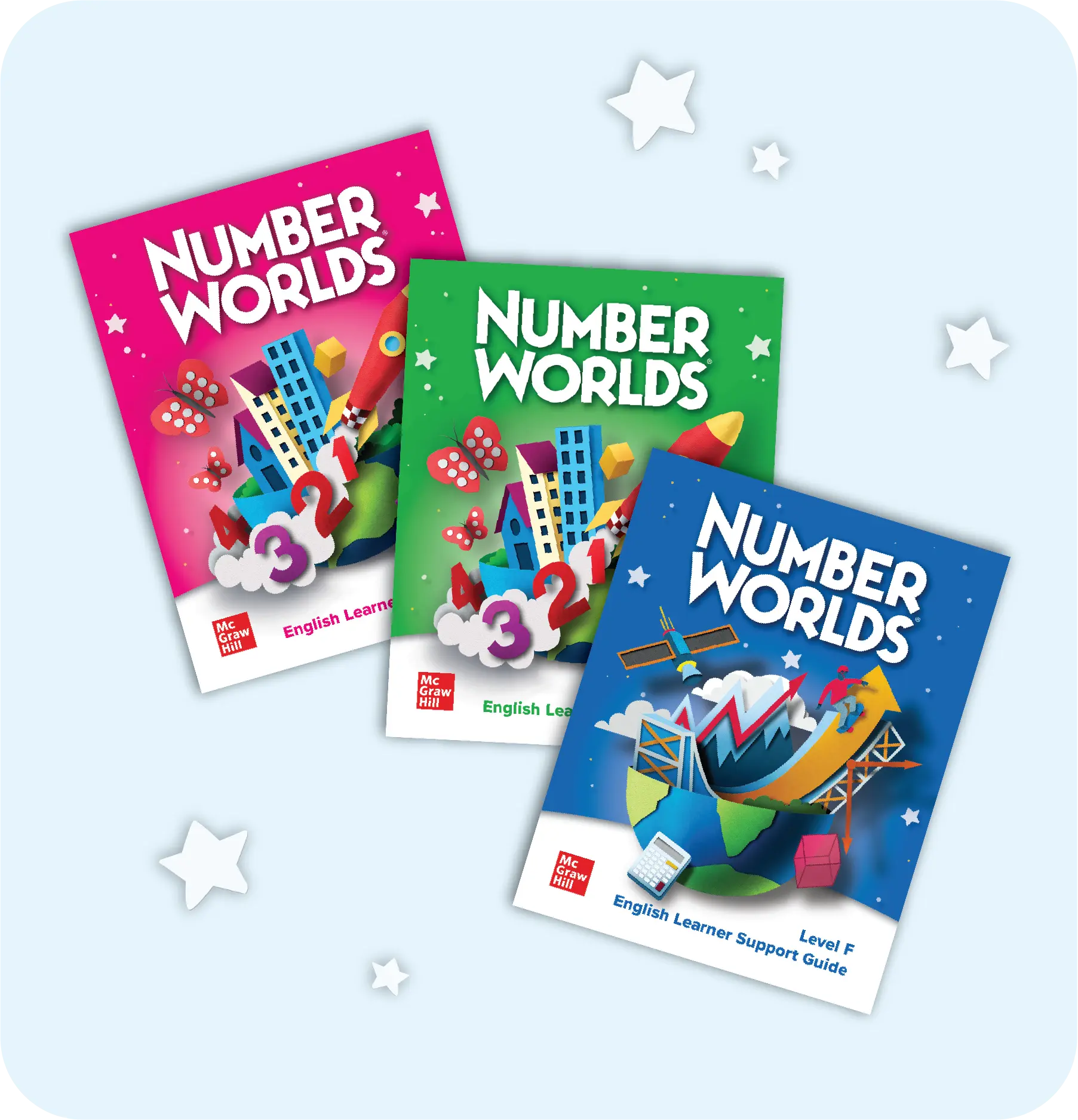
The English Language Learner Support Guides provide teacher supports for working with multilingual students.
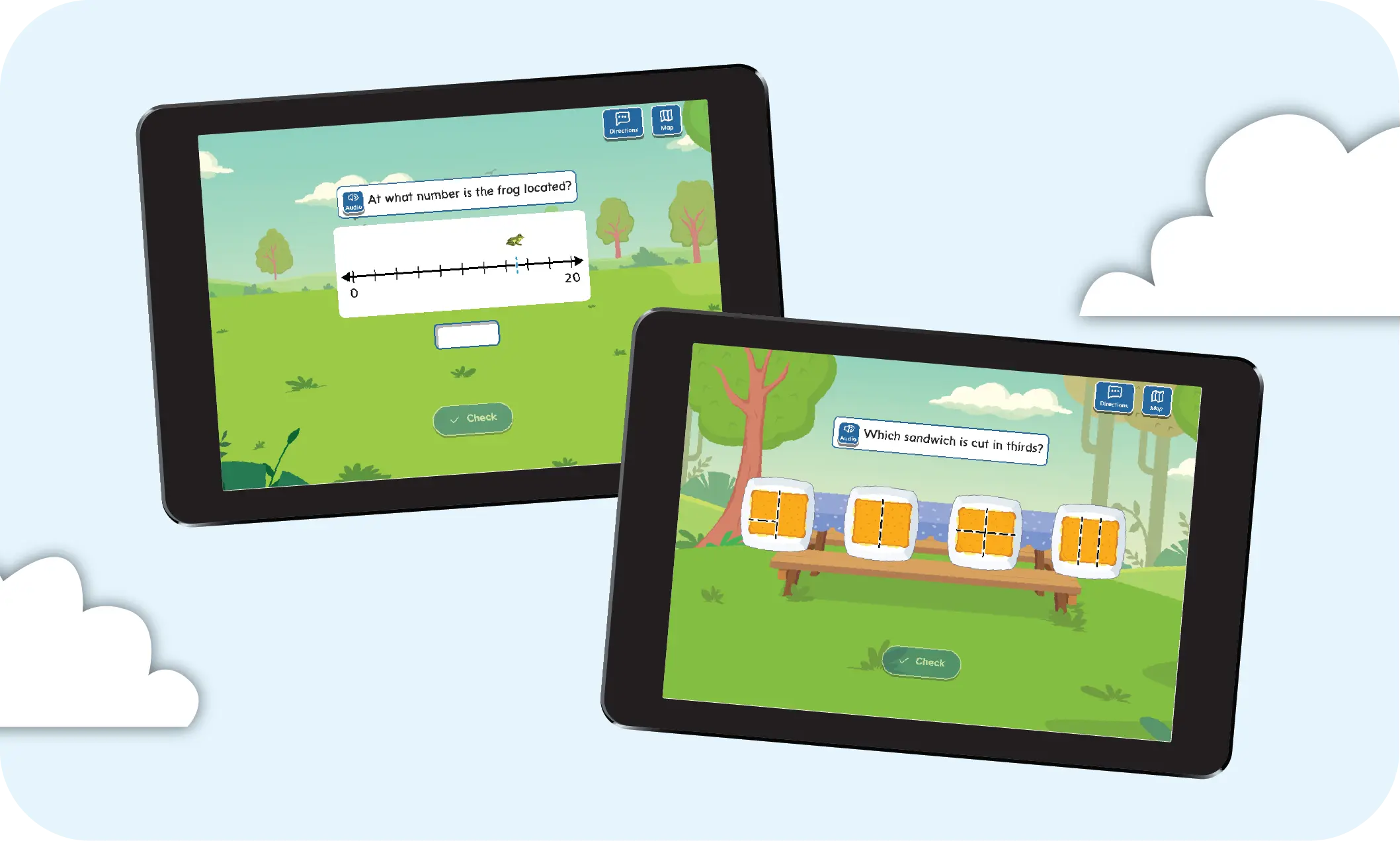
Interactive differentiation provides opportunities for students to spend more time learning critical math concepts with hands-on and adaptive digital games.
Alternative groupings help teachers adapt instruction to fit various learning environments such as one-on-one tutoring, summer school, and after-school settings.
Daily progress monitoring allows teachers to swiftly adapt instruction and to provide targeted remediation for struggling students.
Weekly project-based learning activities empower students to apply and demonstrate mastery of concepts and skills through discussion, research, and presentation.
Interactive Games
Number Worlds uses fun, game-based activities to get students excited about math and accelerate their learning.
An effective balance between hands-on and digital games helps students apply concepts in a variety of settings.
Through purposeful activities, students develop conceptual understanding and computational fluency as they actively apply concepts.
Dynamic Assessment and Reporting
Assessment tools allow teachers and administrators to correctly place and monitor at-risk students. A variety of assessment options evaluate student proficiency, inform instruction, and visually track progress.
The Placement Test: Identify students’ abilities and place them at the appropriate level within the program. After placement, teachers can assign a unit pretest to determine students’ baseline measures for the selected unit.
The Number Knowledge Test: Provide PreK–1 students with an initial screener to place them into one of three prevention levels. This assessment can also be used with K–5 students to determine their ability to make sense of quantitative problems.
Informal Assessments: Build a more complete picture of student performance with informal assessments embedded in each lesson. Teachers can use the online assessment tool or the Student Assessment Record to record their observations.
Formal Assessments: Evaluate student understanding weekly, at the end of each unit, and through cumulative assessments to inform instruction. Online testing measures and prepares students for high-stakes tests.
Research and Success
College and career readiness today requires a solid mathematical foundation. Based on the findings from field tests, effectiveness studies, education research, and research around how children learn, Number Worlds and Building Blocks™ Adaptive are proven as effective curriculum intervention solutions to bring students struggling in mathematics up to par with their peers in math literacy and fluency.
Download Research and Efficacy Brochure
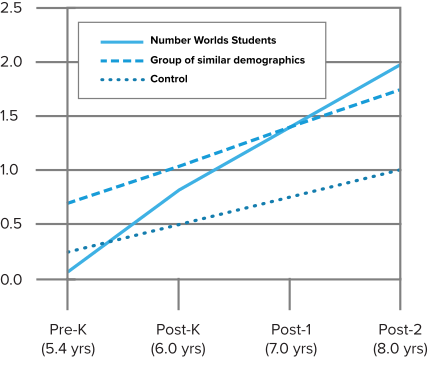
Rigorous field testing shows that students who began at a disadvantage surpassed the performance of students who began on level with their peers, simply with the help of the Number Worlds program. A longitudinal study measuring the progress of three groups of children from the beginning of Kindergarten to the end of Grade 2 demonstrates the program’s efficacy.
Results with Building Blocks Adaptive
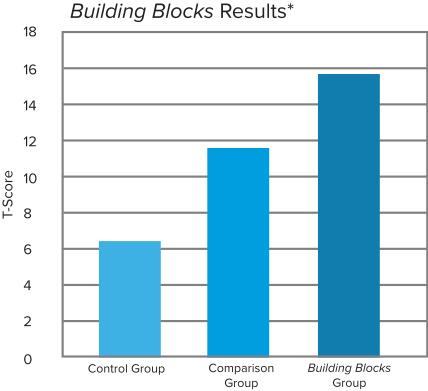
Building Blocks Adaptive software, embedded in the Number Worlds program, is the result of National Science Foundation-funded research. Building Blocks Adaptive includes online activities and an adaptive assignment engine that guides children through research-based learning trajectories. In research studies, Building Blocks Adaptive software was shown to increase children’s knowledge of essential mathematical concepts and skills. One study tested Building Blocks Adaptive against a comparable math program and a no-treatment control group. All classrooms were randomly assigned—the "gold standard" of scientific evaluation.
Doug Clements Discusses Learning Trajectories
Children typically follow an observable developmental progression in learning math concepts with recognizable stages or levels. This developmental path can be described as part of a learning trajectory.
Applying Number Worlds and Building Blocks in the classroom leads children through the natural developmental progression, allowing them to retain and understand concepts more thoroughly.
The number line is a tool used in elementary, middle, and high school classrooms. Recent research suggests the importance of the number line as a tool for helping children develop greater flexibility in mental arithmetic. Find out how Number Worlds provides activities involving the number line.
The Number Worlds curriculum is often referred to as a “research-based” program to distinguish it from more traditional mathematics programs that are produced by educational publishing houses to teach learning goals established by the mathematics education community.
Project-based Learning activities focus on extending standards, while giving students experience working in group settings. Learn more about the built-in project-based learning lessons in Number Worlds.
Number Worlds professional development is built around five guiding principles of effective professional learning: content-specific, active engagement, teaching models, collaborative learning, and applied practice. Professional development activities in the program offer materials that result in effective professional development activities.
For more than a decade, increasing numbers of educators have stopped relying solely on print-based materials; instead, they have been incorporating digital programs into their daily approaches to lesson planning, instruction, and assessment. Find out how Number Worlds utilizes the digital component of Building Blocks.
Rigor is a sought-after element in mathematics classrooms around the country. Adding rigor to program design provides students with the conceptual understanding, procedural skill and fluency, and application of learning context. Number Worlds is proven to develop conceptual understanding and procedural knowledge.
Number Worlds was designed to introduce and develop students’ understanding of the three worlds of mathematics: quantity, number, and symbols. Students develop understanding by exploring five different ways numbers and quantities are represented:
Object Land
In Object Land, students explore the world of numbers by counting and comparing sets of objects or pictures of objects. In Object Land, you might ask: How many or few do you have? or Which is bigger or smaller?
Picture Land
In Picture Land, numbers are represented as sets of stylized, semi-abstract dot-set patterns, such as in a die, tally marks, or numerals. In Picture Land, you might ask: What did you roll/pick? or Which has more or less?
Line Land
Hairline Text Line Land In Line Land, numbers are represented as points on a path or line. The language used for numbers in Line Land refers to a particular time and place on a line and also to moves along a line. In Line Land, you might ask: How far did you go? or Did you go forward or backward?
Sky Land
In Sky Land, numbers are represented as a position on a vertical scale, such as a thermometer or a bar graph. In Sky Land, you might ask: How high or low are you now? or Who is above or below?
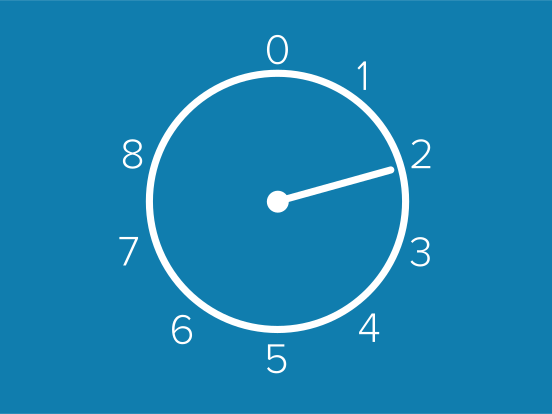
Circle Land
In Circle Land, numbers are represented as a point on a dial, such as a clock face or a sundial. In Circle Land, you might ask: How many times did you go around? or What did you land on?
Number Worlds is a fabulous math program that offers direct instruction at the student’s level, with time for practice and mastery of all skills taught.
Sharon Griffin is Professor Emerita of Education and Psychology at Clark University in Worcester, Massachusetts. She received a bachelor's in psychology from McGill University, a master's in education from the University of New Hampshire, and a doctorate in cognitive science from the University of Toronto. Before coming to Clark University in 1989, she worked as a research associate at the Ontario Institute for Studies in Education.
Dr. Griffin has received several research awards for applying the findings of cognitive science to (a) improve mathematics learning and achievement for at-risk children, (b) teach number sense, and (c) enable teachers of mathematics to acquire the skills needed to enhance their students’ math learning and achievement.
Dr. Griffin has also served on several national and international advisory boards on projects designed to enhance the cognitive, mathematical, and language development of children from birth through the elementary school years.
As a member of the Mathematical Sciences Education Board at the National Academies of Science (NAS) and the Center of Education Research and Innovation at the Organization for Economic Collaboration and Development (OECD), she also helped shape the direction of education research and policy for the United States, Canada, the U.K., and several European countries.
Dr. Douglas Clements, Kennedy Endowed Chair in Early Childhood Learning and professor at the University of Denver, is widely regarded as the major scholar in the field of early childhood mathematics education, with equal relevance to the academy, to the classroom, and to the educational policy arena. At the national level, his contributions have led to the development of new mathematics curricula, teaching approaches, teacher training initiatives, and models of "scaling up" interventions. His contributions have also had a tremendous impact on educational planning and policy, particularly in the area of mathematical literacy and access. Dr. Clements also sits on the National Research Council Committee on Science of Children Birth to Age 8: Deepening and Broadening the Foundation for Success for The National Academies of Sciences’ Institute of Medicine.
Dr. Julie Sarama, Kennedy Endowed Chair in Innovative Learning Technologies and professor at the University of Denver, conducts research on young children’s development of mathematical concepts and competencies, the implementation and scale-up of educational reform, professional development models and their influence on student learning, and the implementation and effects of software environments in mathematics classrooms. These studies have been published in more than 50 refereed articles, 4 books, 30 chapters, and 60 additional publications. She has been both principal and co-principal investigator on seven projects funded by the National Science Foundation. Dr. Sarama is also co-directing three large-scale studies funded by the U.S. Education Department’s Institute of Educational Studies (IES).
Top
Regional Page Available
It looks like you're outside the United States. Do you want to see your regional version of this page?
prek-12
2026-07-31T16:52:38.076-04:00
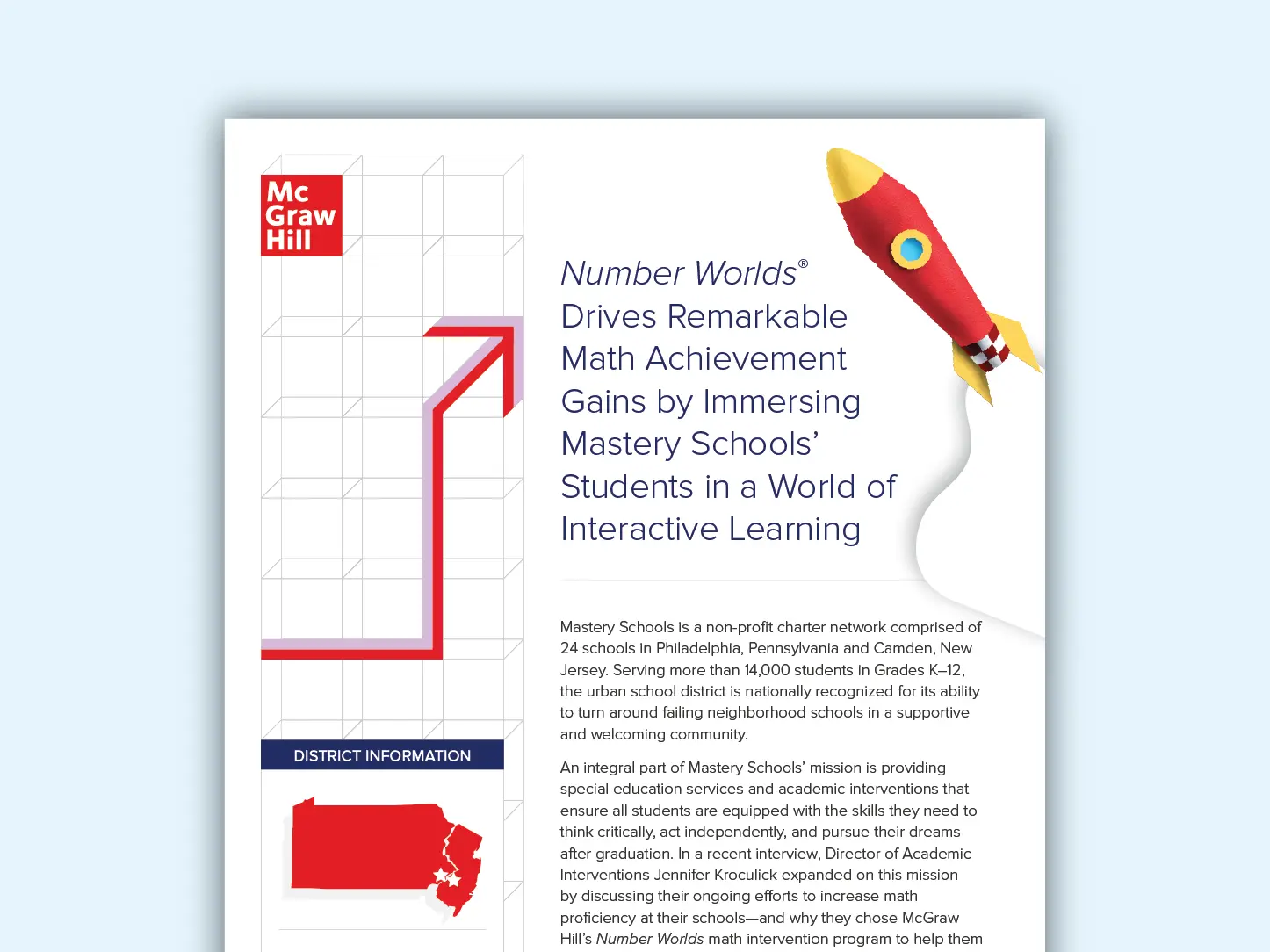
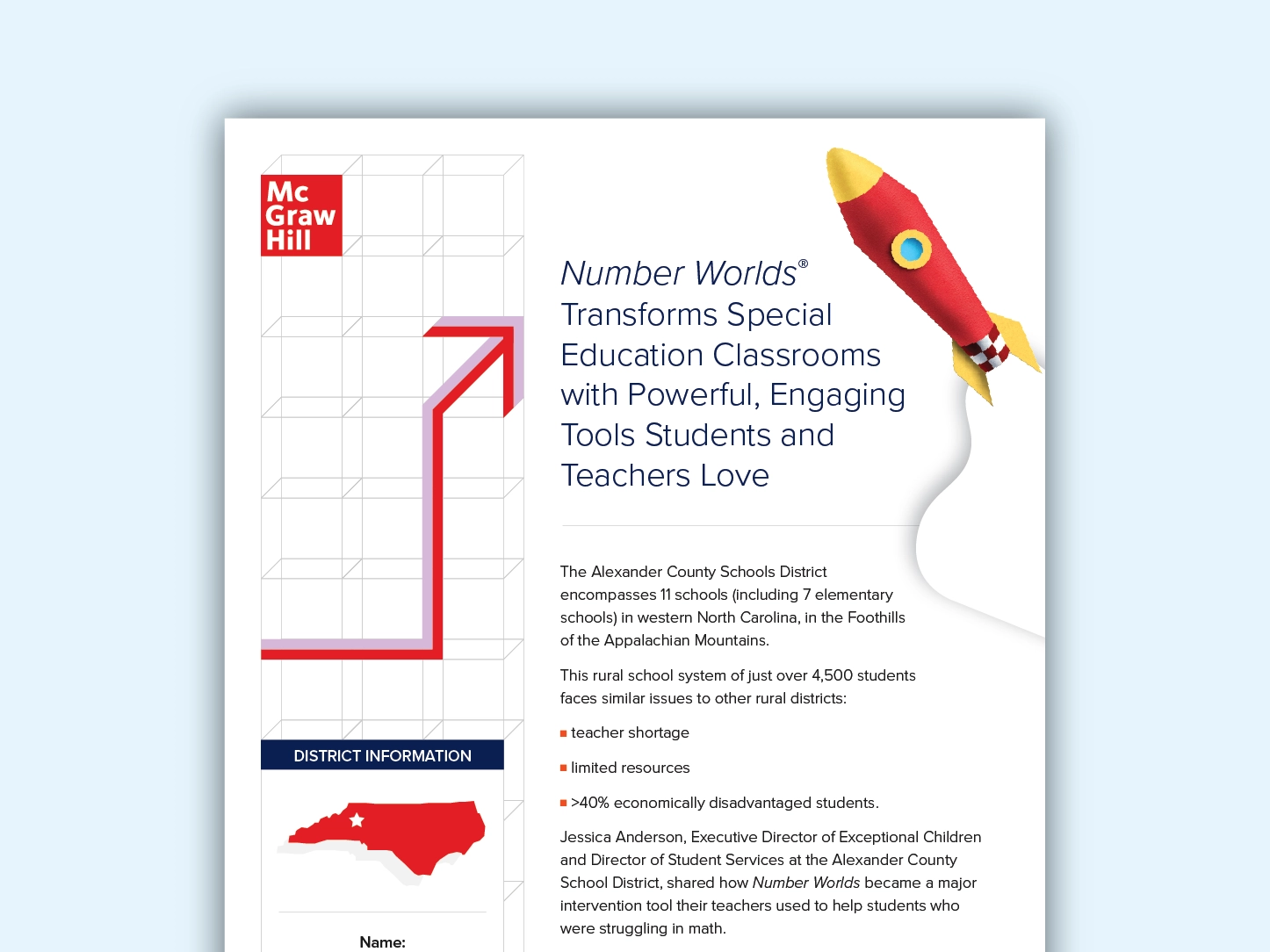
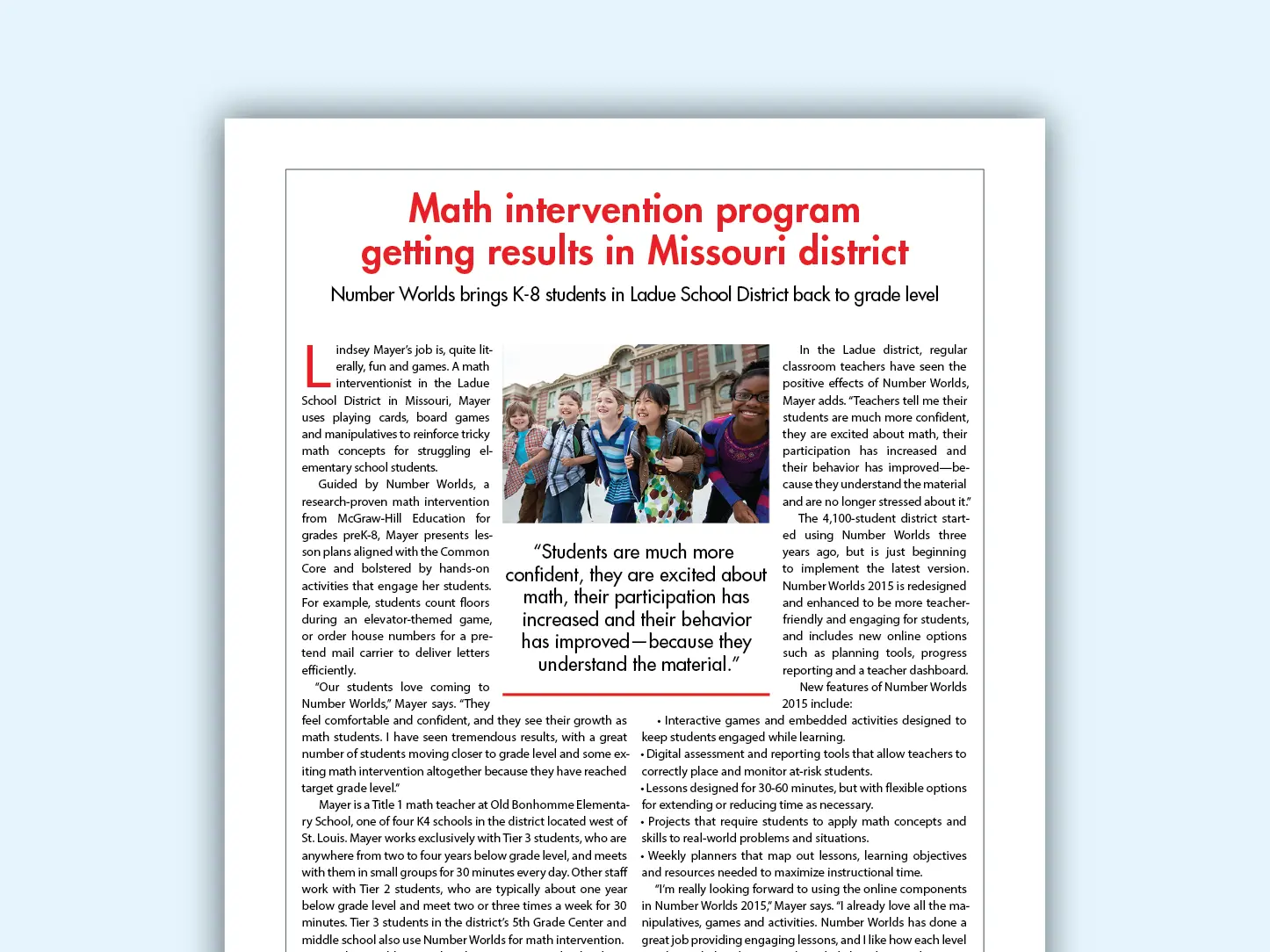
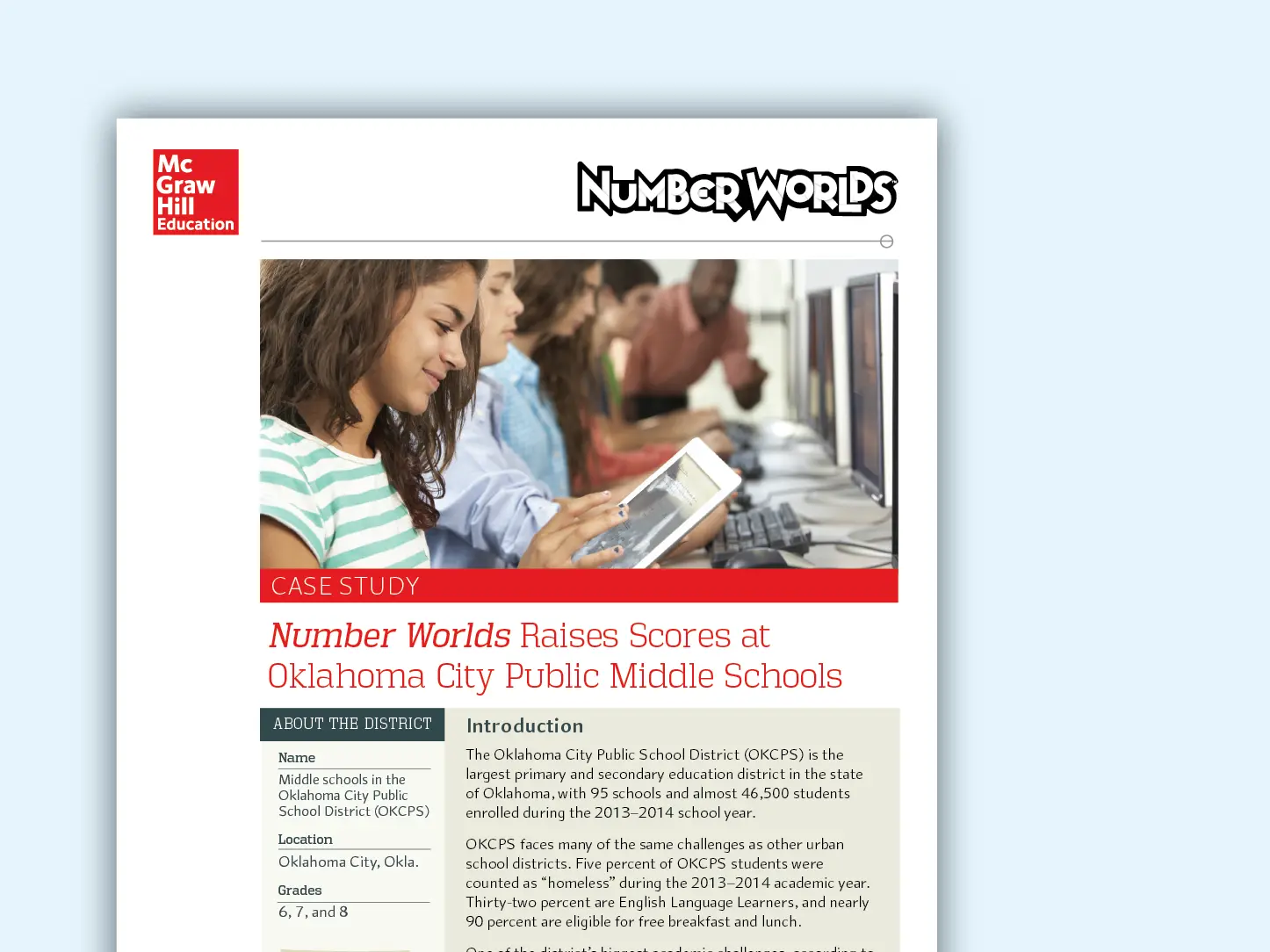
prek12 Program Foundation <h1><span class="text-white"><strong>Program Foundation</strong></span></h1> <p><span class="text-white">Rooted in decades of research and crafted by a team of experts in mathematics education, <em>Number Worlds</em>® gives students the foundational skills they need to build deep conceptual understanding and close gaps in performance. Proven to work through years of rigorous field testing, the program uses best pedagogical practices to launch students toward grade-level proficiency and beyond.</span></p> I would like to learn about... <h2><strong>Pedagogy</strong></h2> Explore Number Worlds Pedagogy Components <p><strong>Built-in Differentiation</strong></p> <p><em>Number Worlds</em> features a variety of instructional tools to help support diverse learners and bring every student up to speed. </p> <ul> <li><strong>The English Language Learner Support Guides</strong> provide teacher supports for working with multilingual students. </li> <li><strong>Interactive differentiation</strong> provides opportunities for students to spend more time learning critical math concepts with hands-on and adaptive digital games. </li> <li><strong>Alternative groupings</strong> help teachers adapt instruction to fit various learning environments such as one-on-one tutoring, summer school, and after-school settings. </li> <li><strong>Daily progress monitoring</strong> allows teachers to swiftly adapt instruction and to provide targeted remediation for struggling students. </li> <li><strong>Weekly project-based learning activities</strong> empower students to apply and demonstrate mastery of concepts and skills through discussion, research, and presentation. </li> </ul> <p><strong>Interactive Games</strong></p> <p><em>Number Worlds</em> uses fun, game-based activities to get students excited about math and accelerate their learning.</p> <ul> <li>An effective balance between hands-on and digital games helps students apply concepts in a variety of settings. </li> <li>Through purposeful activities, students develop conceptual understanding and computational fluency as they actively apply concepts.</li> </ul> <p><strong>Dynamic Assessment and Reporting</strong></p> <p>Assessment tools allow teachers and administrators to correctly place and monitor at-risk students. A variety of assessment options evaluate student proficiency, inform instruction, and visually track progress.</p> <ul> <li><strong>The Placement Test:</strong> Identify students’ abilities and place them at the appropriate level within the program. After placement, teachers can assign a unit pretest to determine students’ baseline measures for the selected unit. </li> <li><strong>The Number Knowledge Test:</strong> Provide PreK–1 students with an initial screener to place them into one of three prevention levels. This assessment can also be used with K–5 students to determine their ability to make sense of quantitative problems. </li> <li><strong>Informal Assessments: </strong>Build a more complete picture of student performance with informal assessments embedded in each lesson. Teachers can use the online assessment tool or the Student Assessment Record to record their observations. </li> <li><strong>Formal Assessments:</strong> Evaluate student understanding weekly, at the end of each unit, and through cumulative assessments to inform instruction. Online testing measures and prepares students for high-stakes tests.</li> </ul> Engage Engage Assess Assess <h2><span class="text-white"><strong>Research and Success</strong></span></h2> <p><span class="text-white">College and career readiness today requires a solid mathematical foundation. Based on the findings from field tests, effectiveness studies, education research, and research around how children learn,<em> Number Worlds</em> and <em>Building Blocks</em>™ Adaptive are proven as effective curriculum intervention solutions to bring students struggling in mathematics up to par with their peers in math literacy and fluency.<br> Download Research and Efficacy Brochure</span></p> Download Research and Efficacy Brochure <p>First accordion item</p> Results Thought Leadership White Papers Success Stories Graph showing Number Worlds resuilts in PreK, Post-K, Post-1, and Post-2 <h3><strong>Results with <em>Number Worlds</em></strong></h3> <p>Rigorous field testing shows that students who began at a disadvantage surpassed the performance of students who began on level with their peers, simply with the help of the <em>Number Worlds</em> program. A longitudinal study measuring the progress of three groups of children from the beginning of Kindergarten to the end of Grade 2 demonstrates the program’s efficacy.</p> <h3><span class="fw-light">Results with <i>Number Worlds</i></span></h3> <p>Rigorous field testing shows that students who began at a disadvantage surpassed the performance of students who began on level with their peers, simply with the help of the <i>Number Worlds</i> program. A longitudinal study measuring the progress of three groups of children from the beginning of Kindergarten to the end of Grade 2 demonstrates the program’s efficacy.</p> Graph showing Building Blocks results between Control group, Comparison group and Building Blocks group Graph showing Building Blocks results between Control group, Comparison group and Building Blocks group <h3><strong>Results with <em>Building Blocks</em> Adaptive</strong></h3> <p><em>Building Blocks</em> Adaptive software, embedded in the <em>Number Worlds</em> program, is the result of National Science Foundation-funded research. <em>Building Blocks</em> Adaptive includes online activities and an adaptive assignment engine that guides children through research-based learning trajectories. In research studies, <em>Building Blocks</em> Adaptive software was shown to increase children’s knowledge of essential mathematical concepts and skills. One study tested <em>Building Blocks</em> Adaptive against a comparable math program and a no-treatment control group. All classrooms were randomly assigned—the "gold standard" of scientific evaluation.</p> Graph showing Building Blocks results between Control group, Comparison group and Building Blocks group <h3><strong>Doug Clements Discusses Learning Trajectories</strong></h3> <p>Children typically follow an observable developmental progression in learning math concepts with recognizable stages or levels. This developmental path can be described as part of a learning trajectory.</p> <p>Applying <em>Number Worlds</em> and <em>Building Blocks</em> in the classroom leads children through the natural developmental progression, allowing them to retain and understand concepts more thoroughly.</p> <p><a href="/content/mheducation/us/en/prek-12/program/microsites/MKTSP-TMB03M02.html" target="_self">Learn more about <em>Building Blocks</em>.</a></p> Download the The Number Line and Math State Standards PDF The number line is a tool used in elementary, middle, and high school classrooms. Recent research suggests the importance of the number line as a tool for helping children develop greater flexibility in mental arithmetic. Find out how Number Worlds provides activities involving the number line. The Number Line and Math State Standards Download the Applying Games and Manipulatives in Math Intervention PDF The Number Worlds curriculum is often referred to as a “research-based” program to distinguish it from more traditional mathematics programs that are produced by educational publishing houses to teach learning goals established by the mathematics education community. Applying Games and Manipulatives in Math Intervention Download the Leveraging Project-Based Learning to Challenge Math Understanding here Project-based Learning activities focus on extending standards, while giving students experience working in group settings. Learn more about the built-in project-based learning lessons in Number Worlds. Leveraging Project-Based Learning to Challenge Math Understanding Download the The Power of PD and Self-Efficacy in the Teaching of MathematicsPDF Number Worlds professional development is built around five guiding principles of effective professional learning: content-specific, active engagement, teaching models, collaborative learning, and applied practice. Professional development activities in the program offer materials that result in effective professional development activities. The Power of PD and Self-Efficacy in the Teaching of Mathematics Download the Adaptive Learning and Building Blocks PDF For more than a decade, increasing numbers of educators have stopped relying solely on print-based materials; instead, they have been incorporating digital programs into their daily approaches to lesson planning, instruction, and assessment. Find out how Number Worlds utilizes the digital component of Building Blocks. Adaptive Learning and Building Blocks Download the Rigor: Defined and Embedded in Number Worlds PDF Rigor is a sought-after element in mathematics classrooms around the country. Adding rigor to program design provides students with the conceptual understanding, procedural skill and fluency, and application of learning context. Number Worlds is proven to develop conceptual understanding and procedural knowledge. Rigor: Defined and Embedded in Number Worlds Read Success story for Mastery Schools Philadelphia, Pennsylvania and Camden, New Jersey Mastery Schools Read Success story for Alexander County Schools Alexander County, North Carolina Alexander County School District Read Success story for Ladue School District Ladue, Missouri Ladue School District Read Success story for Oklahoma City Public Middle Schools Oklahoma City, Oklahoma Oklahoma City Public Middle Schools Pittsburgh, Pennsylvania Pittsburgh Public Schools Read success story for Hazelwood School District Florissant, Missouri Hazelwood School District <h2><strong>The Three Worlds and Five Lands</strong></h2> <p><em>Number Worlds</em> was designed to introduce and develop students’ understanding of the three worlds of mathematics: quantity, number, and symbols. Students develop understanding by exploring five different ways numbers and quantities are represented:</p> Different Lands In Object Land, students explore the world of numbers by counting and comparing sets of objects or pictures of objects. In Object Land, you might ask: How many or few do you have? or Which is bigger or smaller? two squares Object Land In Picture Land, numbers are represented as sets of stylized, semi-abstract dot-set patterns, such as in a die, tally marks, or numerals. In Picture Land, you might ask: What did you roll/pick? or Which has more or less? a dice with two dots in it Picture Land Hairline Text Line Land In Line Land, numbers are represented as points on a path or line. The language used for numbers in Line Land refers to a particular time and place on a line and also to moves along a line. In Line Land, you might ask: How far did you go? or Did you go forward or backward? a parallelogram Line Land In Sky Land, numbers are represented as a position on a vertical scale, such as a thermometer or a bar graph. In Sky Land, you might ask: How high or low are you now? or Who is above or below? temperature guage at 2 out of 5 Sky Land In Circle Land, numbers are represented as a point on a dial, such as a clock face or a sundial. In Circle Land, you might ask: How many times did you go around? or What did you land on? a circle clock at 2 out of 8 Circle Land <p><span class="h3"><strong><em>Number Worlds</em> is a fabulous math program that offers direct instruction at the student’s level, with time for practice and mastery of all skills taught.</strong></span></p> <p>JoAnne, Intervention Specialist, North Carolina</p> <h2><strong>Program Authors</strong></h2> View Number Worlds Program Authors <h3><strong>Dr. Sharon Griffin</strong></h3> Dr. Sharon Griffin <h3><strong>Dr. Sharon Griffin</strong></h3> <p>Sharon Griffin is Professor Emerita of Education and Psychology at Clark University in Worcester, Massachusetts. She received a bachelor's in psychology from McGill University, a master's in education from the University of New Hampshire, and a doctorate in cognitive science from the University of Toronto. Before coming to Clark University in 1989, she worked as a research associate at the Ontario Institute for Studies in Education.</p> <p>Dr. Griffin has received several research awards for applying the findings of cognitive science to (a) improve mathematics learning and achievement for at-risk children, (b) teach number sense, and (c) enable teachers of mathematics to acquire the skills needed to enhance their students’ math learning and achievement.</p> <p>Dr. Griffin has also served on several national and international advisory boards on projects designed to enhance the cognitive, mathematical, and language development of children from birth through the elementary school years.</p> <p>As a member of the Mathematical Sciences Education Board at the National Academies of Science (NAS) and the Center of Education Research and Innovation at the Organization for Economic Collaboration and Development (OECD), she also helped shape the direction of education research and policy for the United States, Canada, the U.K., and several European countries.</p> <h3><strong>Dr. Douglas Clements</strong><br> </h3> <p>Dr. Douglas Clements, Kennedy Endowed Chair in Early Childhood Learning and professor at the University of Denver, is widely regarded as the major scholar in the field of early childhood mathematics education, with equal relevance to the academy, to the classroom, and to the educational policy arena. At the national level, his contributions have led to the development of new mathematics curricula, teaching approaches, teacher training initiatives, and models of "scaling up" interventions. His contributions have also had a tremendous impact on educational planning and policy, particularly in the area of mathematical literacy and access. Dr. Clements also sits on the National Research Council Committee on Science of Children Birth to Age 8: Deepening and Broadening the Foundation for Success for The National Academies of Sciences’ Institute of Medicine.</p> <h3><strong>Dr. Douglas Clements</strong></h3> <p>Dr. Douglas Clements, Kennedy Endowed Chair in Early Childhood Learning and professor at the University of Denver, is widely regarded as the major scholar in the field of early childhood mathematics education, with equal relevance to the academy, to the classroom, and to the educational policy arena. At the national level, his contributions have led to the development of new mathematics curricula, teaching approaches, teacher training initiatives, and models of "scaling up" interventions. His contributions have also had a tremendous impact on educational planning and policy, particularly in the area of mathematical literacy and access. Dr. Clements also sits on the National Research Council Committee on Science of Children Birth to Age 8: Deepening and Broadening the Foundation for Success for The National Academies of Sciences’ Institute of Medicine.</p> Dr. Julie Sarama <h3><strong>Dr. Julie Sarama</strong></h3> <p>Dr. Julie Sarama, Kennedy Endowed Chair in Innovative Learning Technologies and professor at the University of Denver, conducts research on young children’s development of mathematical concepts and competencies, the implementation and scale-up of educational reform, professional development models and their influence on student learning, and the implementation and effects of software environments in mathematics classrooms. These studies have been published in more than 50 refereed articles, 4 books, 30 chapters, and 60 additional publications. She has been both principal and co-principal investigator on seven projects funded by the National Science Foundation. Dr. Sarama is also co-directing three large-scale studies funded by the U.S. Education Department’s Institute of Educational Studies (IES).</p> Dr. Sharon Griffin Dr. Sharon Griffin Dr. Douglas Clements Dr. Douglas Clements Dr. Juile Sarama Dr. Juile Sarama