* The estimated amount of time this product will be on the market is based on a number of factors, including faculty input to instructional design and the prior revision cycle and updates to academic research-which typically results in a revision cycle ranging from every two to four years for this product. Pricing subject to change at any time.

Instructor Quick Actions

Get eBook Access Get access as soon as you validate!
Request a Print Sample Get a copy as soon as validated.
Contact a Rep Find a local rep best suited for you.
Find Rep

Product Information

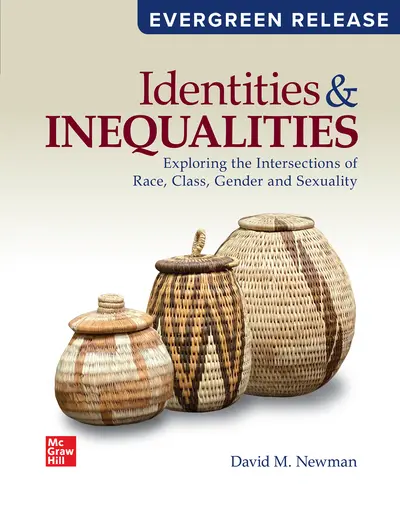
Identities and Inequalities examines the merging of four key social identifiers - race (and ethnicity); class; gender; and sexuality--from the perspective of individuals in particular cultural, institutional, and historical contexts. The text takes an integrated approach to how the four key social identifiers work together or in opposition to form people's social identities and experiences with inequality. This release has been updated to include the most current statistics, scholarship, and examples. The Investigating Identities and Inequalities exercises at the end of each chapter have also been revised.

McGraw Hill eBooks and digital platforms use an Evergreen delivery model with a release-centered process that makes it easy to keep courses fresh, engaging, and relevant.

Release Notes provide detailed information about new and updated content delivered with each release.

Your account requires validation. Please contact your sales representative.

PART ONE: IDENTITIES

1: Differences and Similarities

2: Manufacturing Identities: The Social Construction of Race, Class, Gender, and Sexuality

3: Communicating and Portraying Identities: Race, Class, Gender, and Sexuality in Language and the Media

4: Learning Identities: Families, Schools, and Socialization

PART TWO: INEQUALITIES

5: Inflicting Inequalities: The Nature of Prejudice and Discrimination in Everyday Life

6: Inequalities in Economics and Work

7: Inequalities in Law and Justice

8: Inequalities in Health and Illness

9: The Futures of Identities and Inequalities

About the Author

David M. Newman

David has been a Professor of Sociology at DePauw University for the past 30 years. He is currently a Visiting Professor of Sociology at Colgate University, He regularly teaches courses in contemporary society, social deviance, mental illness, family, social psychology, social inequalities, and research methods. He has published numerous articles on teaching and has presented research papers on the intersection of gender and power in intimate relationships. Recently most of his scholarly activity has been devoted to writing and revising several books, including Sociology: Exploring the Architecture of Everyday Life (Sage, 2020); Identities and Inequalities: Exploring the Intersections of Race, Class, Gender, and Sexuality (McGraw-Hill, 2021); and Families: A Sociological Perspective (McGraw-Hill, 2009). His most recent book, A Culture of Second Chances: The Promise, Practice and Price of Starting Over in Everyday Life (Lexington Books, 2020), examines the cultural meaning, institutional importance, and social limitations of “second chance” and “permanent stigma” narratives in everyday life.

Ways of reading

  • No information about appearance modifiability is available.
  • Not all of the content will be readable as read aloud speech or dynamic braille.
  • Has alternative text descriptions for images.
  • No information about prerecorded audio is available.

Conformance

This publication claims to meet EPUB Accessibility 1.1 Web Content Accessibility Guidelines (WCAG) 2.2 Level AA.

Navigation

  • Table of contents to all chapters of the text via links
  • Index with links to referenced entries
  • Elements such as headings, tables, etc for structured navigation

Rich content

  • Chemical formulas in accessible format (MathML)
  • Information-rich images are described by extended descriptions

Hazards

  • The publication contains no hazards.

Accessibility summary

  • Boxed sidebars are marked as complementary regions (asides) to aid navigation. In-text references to figures, sections, and pages are linked for easy access however, there are no back links provided. Tables are properly marked up for screen reader compatibility, including summaries for complex tables.

Legal considerations

  • No information is available.

Additional accessibility information

  • Color is not the sole means of conveying information
  • Page breaks included

affordability icon

Affordability

Reduce course material costs for your students while still providing full access to everything they need to be successful. It isn't too good to be true - it's Inclusive Access.

Need support?   We're here to help - Get real-world support and resources every step of the way.

Top