* The estimated amount of time this product will be on the market is based on a number of factors, including faculty input to instructional design and the prior revision cycle and updates to academic research-which typically results in a revision cycle ranging from every two to four years for this product. Pricing subject to change at any time.

Instructor Quick Actions

Get eBook Access Get access as soon as you validate!
Request a Print Sample Get a copy as soon as validated.
Contact a Rep Find a local rep best suited for you.
Find Rep

Product Information

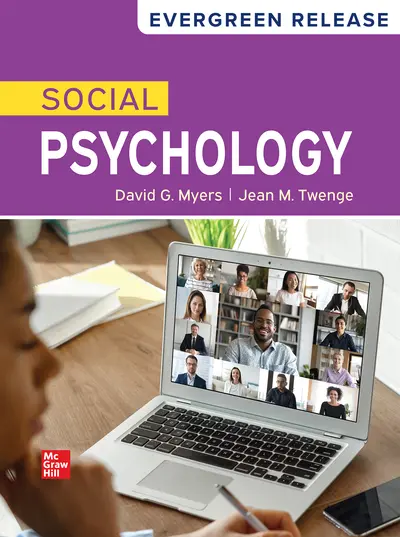
Connecting Social Psychology to the world around us. Social Psychology introduces students to the science of us: our thoughts, feelings, and behaviors in a changing world. Students learn to think critically about everyday behaviors and gain an appreciation for the world around them, regardless of background or major. Social Psychology's conversational voice helps students to access and enjoy this exciting science. Students explore scientific studies of universal questions of love, hate, conformity and independence, prejudice and helping, persuasion and self-determination.

McGraw Hill eBooks and digital platforms use an Evergreen delivery model with a release-centered process that makes it easy to keep courses fresh, engaging, and relevant.

Release Notes provide detailed information about new and updated content delivered with each release.

Your account requires validation. Please contact your sales representative.

1 Introducing Social Psychology

Part One Social Thinking

2 The Self in a Social World

3 Social Beliefs and Judgments

4 Behavior and Attitudes

Part Two Social Influence

5 Genes, Culture, and Gender

6 Conformity and Obedience

7 Persuasion

8 Group Influence

Part Three Social Relations

9 Prejudice

10 Aggression

11 Attraction and Intimacy

12 Helping

13 Conflict and Peacemaking

Part Four Applying Social Psychology

14 Social Psychology in the Clinic

15 Social Psychology in Court

16 Social Psychology and the Sustainable Future

About the Author

David Myers

David Myers is the John Dirk Werkman Professor of Psychology at Hope College where he has taught for the past 30 years.  David Myers' love of teaching psychology has been rewarded by students on many occasions with numerous “Outstanding Professor” awards.  An award-winning researcher, Dr. Myers received the Gordon Allport Prize from Division 9 of the American Psychological Association for his work on group polarization.  His scientific articles have appeared in more than two dozen journals, including Science, American Scientist, Psychological Bulletin, and Psychological Science.  He has served his discipline as consulting editor to the Journal of Experimental Social Psychology and the Journal of Personality and Social Psychology.

Jean Twenge

As Professor of Psychology at San Diego State University, Jean M. Twenge has authored more than 120 scientific publications on generational differences, cultural change, social rejection, gender roles, self-esteem, and narcissism. Her research has been covered in Time, Newsweek, The New York Times, USA Today, U.S. News and World Report, and The Washington Post, and she has been featured on Today, Good Morning America, CBS This Morning, Fox and Friends, NBC Nightly News, Dateline NBC, and National Public Radio.

She summarized this research for a broader audience in the books Generation Me: Why Today's Young Americans Are More Confident, Assertive, Entitled- and More Miserable Than Ever Before and The Narcissism Epidemic: Living in the Age of Entitlement (co-authored with W. Keith Campbell). She has written for general audiences on several websites and magazines, including a piece for The Atlantic that was nominated for a National Magazine Award. She frequently gives talks and seminars on generational differences to audiences such as college faculty and staff, military personnel, camp directors, and corporate executives.

Dr. Twenge grew up in Minnesota and Texas. She holds a B.A. and M.A. from the University of Chicago and a Ph.D. from the University of Michigan. She completed a postdoctoral research fellowship in social psychology at Case Western Reserve University. She lives in San Diego with her husband and three daughters.

Ways of reading

  • No information about appearance modifiability is available.
  • Not all of the content will be readable as read aloud speech or dynamic braille.
  • Has alternative text descriptions for images.
  • No information about prerecorded audio is available.

Conformance

This publication claims to meet EPUB Accessibility 1.1 Web Content Accessibility Guidelines (WCAG) 2.2 Level AA.

Navigation

  • Table of contents to all chapters of the text via links
  • Index with links to referenced entries
  • Elements such as headings, tables, etc for structured navigation

Rich content

  • Math formulas in accessible format (MathML)
  • Chemical formulas in accessible format (MathML)
  • Information-rich images are described by extended descriptions

Hazards

  • The publication contains no hazards.

Accessibility summary

  • Boxed sidebars are marked as complementary regions (asides) to aid navigation. In-text references to figures, sections, and pages are linked for easy access however, there are no back links provided. Tables are properly marked up for screen reader compatibility, including summaries for complex tables.

Legal considerations

  • No information is available.

Additional accessibility information

  • Color is not the sole means of conveying information
  • Page breaks included

affordability icon

Affordability

Reduce course material costs for your students while still providing full access to everything they need to be successful. It isn't too good to be true - it's Inclusive Access.

Need support?   We're here to help - Get real-world support and resources every step of the way.

Top