* The estimated amount of time this product will be on the market is based on a number of factors, including faculty input to instructional design and the prior revision cycle and updates to academic research-which typically results in a revision cycle ranging from every two to four years for this product. Pricing subject to change at any time.

Instructor Quick Actions

Get eBook Access Get access as soon as you validate!
Request a Print Sample Get a copy as soon as validated.
Contact a Rep Find a local rep best suited for you.
Find Rep

Product Information

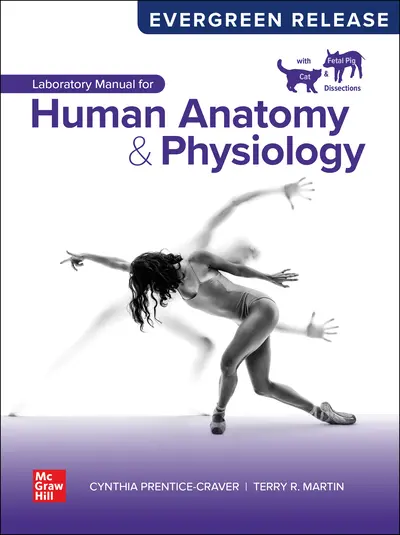
Author Cynthia Prentice-Craver’s over thirty years of passion for and experience in teaching human anatomy and physiology, and her commitment to developing curriculum that stimulates student curiosity and enthusiasm, steered her cultivation of this 2026 release laboratory manual. Terry, the original author of this laboratory manual, had forty years of experience teaching anatomy and physiology courses, authored three different laboratory manuals, and was actively involved in the Human Anatomy and Physiology Society (HAPS), which drove his determination to create a laboratory manual with an innovative approach that would benefit students. Cynthia is honored to have had Terry Martin as her mentor and coauthor on previous editions, and she has worked to uphold the reputation and brand while developing this 2026 release laboratory manual. The Laboratory Manual for Human Anatomy & Physiology includes sixty-three laboratory exercises, three supplemental labs found online, six cat dissection labs, six fetal pig dissection labs, and sixty-five Virtual Lab guided exercises. This laboratory manual is written to work well with any anatomy and physiology text.

McGraw Hill eBooks and digital platforms use an Evergreen delivery model with a release-centered process that makes it easy to keep courses fresh, engaging, and relevant.

Release Notes provide detailed information about new and updated content delivered with each release.

Your account requires validation. Please contact your sales representative.

Fundamentals of Human Anatomy and Physiology1 Scientific Method and Measurements2 Body Organization, Membranes, and Terminology3 Chemistry of Life 4 Care and Use of the MicroscopeCells5 Cell Structure and Function6 Movements Through Membranes7 Cell Cycle Tissues8 Epithelial Tissues9 Connective Tissues10 Muscle and Nervous TissuesIntegumentary System11 Integumentary SystemSkeletal System12 Bone Structure and Classification13 Organization of the Skeleton14 Skull 15 Vertebral Column and Thoracic Cage 16 Pectoral Girdle and Upper Limb17 Pelvic Girdle and Lower Limb18 Fetal Skeleton19 Joint Structure and MovementsMuscular System20 Skeletal Muscle Structure and Function21 Electromyography: BIOPAC® Exercise22 Muscles of the Head and Neck23 Muscles of the Chest, Shoulder, and Upper Limb24 Muscles of the Vertebral Column, Abdominal Wall, and Pelvic Floor25 Muscles of the Hip and Lower LimbSurface Anatomy26 Surface AnatomyNervous System27 Nervous Tissue and Nerves28 Meninges, Spinal Cord, and Spinal Nerves29 Reflex Arc and Somatic Reflexes 30 Brain and Cranial Nerves31A Reaction Time: BIOPAC® Exercise31B Electroencephalography I: BIOPAC® Exercise32 Dissection of the Sheep BrainGeneral and Special Senses33 General Senses 34 Smell and Taste 35 Eye Structure 36 Visual Tests and Demonstrations 37 Ear and Hearing 38 Ear and Equilibrium Endocrine System39 Endocrine Structure and Function 40 Diabetic Physiology Cardiovascular System41 Blood Cells 42 Blood Testing 43 Blood Typing 44 Heart Structure 45 Cardiac Cycle 46 Electrocardiography: BIOPAC® Exercise47 Blood Vessel Structure, Arteries, and Veins48 Pulse Rate and Blood PressureLymphatic System49 Lymphatic SystemRespiratory System50 Respiratory Organs51 Breathing and Respiratory Volume52 Spirometry: BIOPAC® Exercise53 Control of BreathingDigestive System54 Digestive Organs55 Action of a Digestive Enzyme56 MetabolismUrinary System57 Urinary Organs58 UrinalysisReproductive System and Development59 Male Reproductive System60 Female Reproductive System61 Meiosis, Fertilization, and Early Development62 GeneticsCat Dissection63 Cat Dissection: Musculature64 Cat Dissection: Cardiovascular System65 Cat Dissection: Respiratory System66 Cat Dissection: Digestive System67 Cat Dissection: Urinary System68 Cat Dissection: Reproductive SystemsFetal Pig Dissection69 Fetal Pig Dissection: Musculature70 Fetal Pig Dissection: Cardiovascular System71 Fetal Pig Dissection: Respiratory System72 Fetal Pig Dissection: Digestive System73 Fetal Pig Dissection: Urinary System74 Fetal Pig Dissection: Reproductive SystemsSupplemental Laboratory Exercises*S-1 Skeletal Muscle Contraction S-2 Nerve Impulse Stimulation S-3 Factors Affecting the Cardiac CycleAppendix 1 Laboratory Safety GuidelinesAppendix 2 Preparation of SolutionsAppendix 3 Assessment of Laboratory AssessmentsAppendix 4 Table of Correlations—Laboratory Exercises and Virtual Labs—Followed by Guided Exercises for Virtual LabsIndex

About the Author

Cynthia Prentice-Craver

Cynthia Prentice-Craver has been teaching human anatomy and physiology for over twenty-eight years at Chemeketa Community College. Cynthia’s teaching experience both in grades 6–12 and in college, her passion for curriculum development, and her appetite for learning fuel her desire to write. Her M.S. in Curriculum and Instruction, B.S. in Exercise Science, and extended graduate course-work in biological sciences have been instrumental in achieving effective results in the online and on campus courses she teaches. Cynthia was a contributing author for the Martin Laboratory Manual for Human Anatomy & Physiology, Third Edition, and Hole’s Essentials of Human Anatomy & Physiology, Fourteenth Edition. She co-authored Hole’s Human Anatomy & Physiology, Sixteenth Edition, and the Martin Laboratory Manual for Human Anatomy & Physiology, Fourth and Fifth Editions, and authored the digital content for these laboratory manuals. Cynthia is a member of the Human Anatomy and Physiology Society (HAPS) and the Textbook & Academic Authors Association (TAA). Her professional experiences include serving as a program chair for eight years, developing curriculum, serving on various committees, and being a reviewer and advisor of textbooks and digital products. Beyond her professional pursuits, Cynthia’s passions include reading and listening to books, attending exercise classes, walking outdoors, attending concerts, traveling, and spending time with her family and friends.

Terry R. Martin

Accessibility

Creating accessible products is a priority for McGraw Hill. We make accessibility and adhering to WCAG AA guidelines a part of our day-to-day development efforts and product roadmaps.

For more information, visit our accessibility page, or contact us at accessibility@mheducation.com

affordability icon

Affordability

Reduce course material costs for your students while still providing full access to everything they need to be successful. It isn't too good to be true - it's Inclusive Access.

Need support?   We're here to help - Get real-world support and resources every step of the way.

Top