* The estimated amount of time this product will be on the market is based on a number of factors, including faculty input to instructional design and the prior revision cycle and updates to academic research-which typically results in a revision cycle ranging from every two to four years for this product. Pricing subject to change at any time.

Instructor Quick Actions

Get eBook Access Get access as soon as you validate!
Request a Print Sample Get a copy as soon as validated.
Contact a Rep Find a local rep best suited for you.
Find Rep

Product Information

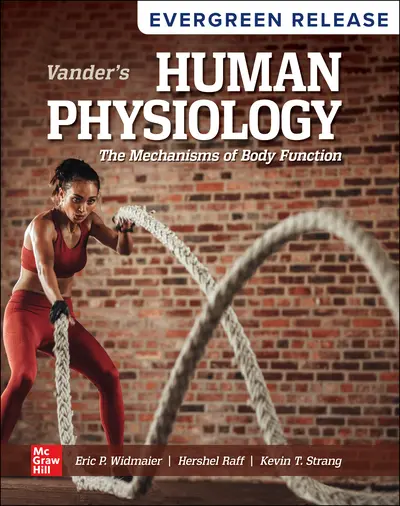
Vander's Human Physiology is an integrated package of textual and digital material that delivers basic and clinical content, real-life applications, and educational technologies. All these pieces come together to facilitate learning and enthusiasm for understanding the mechanisms of body function. Key focus areas include homeostasis, exercise, and human health. These and other areas of interest are elaborated upon, beginning with Chapter 1, where the key "General Principles of Physiology," an underlying theme in the book, is first introduced. Unifying themes, such as homeostasis, are explored throughout the book at all levels of system, organ, tissue, and cellular function- themes that are always related to pathophysiology through the use of compelling clinical case studies in all chapters, and a final chapter with several cases that integrate material across the entire book.

McGraw Hill eBooks and digital platforms use an Evergreen delivery model with a release-centered process that makes it easy to keep courses fresh, engaging, and relevant.

Release Notes provide detailed information about new and updated content delivered with each release.

Your account requires validation. Please contact your sales representative.

1. Homeostasis: A Framework for Human Physiology
2. Chemical Composition of the Body and Its Relation to Physiology
3. Cellular Structure, Proteins, and Metabolic Pathways
4. Movement of Solutes and Water Across Cell Membranes
5. Cell Signaling in Physiology
6. Neuronal Signaling and the Structure of the Nervous System
7. Sensory Physiology
8. Consciousness, the Brain, and Behavior
9. Muscle
10. Control of Body Movement
11. The Endocrine System
12. Cardiovascular Physiology
13. Respiratory Physiology
14. The Kidneys and Regulation of Water and Inorganic Ions
15. The Digestion and Absorption of Food
16. Regulation of Organic Metabolism and Energy Balance
17. Reproduction
18. The Immune System
19. Medical Physiology: Integration Using Clinical Cases

About the Author

Eric P. Widmaier

Eric P. Widmaier received his Ph.D. in 1984 in Endocrinology from the University of California at San Francisco.  His postdoctoral training was in endocrinology and physiology at the Worcester Foundation for Experimental Biology, and The Salk Institute in La Jolla, CA.  He is currently Professor of Biology at Boston University.

Hershel Raff

Kevin T. Strang

Accessibility

Creating accessible products is a priority for McGraw Hill. We make accessibility and adhering to WCAG AA guidelines a part of our day-to-day development efforts and product roadmaps.

For more information, visit our accessibility page, or contact us at accessibility@mheducation.com

affordability icon

Affordability

Reduce course material costs for your students while still providing full access to everything they need to be successful. It isn't too good to be true - it's Inclusive Access.

Need support?   We're here to help - Get real-world support and resources every step of the way.

Top