* The estimated amount of time this product will be on the market is based on a number of factors, including faculty input to instructional design and the prior revision cycle and updates to academic research-which typically results in a revision cycle ranging from every two to four years for this product. Pricing subject to change at any time.

Instructor Quick Actions

Get eBook Access Get access as soon as you validate!
Request a Print Sample Get a copy as soon as validated.
Contact a Rep Find a local rep best suited for you.
Find Rep

Product Information

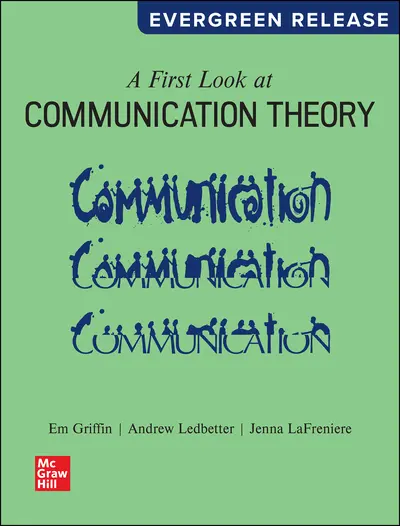
Communication Theory encourages students who are encountering the field for the first time to tackle theories without fear. The authors' conversational style and relevant examples keep complex theories within the grasp of first-time theory students. They introduce over 30 diverse theories that are a mix of foundational and recent scholarship and, with the benefit of numerous examples and connections to pop culture, help students apply them to their own lives. The discrete presentation of the theories ensures a well-rounded understanding of each while promoting integrative thinking and facilitating the ability of instructors to skip or rearrange their presentation. The broad selection of theories - from the classics to the cutting edge - ensures that students have a solid foundation with which to begin understanding the relationships between theories.

Division One: Overview

1: Launching Your Study

2: Talk About Theory

3: Weighing the Words

4: Mapping the Territory

Division Two: Interpersonal Communication Interpersonal Messages

5: Symbolic Interactionism

6: Expectancy Violations Theory

7: Family Communication Patterns Theory

Relationship Development

8: Social Penetration Theory

9: Uncertainty Reduction Theory

10: Social Information Processing Theory

Relationship Maintenance

11: Relational Dialectics Theory

12: Communication Privacy Management Theory

13: Media Multiplexity Theory

Division Three: Social Influence Persuasion

14: Social Judgment Theory

15: Elaboration Likelihood Model

16: Cognitive Dissonance Theory

Public Rhetoric

17: The Rhetoric

18: Dramatism

19: Narrative Paradigm

Division Four: Group and Organizational Communication

Group Communication

20: Functional Perspective on Group Decision-Making

21: Symbolic Convergence Theory

Organizational Communication

22: Cultural Approach to Organizations

23: Communicative Constitution of Organizations

24: Critical Theory of Communication in Organizations

Division Five: Cultural Context

Intercultural Communication

25: Communication Accommodation Theory

26: Face-Negotiation Theory

27: Co-Cultural Theory

28: Afrocentricity Gender and Communication

29: Feminist Standpoint Theory

30: Muted Group Theory

Division Six: Mass Communication

Media and Culture

31: Media Ecology

32: Context Collapse

33: Semiotics

34: Cultural Studies

Media Effects

35: Uses and Gratifications

36: Cultivation Theory

37: Agenda-Setting Theory

Division Seven: Integration

38: Common Threads in Comm Theories

About the Author

Em Griffin

Em Griffin received his B.A. in political science from the University of Michigan, and his M.A. and Ph.D. in Communication from Northwestern University. He is professor of communication at Wheaton College in Illinois, where he has taught for the past 26 years and has been chosen Teacher of the Year. His research interest centers on the development of close friendships. Dr. Griffin is the author of three applied communication books: The Mind Changers analyzes practical techniques of persuasion; Getting Together offers research-based suggestions for effective group leadership; and Making Friends describes the way that quality interpersonal communication can build close relationships. He also leads workshops on these topics in the Philippines, Singapore, and the United States.

Andrew M. Ledbetter

Andrew Ledbetter received his M.A. and Ph.D. in communication studies from the University of Kansas. He is associate professor of communication studies at Texas Christian University. His research addresses how people use communication technology to maintain their interpersonal relationships. A related interest concerns how parent–child communication predicts health and well-being. Dr. Ledbetter has published more than 35 articles and received recognition for teaching excellence from both the National Communication Association and Central States Communication Association.

Glenn G. Sparks

Glenn Sparks received his Ph.D. in communication arts from the University of Wisconsin–Madison. He is a professor in the Brian Lamb School of Communication at Purdue University in Indiana, where he has taught for 28 years. His research focuses on the effects of media. Dr. Sparks is the author of Media Effects Research: A Basic Overview and a personal memoir, Rolling in Dough: Lessons I Learned in a Doughnut Shop; he is co-author of Refrigerator Rights: Our Crucial Need for Close Connection.

Accessibility

Creating accessible products is a priority for McGraw Hill. We make accessibility and adhering to WCAG AA guidelines a part of our day-to-day development efforts and product roadmaps.

For more information, visit our accessibility page, or contact us at accessibility@mheducation.com

affordability icon

Affordability

Reduce course material costs for your students while still providing full access to everything they need to be successful. It isn't too good to be true - it's Inclusive Access.

Need support?   We're here to help - Get real-world support and resources every step of the way.

Top