End-of-School-Year AI Insights: Trends, Takeaways, and What’s Next in Higher Education

Students used a lot of AI this school year. Here's what we learned from use of ours.


By: Dr. Dave Duke, Chief Product Officer, Higher Education
Tags: Article, Artificial Intelligence (AI), Blog, Corporate

Key Takeaways:

At the end of the academic year, student usage patterns offer a clearer picture of how AI is being used in higher education. The data points to three broad takeaways:

  1. Student engagement increases when AI support is embedded in the learning experience.
  2. They are using McGraw Hill’s AI tools to build understanding rather than avoid the work.
  3. AI can extend access to support beyond the classroom.

Learn More:

Although AI is not new, this academic year was certainly one in which use of it became more embedded in the learning and teaching process than ever before.

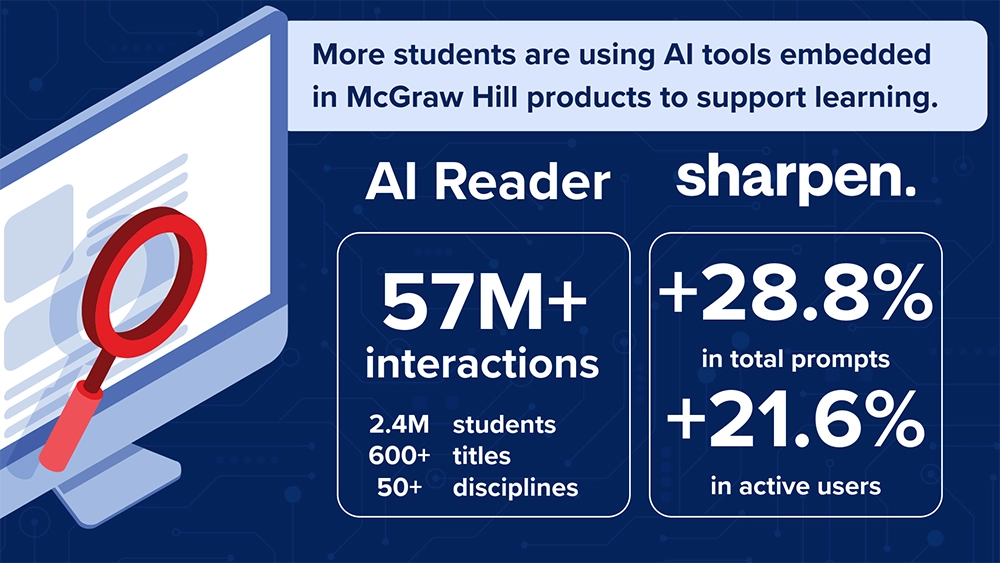
McGraw Hill’s AI Reader tool: Used 57 million times by nearly 2.4 million students during the school year.

  • AI Reader is an embedded generative AI tool available across over 600 titles and 57 academic disciplines that supports active reading by allowing students to highlight passages for simplified explanations and comprehension checks, helping learners engage more deeply with the content and learn at their own pace.

McGraw Hill’s Ask Sharpen AI tool: Total number of prompts entered was up 28.8% and total active users were up 21.6% when comparing the winter/spring semester versus Fall 2025.

  • Ask Sharpen, another GenAI tool added to our popular Sharpen study app at the beginning of the school year, allows students to ask academic questions, generate personalized study help, and surface relevant study activities aligned with their coursework. Because it’s available on their phones, students are increasingly using it as a convenient way to support their unique study workflows and exam prep practices.

The increased adoption and use of these AI tools across McGraw Hill’s products and across a full academic year has provided a unique opportunity to observe key takeaways related to how AI is affecting the learning process and how students are adapting.

Here’s some of what we have learned.

Takeaway 1: Students are adopting AI tools that are embedded in the learning experience.

The recent instinct in ed tech has been to build AI as a destination or a standalone tool that students are expected to seek out. The data from AI Reader challenges that assumption.

Our data shows 77 percent of students who use AI Reader once continue to use it, averaging 5.8 sessions per week.

This is not an accident. It is the product design. When support is located inside the learning experience, students use it consistently and return to it. They’re not navigating away to find help. The help finds them at the moment they need it. This is promising, especially in light of our previous research showing that students who use AI Reader most extensively show higher engagement with course materials overall.

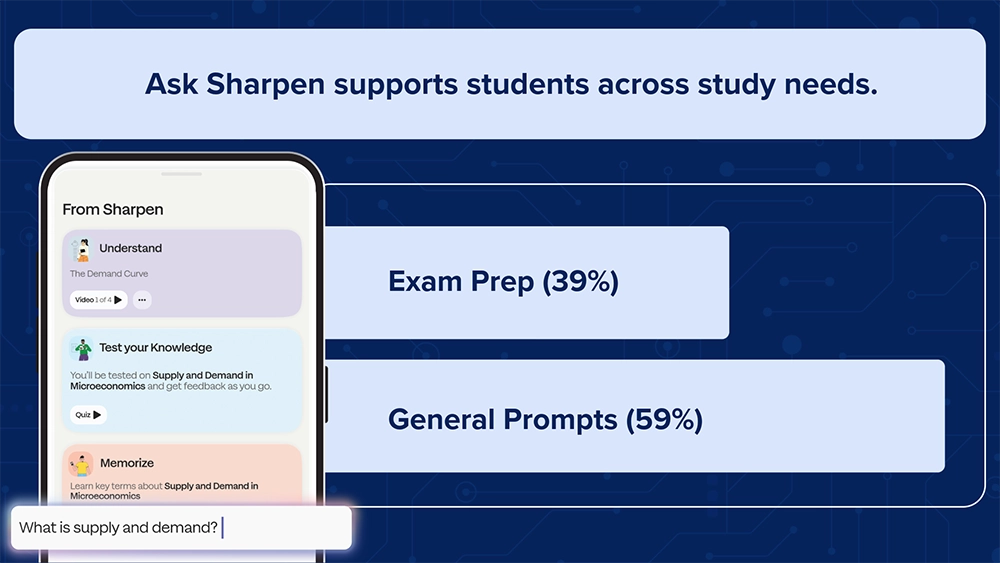
Ask Sharpen shows a similar pattern, but with a different flavor. Because students can engage with it however and whenever they need to, usage reflects learning intent. Thirty-nine percent of Ask Sharpen engagements are directly tied to exam preparation, such as a student quizzing themselves on a specific chapter. But 59% are something harder to categorize: open-ended, unstructured queries where students are simply trying to make sense of something.

Takeaway 2: Students use embedded AI as learning support, not a shortcut.

The loudest concern about AI in education is that students will use it to skip the hard parts. It is a reasonable concern, and it is happening with widely available general purpose GenAI tools. It is also, based on what we’re seeing, largely wrong when AI is embedded seamlessly into the existing learning experience.

Within Connect, assessment questions are embedded directly into the reading and studying experience. Usage data shows:

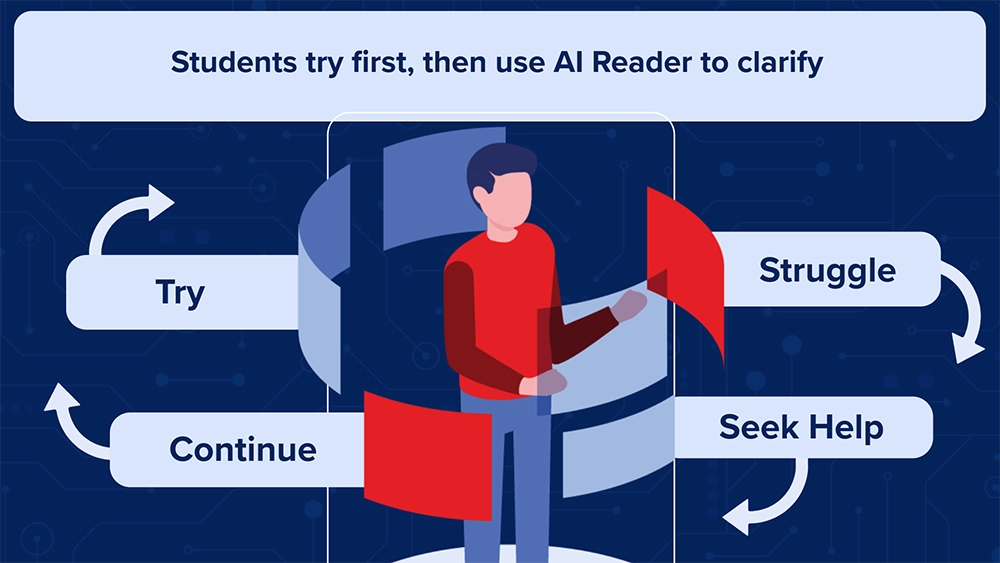
  • Students try to answer the question first, get it wrong, and then turn to AI Reader for clarification;
  • Students who use AI Reader complete more assigned learning objectives in their course by the end of the term.

The tool isn’t replacing the work. It’s helping students work through it. That distinction matters enormously when you’re trying to build products that improve outcomes, not just engagement.

Ask Sharpen reinforces this further. Usage patterns show a strong preference for multi-turn interactions rather than one-off answers. Students ask a question, get a response, push back, and ask a follow-up. After introducing Ask Sharpen’s multi-turn capability, we saw per-user engagement increase 36% rather than dropping off, which is exactly what you’d expect if students were using the tool to build understanding rather than collect answers.

Takeaway 3: Embedded AI extends instructional support beyond the classroom.

Instructors cannot be everywhere at once. Office hours have a time limit. Tutoring centers have capacity constraints. The moments when students most need support, usually late at night before an exam or midway through a reading they can’t crack, are rarely the moments when help is available.

This has always been one of higher education’s quiet inequities. Students who attend institutions with well-staffed support centers, or who simply have the confidence to email a professor at 10pm, get more access to help. Everyone else waits. AI changes that equation, but only if it is designed to be present in the moments and channels where students actually work.

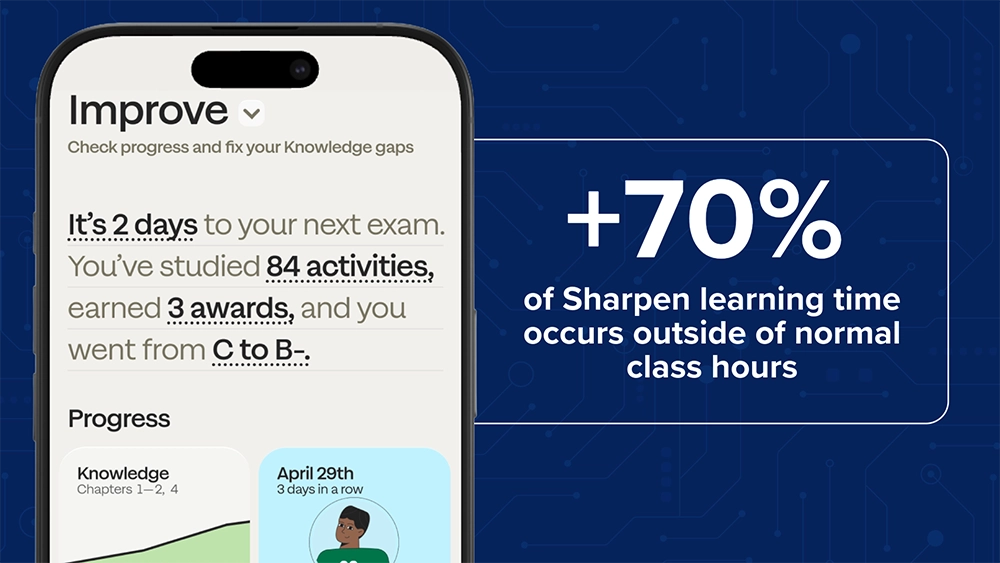
Sharpen addresses this directly. The data shows more than 70% of Sharpen learning time occurs outside normal classroom hours, with students engaging most heavily in the evenings and late at night.

AI Reader helps here, too. When a student hits a comprehension wall at 11pm, they can highlight the passage and get an explanation, without waiting and without losing momentum: the spirit of office hours, available at the moment of need, anywhere, at any hour.

These tools are not designed to simulate a teaching relationship, and they do not try to. The instructor remains at the center of the learning experience, setting context, building relationships, shaping the intellectual arc of a course. What AI changes is the distance between instruction and the student’s next moment of confusion. That distance is now much shorter, and that is a meaningful improvement in the conditions under which learning happens and can make student success initiatives easier for faculty and institutions to scale.

What’s Next

A year of usage data is not just a report card. It’s a roadmap for us.

We are not trying to add AI everywhere. We are trying to add it in the right places, the moments of friction, confusion, and unmet needs where a well-designed intervention changes what a student does next.

That discipline in product strategy is what separates tools that drive improvement from tools that drive only engagement, demonstrated by a recent Sharpen efficacy study, where final exam scores were 47% higher among Sharpen users.

A few things come into focus as we look ahead:

The students have spoken, more than 57 million times. They want help that meets them where they are.

Read more from Dr. Dave Duke here: