2026 McGraw Hill Global Education Insights Report

As Technology and AI Reshape Education,
Human Connection Matters More Than Ever  

Today's educators and students face unique challenges as they navigate a changing world. Our third annual survey of 1,300+ educators from around the globe shares a view of education that can serve as a blueprint for improving learning outcomes in the future. 

Walking a technology tightrope, educators push for balance. 

Technology is taking a toll on students.

Screen time is the biggest obstacle to student success, and 42% of educators say students’ ability to focus has declined compared to five years ago. 

Top 3 Obstacles to Student Success

1

Spending too much time on screens. 

2

Challenges outside of school.

3

Struggling with behavioral/mental health issues.

I think the biggest challenge technology presents to student learning today is competition for their attention, making it more difficult for them to sustain focus while persevering through challenging tasks, directions, and assignments. While technology offers incredible educational opportunities, students must also learn how to use it intentionally and appropriately rather than allowing it to distract them.

We’re at a crossroads with AI:

AI is saving educators time, but trust remains conditional: Nearly 4 in 5 educators say AI tools have saved them time, but they trust AI embedded in education platforms significantly more than general GenAI chatbots, with trust in chatbots declining 33% vs. last year. 

Educators are

81%

more likely to completely trust the information their students receive from AI embedded in the education platforms they use in the classroom vs. general GenAI chatbots.

4 in 5 educators are comfortable with students using AI when it is integrated into their courseware or curriculum.

As educators, we’re at a crossroads. If utilized with cautious optimism and strong boundaries, AI can be a powerful tool in the classroom. As an educator, my job is to ensure that any tool used enhances learning by serving as a scaffold for learning rather than replacing human interaction and critical thinking.

The path forward? Reclaiming the classroom.

Educators identified the most effective ways to support today’s learners:

  1. Preserve the human aspects of teaching 
  2. Target balance over bans when it comes to devices in school
  3. Work with policymakers and school leaders to establish guidance around AI use
  4. Increase our focus on teaching critical thinking and creating career-centered learning experiences 

Educators: AI can never replace...

1

73%

Social/emotional
support.

2

72%

Teacher-student relationships.

3

66%

In-classroom
teaching.

AI can enhance speed, personalization, and access to knowledge, while educators contribute what technology cannot — emotional intelligence, ethical judgment, mentorship, and the ability to inspire curiosity, resilience, and critical thinking. The future of education lies not in choosing between human and artificial intelligence, but in combining the strengths of both.

Screen time concerns

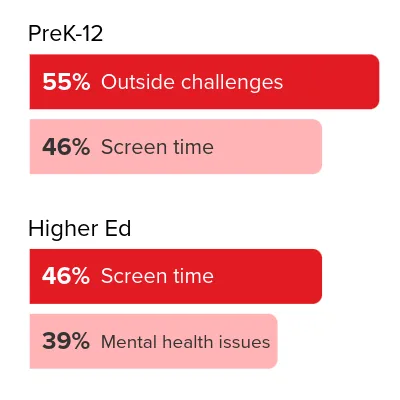
PreK-12: 55% Outside challenges, 46% Screen time; Higher Ed: 46% Screentime; 39% Mental health issues

Spending too much time on screens was reported by educators globally as the largest obstacle to student success. Notably, screen time ranked as a higher concern globally for Higher Ed instructors, who ranked it #1, vs PreK–12 teachers, who ranked it #2 behind challenges outside of school.

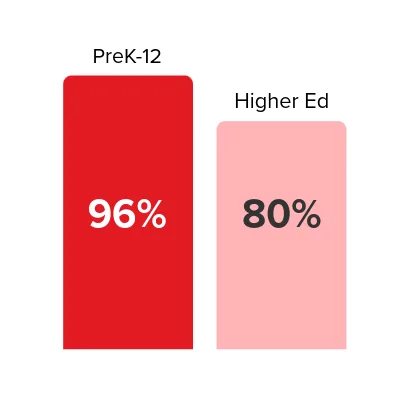
Educators prefer balance over bans when it comes to phones in school, with PreK–12 teachers (96%) more supportive of restrictions than Higher Ed instructors (80%). 

Which approaches to cell phone restrictions would be most effective?

Technology’s ripple-down effect

Students’ abilities to focus and to manage frustration and emotions have declined in the last five years, according to educators globally.

Concern is highest among U.S. PreK–12, Latin America PreK–12, and Asia PreK–12.

Two-thirds of educators are worried about their students’ mental health.

Student behavior and mental health issues represent the top obstacle to student success for U.S.-based PreK–12 and higher education educators. 

A noteworthy portion of educators say their students haven’t fully recovered academically or emotionally from the COVID-19 pandemic.

Most Higher Education instructors believe students have recovered academically (86%) and socially (75%), while PreK–12 educators are less likely to agree, with only 58% and 60% saying the same.

If students are spending all their time on screens and iPads and phones — how can we use some of the tools they're already used to and comfortable with to engage them? If what they're learning in school doesn't resemble at all how life works in their regular life, young people check out mentally.

The human elements of teaching are irreplaceable.

I'm a teacher to be with the students. I'm not a teacher to make a paycheck and go home. If I've chosen to stick with this profession for so long, it's because of my students and how I can make an impact. 

A recipe for student success from the world’s educators

Which skills did educators say were most important for student success in future careers?

  • Critical thinking and problem-solving (95%)
  • Real-world, applied learning experiences (95%)
  • Career exploration and vocational guidance (93%)
  • Communication and collaboration (91%)
  • Financial literacy (91%) 
  • AI literacy (84%)

More relevant career-connected curriculum (45%) and mental health support services (40%) have the most potential to help students overcome obstacles, followed by smaller class sizes (34%) and after-school academic support programs (33%), according to educators. 

The top two priorities for policymakers and school leaders around technology and digital learning should be setting guidelines for use of GenAI (59%) and protecting student/school data (54%) .

The large majority of educators, including PreK–12 educators, are not in favor of outright cell phone bans on school campuses. PreK–12 educators were most supportive of allowing cell phone use with teacher permission for instructional purposes, and of having students store phones in lockers or other storage spaces.

2026 McGraw Hill Education Insights 

On topics such as student cell phone use, trust in artificial intelligence, and priorities for policymakers, educators in different parts of the world have differing views.

Click to see the top education technology priorities for policymakers by region, and to download regional reports below. 

Morning Consult conducted global research across six regions via online panel interviewing and collecting responses from 567 PreK–12 educators and 747 Higher Education instructors from April 10th – May 8th, 2026 on behalf of McGraw Hill. Countries surveyed include the United States, Canada, Mexico, Colombia, United Arab Emirates, Saudi Arabia, Egypt, Qatar, Vietnam, Republic of Korea, Singapore, Malaysia, Thailand, United Kingdom, Norway, Sweden, Denmark, France and the Netherlands. Only the countries fielded in this research are represented in the global data, and data is not weighted to account for population size or prevalence of PreK–12/Higher Education educators in each country, with some countries having greater contribution than others due to differences in sample sizes.

McGraw Hill is a leading global provider of education solutions for PreK–12, Higher Education and professional learning, supporting the evolving needs of millions of educators and students around the world. We provide trusted, high-quality content and personalized learning experiences that use data, technology and learning science to help students progress towards their goals. Through our commitment to fostering a culture of innovation and belonging, we are dedicated to improving outcomes and access to education for all. We have over 30 offices across North America, Asia, Australia, Europe, the Middle East and South America, and make our learning solutions available in more than 80 languages.

Top