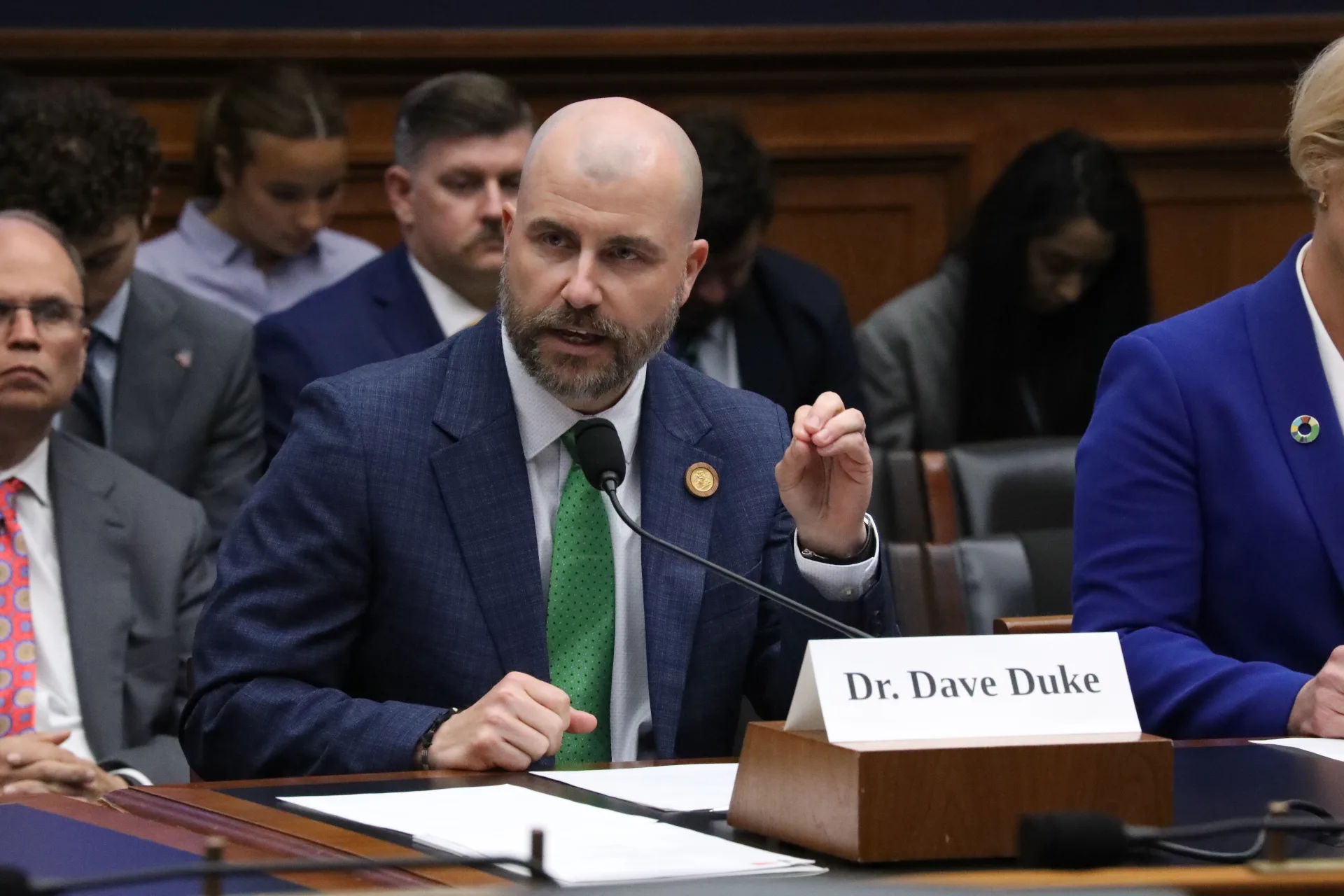
On June 3, 2026, Dr. Dave Duke, Chief Product Officer for Higher Education at McGraw Hill, testified at a hearing (“Building an AI-Ready America: Higher Education in the Age of AI”) before the U.S. House of Representatives’ Subcommittee on Higher Education and Workforce Development.
Posted here is his oral testimony before the subcommittee.
Opening
Chairman Owens, Ranking Member Adams, and Members of the Subcommittee, thank you. My name is Dr. Dave Duke. I serve as the Chief Product Officer for McGraw Hill Higher Education. I am grateful for the opportunity to appear before you today.
I want to talk about something more uncomfortable than AI adoption rates: a gap that is opening in American higher education right now, that our institutions are not yet equipped to close.
The Gap
Two things are happening simultaneously. Employers across every major sector of the American economy now expect AI proficiency from college graduates. It is showing up in entry-level job descriptions. Hiring managers, many of which are not yet adept at using AI themselves, are expecting graduates to work with AI tools productively and responsibly within a specific professional domain.
And this is also true: most institutions of higher education are not preparing their graduates to meet that expectation. The response to AI on campus has been fragmented and inconsistent. The gap between what higher education is producing and what the economy now requires is real and it is growing. It is a structural challenge.
The Proficiency Dilemma
I call this the proficiency dilemma, and it has two sides that are in tension.
On one side: students are using AI constantly. They have developed a practical fluency through daily use. But fluency through unsupervised use is not the same as cultivated professional competency. They have not developed the critical thinking or domain expertise that AI will demand of them as professionals. They have learned to produce outputs without developing the capacity to evaluate them.
On the other side: academic institutions that have responded to AI primarily through restriction and detection are producing a different kind of graduate. One who has been taught that AI is something to be managed and avoided, rather than understood and used with skill and judgment.
The right answer is neither unrestricted use nor aggressive restriction. It is intentional, structured, pedagogically sophisticated integration—teaching students not only how to use these tools, but when, why, and with what critical judgment. Very few institutions are doing this well, and I want you to know that. Faculty are making individual decisions in a policy vacuum, often without guidance, without professional development, and without the time to think through what responsible AI integration requires.
What Is at Stake
Let me explain what is at stake if we get this wrong.
We will produce a generation of graduates who are simultaneously over-reliant on AI and underprepared to work with it professionally. We will widen—not narrow—the gap between students who receive structured AI education and those who do not. And we will perpetuate a disadvantaged workforce that has a difficult time competing in the global economy.
Higher education has always been America's mechanism for translating individual potential into national strength. If we allow it to fall behind the economy it is meant to serve, we are not just failing students. We are failing ourselves.
Recommendations
I leave you with three recommendations.
First: Treat AI proficiency as a core educational competency. A nation-wide commitment, built into accreditation standards and general education frameworks to clarify the expectations of an AI-ready America.
Second: Initiate the development of institutional AI frameworks that create actionable guidance that faculty and administrators need but currently lack so that individual educators are not left to navigate this transformation on their own.
Third: Examine the variation in AI readiness among all institutions explicitly. Well-organized and better positioned universities have advantages in AI adoption that smaller regional and community colleges do not. The benefits of AI in higher education should be broadly shared.
Closing
The question before American higher education is not whether AI will transform the experience of learning and working. It already has. The question is whether our institutions will lead that transformation.
The students sitting in classrooms today will spend the most consequential years of their careers in an AI-shaped economy. They deserve an education that prepares them for that reality.
McGraw Hill is committed to that work, and we are grateful for this Subcommittee's attention to it.
Watch a replay of the hearing here.
Read more from Dr. Dave Duke here: “What is machine learning and why does it work so well in education settings?”