* The estimated amount of time this product will be on the market is based on a number of factors, including faculty input to instructional design and the prior revision cycle and updates to academic research-which typically results in a revision cycle ranging from every two to four years for this product. Pricing subject to change at any time.

Instructor Quick Actions

Get eBook Access Get access as soon as you validate!
Request a Print Sample Get a copy as soon as validated.
Contact a Rep Find a local rep best suited for you.
Find Rep

Product Information

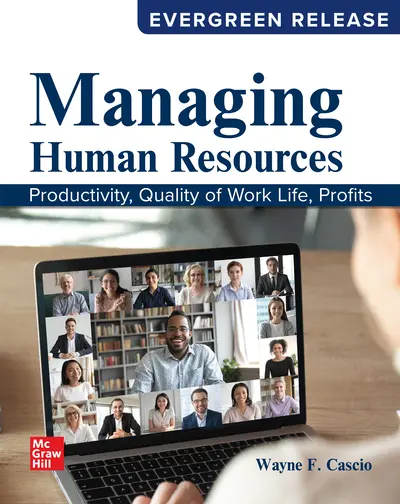
Managing Human Resources is for the general management student whose job inevitably will involve responsibility for managing people. It explicitly links the relationship between productivity, quality of work life, and profits to various human resource management activities and as such, strengthens the students' perception of human resource management as an important function, which affects individuals, organizations, and society. It is research-based and contains strong links to the applicability of this research to real business situations.

McGraw Hill eBooks and digital platforms use an Evergreen delivery model with a release-centered process that makes it easy to keep courses fresh, engaging, and relevant.

Release Notes provide detailed information about new and updated content delivered with each release.

Your account requires validation. Please contact your sales representative.

PART ONE: ENVIRONMENT
1.  Human Resources in a Globally Competitive Business
Environment 
2.  HR Technology 
3.  Talent Analytics: The Financial Impact of HR Activities 
4.  The Legal Context of Employment Decisions 

PART TWO: EMPLOYMENT 
5.  Diversity at Work 
6.  Planning for People 
7.  Recruiting
8.  Staffing 

PART THREE: DEVELOPMENT 
9.  Training and On-Boarding
10. Performance Management

PART FOUR: COMPENSATION 
11. Pay and Incentive Systems 
12. Indirect Compensation: Employee Benefit Plans 

PART FIVE: LABOR-MANAGEMENT ACCOMMODATION 
13. Union Representation and Collective Bargaining 
14. Procedural Justice and Ethics in Employee Relations 

PART SIX: SUPPORT AND INTERNATIONAL IMPLICATIONS 
15. Safety, Health, and Employee Assistance Programs 

About the Author

Wayne Cascio

Earned his B.A. degree from Holy Cross College in 1968, his M.A. degree from Emory University in 1969, and his Ph.D. in industrial/organizational psychology from the University of Rochester in 1973. Since that time he has taught at Florida International University, the University of California/ Berkeley, and the University of Colorado/Denver, where he is at present Professor of Management. He has served president both of the Human Resources Division of the Academy of Management and of the Society for Industrial and Organizational Psychology. In addition to hosting an annual week-long conference on international human resource management at the University of Colorado, Professor Cascio has consulted on five continents with a wide variety of organizations in both the public and private sectors on HR matters. He also periodically testifies as an expert witness in employment discrimination cases. Professor Cascio is an active researcher and is the author or editor of five books on human resources management.

Ways of reading

  • No information about appearance modifiability is available.
  • Not all of the content will be readable as read aloud speech or dynamic braille.
  • Has alternative text descriptions for images.
  • No information about prerecorded audio is available.

Conformance

This publication claims to meet EPUB Accessibility 1.1 Web Content Accessibility Guidelines (WCAG) 2.2 Level AA.

Navigation

  • Table of contents to all chapters of the text via links
  • Index with links to referenced entries
  • Elements such as headings, tables, etc for structured navigation

Rich content

  • Math formulas in accessible format (MathML)
  • Chemical formulas in accessible format (MathML)
  • Information-rich images are described by extended descriptions

Hazards

  • The publication contains no hazards.

Accessibility summary

  • For pedagogical reasons, certain images may not meet required contrast ratios. Boxed sidebars are marked as complementary regions (asides) to aid navigation. Tables are properly marked up for screen reader compatibility, including summaries for complex tables. Where features that are usually not announced by screen readers (SR), such as punctuation or styling, are essential for understanding the content those features are called out in SR-only text.

Legal considerations

  • No information is available.

Additional accessibility information

  • No information is available.

Need support?   We're here to help - Get real-world support and resources every step of the way.

Top