* The estimated amount of time this product will be on the market is based on a number of factors, including faculty input to instructional design and the prior revision cycle and updates to academic research-which typically results in a revision cycle ranging from every two to four years for this product. Pricing subject to change at any time.

Instructor Quick Actions

Get eBook Access Get access as soon as you validate!
Request a Print Sample Get a copy as soon as validated.
Contact a Rep Find a local rep best suited for you.
Find Rep

Product Information

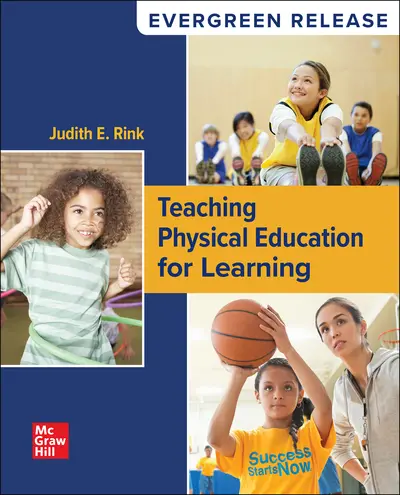
Teaching Physical Education for Learning guides future physical education teachers in designing effective learning experiences for students in grades K-12. This user-friendly text emphasizes developing students' motor skills and physical abilities through interactive teaching strategies. Physical education teachers will not only learn instructional skills, but also how to adapt their teaching to different content and student needs. This latest release provides a foundation for physical education programs that prepare students for a lifetime of physical activity.

McGraw Hill eBooks and digital platforms use an Evergreen delivery model with a release-centered process that makes it easy to keep courses fresh, engaging, and relevant.

Release Notes provide detailed information about new and updated content delivered with each release.

Your account requires validation. Please contact your sales representative.

1 Teaching Physical Education: An Orientation

2 Factors That Influence Learning

3 Designing Learning Experiences and Instructional Tasks

4 Task Presentation

5 Content Analysis and Development

6 Developing and Maintaining a Learning Environment

7 Teacher During Activity

8 Teaching Strategies

9 Student Motivation, Personal Growth, and Inclusion

10 Planning

11 Assessment in the Instructional Process

12 Content-Specific Pedagogy

13 The Teacher as the Continuous Learner

14 Observing Teacher and Student Behavior

About the Author

Judith E. Rink

Judith E. Rink is a professor in the Department of Physical Education at the University of South Carolina, Columbia. She has published numerous books, research and articles related to effective teaching of physical education. She has been an editor of both the Journal for Teaching Physical Education and the Research Quarterly for Exercise and Sport. Dr. Rink was the chairperson of the committee to develop national content standards for physical education and has been the recipient of the NASPE Hall of Fame Award, the Curriculum and Instruction Academy Honor Award and the American Education Association Special Interest Group Outstanding Scholar Honor Award. She is currently the program director the South Carolina Physical Education Assessment Program and is working with the National Association for Physical Education and Sport to develop performance indicators and assessment materials for the national standards.

Ways of reading

  • No information about appearance modifiability is available.
  • Not all of the content will be readable as read aloud speech or dynamic braille.
  • Has alternative text descriptions for images.
  • No information about prerecorded audio is available.

Conformance

This publication claims to meet EPUB Accessibility 1.1 Web Content Accessibility Guidelines (WCAG) 2.2 Level AA.

Navigation

  • Table of contents to all chapters of the text via links
  • Index with links to referenced entries
  • Elements such as headings, tables, etc for structured navigation

Rich content

  • Math formulas in accessible format (MathML)
  • Information-rich images are described by extended descriptions

Hazards

  • The publication contains no hazards.

Accessibility summary

  • Boxed sidebars are marked as complementary regions (asides) to aid navigation. In-text references to figures, sections, and pages are linked for easy access however, there are no back links provided. Tables are properly marked up for screen reader compatibility, including summaries for complex tables. Where features that are usually not announced by screen readers (SR), such as punctuation or styling, are essential for understanding the content those features are called out in SR-only text.

Legal considerations

  • No information is available.

Additional accessibility information

  • Page breaks included

Need support?   We're here to help - Get real-world support and resources every step of the way.

Top