Finding the Balance: What the Screen Time Debate Can Teach Us About AI in Education

Educators are not rejecting technology. They are asking for a more thoughtful approach to it.


By: Philip Moyer, President & CEO, McGraw Hill, Inc.
Tags: Article, Artificial Intelligence (AI), Global Insights Report, Blog, Corporate

We’ve reached a crucial moment in the debate over screens in the classroom.

For decades, schools around the world invested heavily in technology with the hope that greater access would lead to better student outcomes. Yet today, educators, parents and students are more unsettled than ever about technology and less sure of its value to learning. 

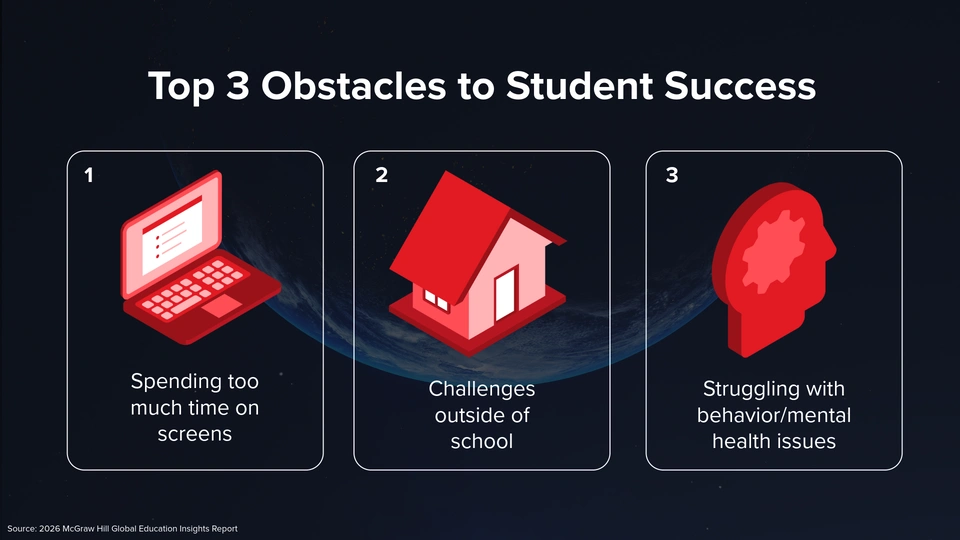
Our newly released 2026 Global Education Insights Report found that excessive screen time is viewed by educators as the single biggest obstacle to student success. Two in five educators say students' ability to focus and manage their emotions has declined over the last five years, while 68% are concerned about student mental health – the top worry for the second year in a row. 

The Lesson of Social Media

We understand so little about the human brain and its interaction with machines, especially for developing minds. Social media’s impact on children is a powerful case study in how a technology, once meant to connect and inform us, can quickly spiral in the wrong direction. This lesson matters more than ever as we start our journey with artificial intelligence in education.

A growing body of neuroscience research suggests that many social platforms can be just as addictive as smoking, intentionally designed to stimulate the brain's dopamine reward system. Likes, notifications and infinite-scroll feeds create addictive cycles of anticipation that make disengagement difficult, particularly for children whose self-regulation systems are still developing.

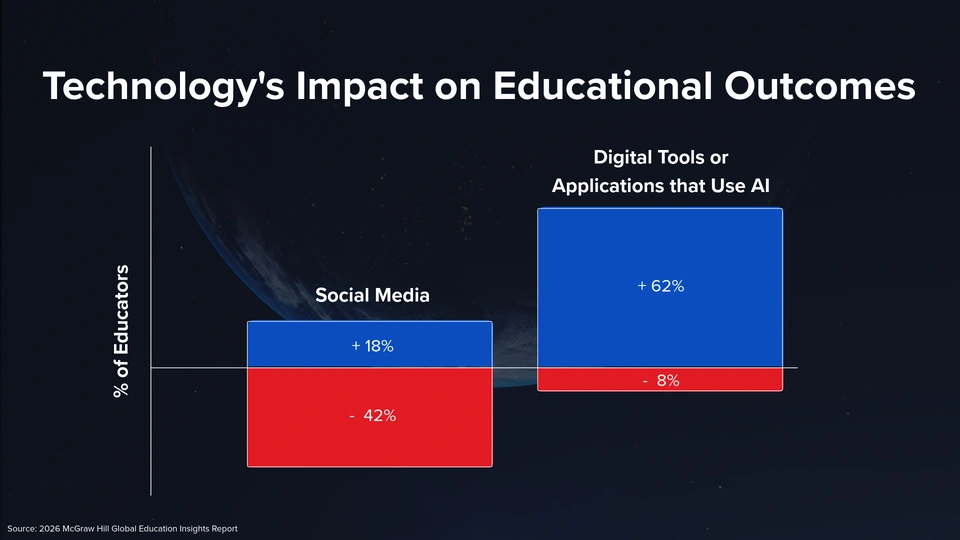
Educators who participated in our study see this impact firsthand. Forty-two percent of those surveyed say social media has a mostly negative impact on educational outcomes – the highest negative rating of any technology we evaluated.

Why Younger Brains Need Different Approaches

Technology designed to maximize engagement versus technology designed to maximize learning produce two very different outcomes. This distinction is especially important for younger learners.

Research increasingly suggests that excessive screen exposure during early childhood can affect the development of attention, working memory and other executive functions that are foundational for learning. A 2025 study involving more than 1,000 preschool children found negative relationships between higher screen time and key self-regulation skills, including cognitive flexibility and verbal working memory. The researchers concluded that screen use for young children should be limited and focused on high-quality educational content.

At the same time, researchers have found stronger reading-related neural pathways among children who spend more time reading printed books than consuming content on screens.

Anyone who has spent even a little time in a kindergarten classroom is probably smiling as they read this, because they already know: young children learn best through conversation, physical play, storytelling, guided practice, reading, movement and human interaction. Technology can support those experiences, but it should not replace them.

Not All Screen Time is Equal

One of the most important lessons from the screen time conversation is that we should not treat all digital experiences as equal by banning all screen time.

A child spending hours playing a game or scrolling social media is not having the same cognitive experience as a student using a carefully designed literacy or mathematics program built on evidence-based learning science. The prefrontal cortex is where learning starts, and it must focus when learning something new. The brain is designed to monotask, which is why the cognitive cost load of switching tasks between learning, gaming or social scrolling can impact learning outcomes. It’s why you don’t remember much after a scrolling session. It’s also why too much gamification ends up defeating the learning experience.

At McGraw Hill we believe that technology used in a classroom should help educators identify learning gaps, personalize instruction and provide support at critical moments. It should strengthen the productive struggle, not eliminate it. When technology simply delivers answers, it short-circuits that process. When it scaffolds understanding and helps students progress through challenges, it becomes a powerful learning tool.

This principle guides our approach to the AI and learning tools we build.

Our learning research spans decades of student behavior, and we develop tools like ALEKS to create high-impact digital learning moments rather than extending screen time. ALEKS Adventure, our AI-powered math solution for grades K–5, ensures students engage in carefully designed learning experiences in 10- to 15-minute sessions. And research shows that use of pedagogically-sound, age-appropriate technology in bite-size lessons can have an outsized impact: first- and second-graders using ALEKS Adventure achieved notable assessment gains and stronger end-of-year math performance, according to a recent Johns Hopkins study.

ALEKS Adventure combines AI and learning science to deliver short, engaging math experiences that help young learners build confidence and mastery.

Why the Equation Changes for Older Students

As students mature, so do their brains and their ability to self-regulate.

Adolescence represents one of the most important periods of brain development after early childhood. Researchers have found significant growth during this time in areas associated with complex memory, self-regulation and adaptive learning, which creates opportunities for more robust and independent uses of technology.

As a student ages and develops more self-regulation abilities, they can be exposed to more screen time to personalize learning, support tutoring, leverage study tools and gain real-time academic support.

Think of it like the lens of a camera opening wider and wider to the world, taking in more stimulation – while still being able to focus.

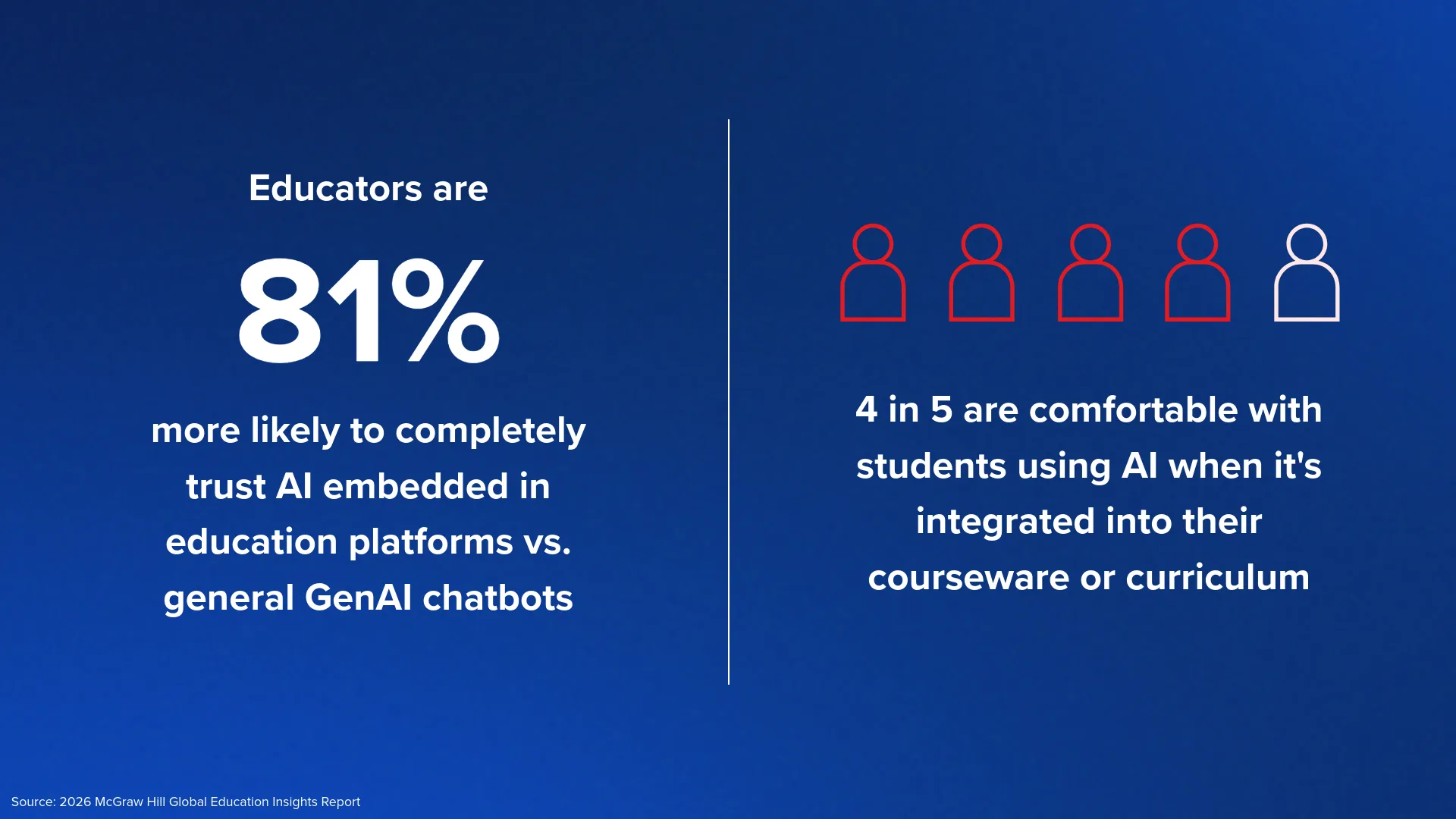
But even older learners have their limit. Too much gamification, video content and scrolling in learning tools can have a negative correlation to education. Teachers see this, too, which is why our Global Education Insights Report found educators are 81% more likely to completely trust AI when it is integrated into existing courseware and curriculum environments designed specifically for education, rather than general-purpose chatbots or apps designed for engagement versus learning.

With our Sharpen mobile study app, professors can push personalized, educational playlists to students. It’s learning delivered when students need it in short, concentrated formats like videos, flashcards or quizzes. Students’ brains are able to focus for 10-20 minutes on learning experiences that their professor curates. It’s an ideal complement – not replacement – to enrich the work happening in the classroom, and we see that students are using it during the hours when instructors are unavailable. Our reports indicate the highest usage between 11pm and 3am.

The same principle guides tools like our Learning Coach AI tutor in Connect, which is designed to extend the professor’s ability to support students when they are studying independently. When an instructor makes it available to their students, Learning Coach helps learners think critically, deepen understanding and get “unstuck” in moments when they need additional support to help a concept click – at any hour of the day or night.

Learning Coach is an AI tutor that helps students work through challenging concepts independently.

A Path Forward for AI in Education

Social media taught us what happens when digital experiences are optimized for attention. AI gives us an opportunity to choose a different path.

Fortunately, the majority (72%) of educators do not expect in-person instruction to decline even as AI adoption grows. And it’s no surprise why. Working together, we can build AI that expands the capacity of teachers while preserving the relationships, mentorship and human connection that make learning possible.

If we keep that principle at the center of how we introduce AI to classrooms around the world, we can avoid repeating the mistakes of the past – and build something far better for the next generation of learners.