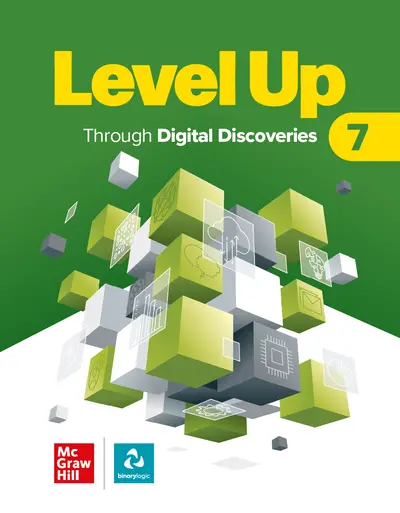
Level Up Through Digital Discoveries 7, 1st edition ©2026

Grades: 6 - 12

Level Up through Digital Discoveries empowers students from grades 1‒12 to develop critical thinking, innovation, and collaboration skills that prepare them for academic success and future tech-driven careers. In Grade 7, learners will master increasingly advanced coding, robotics, and digital design skills, while building creativity, critical thinking, and confidence to innovate with real-world technology.

Program Details

Inspiring Innovation and Future-Ready Skills

The comprehensive Level Up through Digital Discoveries series guides students from their very first clicks in Grade 1 to mastering advanced computing and programming concepts by the end of Grade 12. Across each level, students build confidence in digital communication, coding, design, cybersecurity, AI, and real-world problem-solving. Structured lessons, creative projects, and hands-on activities empower students to build their computing skills. 


This program guides Grade 7 students through advanced digital skills, including Python coding, physical computing with micro:bit, game and app design, and AI concepts. Through structured lessons and hands-on projects, students will strengthen their problem-solving, creativity, and collaboration, while exploring real-world tech applications. By coding games, building smart devices, and working with genAI tools, students gain practical experience with emerging technologies and digital innovation. 

Skill building – Students will learn digital skills such as programming in Python, physical computing, micro:bit programming, digital design, AI concepts, and data management. 

Active learning – The engaging and interactive activities will ensure students are learning to be both independent and able to think critically. 

Bringing the subject to life – This program features a suite of engaging real-life scenarios and activities to engage and motivate learners.

Commitment to pedagogy – The book follows a spiral curriculum ensuring that students are shown the material at relevant and appropriate grade levels, each time at a higher level of difficulty and in greater depth.

Robotics and AI – These are introduced in our earliest grades and gain complexity as learners work their way through the content, with supplementary content available for Robotics for Grades 1‒8.

View Textbook Sampler

Get Instant Sample Access 

1: Creating a Document

  • Lesson 1: Formatting Text – p. 7
  • Lesson 2: Advanced Formatting – p. 23
  • Lesson 3: Images and Graphics – p. 33
  • Lesson 4: Working with Tables – p. 43
  • Lesson 5: Check and Print – p. 55

2: Working with Numbers

  • Lesson 1: Advanced Formatting – p. 75
  • Lesson 2: Simple Calculations – p. 86
  • Lesson 3: Logical Functions – p. 98
  • Lesson 4: Create a Chart – p. 109
  • Lesson 5: Computer Models – p. 117

3: Getting Started with Physical Computing

  • Lesson 1: Introduction to the micro:bit – p. 129
  • Lesson 2: Interacting with the micro:bit – p. 142
  • Lesson 3: Variables – p. 153
  • Lesson 4: Decision-Making – p. 163
  • Lesson 5: Loops – p. 174

4: Presenting Your Ideas

  • Lesson 1: Slides, Text, and Images – p. 187
  • Lesson 2: Transitions and Animations – p. 199
  • Lesson 3: Sound, Video, and 3D Models – p. 209
  • Lesson 4: Charts and Graphs – p. 217
  • Lesson 5: Tips and Tricks – p. 225

5: Introduction to Python

  • Lesson 1: Introduction to Programming – p. 239
  • Lesson 2: Variables and Commands – p. 249
  • Lesson 3: Input Data – p. 259
  • Lesson 4: Conditional Statements – p. 268
  • Lesson 5: Multiple Decisions – p. 277

6: The Evolution of Technology

  • Lesson 1: History and AI Technologies – p. 293
  • Lesson 2: Emerging Technologies – p. 305
  • Lesson 3: Intro to GenAI – p. 313
  • Lesson 4: Prompt Engineering – p. 323
  • Lesson 5: Issues and Social Impact – p. 334