* The estimated amount of time this product will be on the market is based on a number of factors, including faculty input to instructional design and the prior revision cycle and updates to academic research-which typically results in a revision cycle ranging from every two to four years for this product. Pricing subject to change at any time.

Instructor Quick Actions

Get eBook Access Get access as soon as you validate!
Request a Print Sample Get a copy as soon as validated.
Contact a Rep Find a local rep best suited for you.
Find Rep

Product Information

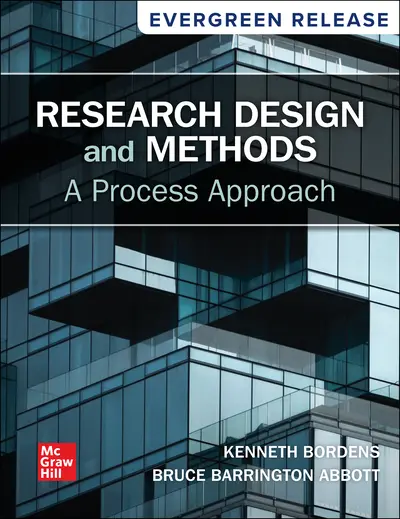
Research Design and Methods: A Process Approach takes students through the research process, from asking and developing a research question, to designing and conducting a study, through analyzing and reporting data. Information on the research process is presented in a lively and engaging way, highlighting the numerous decisions that must be made when designing and conducting research, and emphasizing the importance of ethical conduct, both in the treatment of research subjects and in the conduct of researcher and their reporting of research results. Updates reflect a revolution in research practices that has overtaken psychology and other fields that have relied on null hypothesis significance testing (NHST). This revolution followed the discovery that many established research findings fail the test of replication.

McGraw Hill eBooks and digital platforms use an Evergreen delivery model with a release-centered process that makes it easy to keep courses fresh, engaging, and relevant.

Release Notes provide detailed information about new and updated content delivered with each release.

Your account requires validation. Please contact your sales representative.

1. Explaining Behavior
2. Developing and Evaluating Theories of Behavior
3. Understanding Ethical Issues in the Research Process
4. Getting Ideas for Research
5. Choosing a Research Design
6. Making Systemic Observations
7. Choosing and Using Research Subjects
8. Doing Nonexperimental Research
9. Doing Survey Research
10. Using Between-Subjects and Within-Subjects Experimental Design
11. Using Specialized Research Designs
12. Using Single-Subject Designs
13. Describing Data
14. Using Inferential Statistics
15. Using Multivariate Design and Analysis
16. Reporting Your Research Results

About the Author

Kenneth S. Bordens

Purdue University - Fort Wayne

Bruce Barrington Abbott

Purdue University - Fort Wayne

Ways of reading

  • No information about appearance modifiability is available.
  • Not all of the content will be readable as read aloud speech or dynamic braille.
  • Has alternative text descriptions for images.
  • No information about prerecorded audio is available.

Conformance

This publication claims to meet EPUB Accessibility 1.1 Web Content Accessibility Guidelines (WCAG) 2.2 Level AA.

Navigation

  • Table of contents to all chapters of the text via links
  • Index with links to referenced entries
  • Elements such as headings, tables, etc for structured navigation

Rich content

  • Math formulas in accessible format (MathML)
  • Information-rich images are described by extended descriptions

Hazards

  • The publication contains no hazards.

Accessibility summary

  • Boxed sidebars are marked as complementary regions (asides) to aid navigation. In-text references to figures, sections, and pages are linked for easy access however, there are no back links provided. Tables are properly marked up for screen reader compatibility, including summaries for complex tables. Where features that are usually not announced by screen readers (SR), such as punctuation or styling, are essential for understanding the content those features are called out in SR-only text.

Legal considerations

  • No information is available.

Additional accessibility information

  • Color is not the sole means of conveying information
  • Page breaks included

affordability icon

Affordability

Reduce course material costs for your students while still providing full access to everything they need to be successful. It isn't too good to be true - it's Inclusive Access.

Need support?   We're here to help - Get real-world support and resources every step of the way.

Top