* The estimated amount of time this product will be on the market is based on a number of factors, including faculty input to instructional design and the prior revision cycle and updates to academic research-which typically results in a revision cycle ranging from every two to four years for this product. Pricing subject to change at any time.

Instructor Quick Actions

Get eBook Access Get access as soon as you validate!
Request a Print Sample Get a copy as soon as validated.
Contact a Rep Find a local rep best suited for you.
Find Rep

Product Information

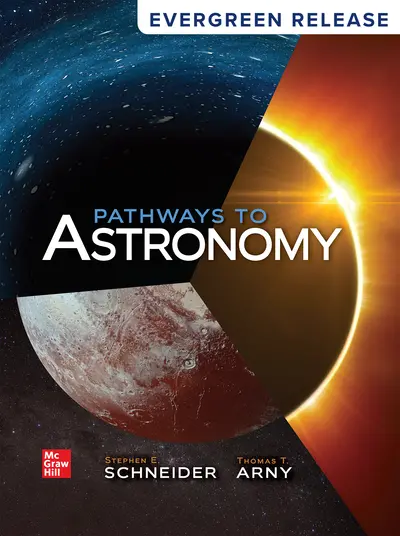
Pathways to Astronomy breaks down introductory astronomy into its component parts. The huge and fascinating field of astronomy is divided into 86 units. These units are woven together to flow naturally for the person who wants to read the text like a book, but it is also possible to assign them in different orders, or skip certain units altogether. Professors can customize the units to fit their course needs. They can select individual units for exploration in lecture while assigning easier units for self-study, or they can cover all the units in full depth in a content-rich course. With the short length of units, students can easily digest the material covered in an individual unit before moving onto the next unit.

McGraw Hill eBooks and digital platforms use an Evergreen delivery model with a release-centered process that makes it easy to keep courses fresh, engaging, and relevant.

Release Notes provide detailed information about new and updated content delivered with each release.

Your account requires validation. Please contact your sales representative.

  • PART I THE COSMIC LANDSCAPE
  • Unit 1. Our Planetary Neighborhood
  • Unit 2. Beyond the Solar System
  • Unit 3. Astronomical Numbers
  • Unit 4. Scientific Foundations of Astronomy
  • Unit 5. The Night Sky
  • Unit 6. The Year
  • Unit 7. The Time of Day
  • Unit 8. Lunar Cycles
  • Unit 9. Calendars
  • Unit 10. Geometry of the Moon, Earth, and Sun
  • Unit 11. Planets: The Wandering Stars
  • Unit 12. The Beginnings of Modern Astronomy
  • Unit 13. Observing the Sky
  • PART II PROBING MATTER, LIGHT, AND THEIR
  • INTERACTIONS
  • Unit 14. Astronomical Motion: Inertia, Mass, and Force
  • Unit 15. Force, Acceleration, and Interaction
  • Unit 16. The Universal Law of Gravity
  • Unit 17. Measuring a Body's Mass Using Orbital Motion
  • Unit 18. Orbital and Escape Velocities
  • Unit 19. Tides
  • Unit 20. Conservation Laws
  • Unit 21. The Dual Nature of Light and Matter
  • Unit 22. The Electromagnetic Spectrum
  • Unit 23. Thermal Radiation
  • Unit 24. Identifying Atoms by Their Spectra
  • Unit 25. The Doppler Shift
  • Unit 26. Special Relativity Unit
  • Unit 27. General Relativity
  • Unit 28. Detecting Light - An Overview
  • Unit 29. Collecting Light
  • Unit 30. Focusing Light
  • Unit 31. Telescope Resolution
  • Unit 32. The Earth's Atmosphere and Space Observatories
  • Unit 33. Amateur Astronomy
  • PART III THE SOLAR SYSTEM
  • Unit 34. The Structure of the Solar System
  • Unit 35. The Origin of the Solar System
  • Unit 36. Other Planetary Systems
  • Unit 37. The Earth as a Terrestrial Planet
  • Unit 38. Earth's Atmosphere and Hydrosphere
  • Unit 39. Our Moon
  • Unit 40. Mercury
  • Unit 41. Venus
  • Unit 42. Mars
  • Unit 43. Asteroids
  • Unit 44 Comparative Planetology
  • Unit 45. Jupiter and Saturn: Gas Giants
  • Unit 46. Uranus and Neptune: Ice Giants
  • Unit 47. Satellite Systems and Rings
  • Unit 48. Ice Worlds, Pluto, and Beyond
  • Unit 49. Comets
  • Unit 50. Impacts on Earth
  • PART IV STARS AND STELLAR EVOLUTION
  • Unit 51. The Sun, Our Star
  • Unit 52. The Sun's Source of Power
  • Unit 53. Solar Activity
  • Unit 54. Surveying the Stars
  • Unit 55. The Luminosities of Stars
  • Unit 56. The Temperatures and Compositions of Stars
  • Unit 57. The Masses of Orbiting Stars
  • Unit 58. The Sizes of Stars
  • Unit 59. The H-R Diagram
  • Unit 60. Overview of Stellar Evolution
  • Unit 61. Star Formation
  • Unit 62. Main-Sequence Stars
  • Unit 63. Giant Stars
  • Unit 64. Variable Stars
  • Unit 65. Mass Loss and Death of Low-Mass Stars
  • Unit 66. Exploding White Dwarfs
  • Unit 67. Old Age and Death of Massive Stars
  • Unit 68. Neutron Stars

About the Author

Steven A. Schneider

Ways of reading

  • No information about appearance modifiability is available.
  • Not all of the content will be readable as read aloud speech or dynamic braille.
  • Has alternative text descriptions for images.
  • No information about prerecorded audio is available.

Conformance

This publication claims to meet EPUB Accessibility 1.1 Web Content Accessibility Guidelines (WCAG) 2.2 Level AA.

Navigation

  • Table of contents to all chapters of the text via links
  • Index with links to referenced entries
  • Elements such as headings, tables, etc for structured navigation

Rich content

  • Math formulas in accessible format (MathML)
  • Chemical formulas in accessible format (MathML)
  • Information-rich images are described by extended descriptions

Hazards

  • No information is available.

Accessibility summary

  • For pedagogical reasons, certain images may not meet required contrast ratios. Boxed sidebars are marked as complementary regions (asides) to aid navigation. In-text references to figures, sections, and pages are linked for easy access however, there are no back links provided. Tables are properly marked up for screen reader compatibility, including summaries for complex tables.

Legal considerations

  • No information is available.

Additional accessibility information

  • Page breaks included

Need support?   We're here to help - Get real-world support and resources every step of the way.

Top