* The estimated amount of time this product will be on the market is based on a number of factors, including faculty input to instructional design and the prior revision cycle and updates to academic research-which typically results in a revision cycle ranging from every two to four years for this product. Pricing subject to change at any time.

Instructor Quick Actions

Get eBook Access Get access as soon as you validate!
Contact a Rep Find a local rep best suited for you.
Find Rep

Product Information

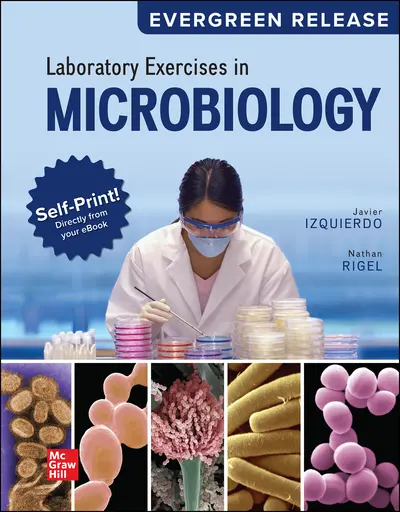
The Izquierdo lab is a majors level manual that accompanies the Willey-Prescott's Microbiology textbook. This laboratory manual provides a balanced introduction to laboratory techniques and principles that are important in each area of microbiology.

Experiments follow the spirit of the ASM guidelines for laboratory content. Each experiment comes with a complete set of pedagogical aids- materials per group of students, learning objectives, pronunciation guide- so students understand the "how" and "why" of the labs in which they participate.

This title includes functionality within the McGraw Hill eBook that will allow students to print text content. Enabling self-print ensures that students can access and print the most up-to-date content, complete with any new Evergreen updates. By providing students with access to the McGraw Hill eBook either standalone or within our Connect platform, students will have the ability to access this print functionality without the added cost of print materials.

McGraw Hill eBooks and digital platforms use an Evergreen delivery model with a release-centered process that makes it easy to keep courses fresh, engaging, and relevant.

Release Notes provide detailed information about new and updated content delivered with each release.

Your account requires validation. Please contact your sales representative.

  • Part One- Microscopic Techniques
  • 1. Bright-Field Light Microscopy and Microscopic Measurement of Organisms
  • 2. The Hanging Drop Slide and Bacterial Motility
  • 3. Dark-Field Light Microscopy
  • 4. Phase-Contrast Microscopy
  • Part Two- Bacterial Cell Biology
  • 5. Aseptic Technique
  • 6. Negative Staining
  • 7. Simple Staining
  • 8. Gram Stain
  • 9. Acid-Fast Staining Procedure
  • 10. Endospore Staining
  • 11. Capsule Staining
  • 12. Flagella Staining
  • Part Three- Basic Culture Techniques
  • 13. Preparation of Microbiology Media and Equipment
  • 14. The Spread-Plate Technique
  • 15. The Streak-Plate Technique
  • 16. The Pour-Plate Technique
  • 17. Cultivation of Anaerobic Bacteria
  • 18. Determination of Bacterial Numbers
  • Part Four- Microbial Biochemistry
  • 19. Carbohydrates I: Fermentation and -Galactosidase Activity
  • 20. Carbohydrates II: Triple Sugar Iron Agar Test
  • 21. Carbohydrates III: Starch Hydrolysis
  • 22. Lipid Hydrolysis
  • 23. Proteins I: The IMViC Tests
  • 24. Proteins II: Gelatin and Casein Hydrolysis
  • 25. Proteins III: Catalase Activity
  • 26. Proteins IV: Oxidase Test
  • 27. Proteins V: Urease Activity
  • 28. Proteins VI: Lysine and Ornithine Decarboxylase Tests
  • 29. Proteins VII: Phenylalanine Deamination
  • 30. Proteins VIII: Dissimilatory Nitrate Reduction
  • Part Five- Environmental Factors Affecting Growth of Microorganisms
  • 31. Temperature
  • 32. pH
  • 33. Osmotic Pressure
  • 34. The Effects of Chemical Agents on Bacteria I: Disinfectants and Other Antimicrobial Products
  • 35. The Effects of Chemical Agents on Bacteria II: Antibiotics
  • 36. Bacterial Growth Curve
  • Part Six- Environmental and Food Microbiology
  • 37. Monitoring Water for Coliforms
  • 38. Enumeration of Soil Microorganisms
  • 39. Winogradsky Columns
  • 40. Bioluminescence
  • 41. Plate Counts and Quality Assessment of Milk
  • Part Seven- Medical Microbiology
  • 42. Staphylococci
  • 43. Pneumococcus
  • 44. Streptococci
  • 45. Neisseriae
  • 46. Normal Human Flora
  • Part Eight- Eukaryotic Microbiology
  • 47. Fungi I: Yeasts (Ascomycota)
  • 48. Fungi II: Zygomycota (Rhizopus), Ascomycota, (Penicillium), and Basidiomycota (Agaricus)

About the Author

Nathan Rigel

Nathan W. Rigel is an associate professor in the Department of Biology at Hofstra University. Since starting his lab in 2013, Dr. Rigel’s research has focused on the various protein trafficking pathways of Acinetobacter. While at Hofstra, Dr. Rigel has taught courses in microbiology, cell and molecular biology, bioinformatics, and bacterial genetics. Dr. Rigel completed his undergraduate studies in Microbiology at the Pennsylvania State University. He then moved south and earned his PhD in Microbiology and Immunology at the University of North Carolina at Chapel Hill while studying the accessory SecA2 protein export system found in mycobacteria. In 2009, Dr. Rigel returned north to study assembly of outer membrane proteins in Gram-negative bacteria as a postdoctoral research associate in the Department of Molecular Biology at Princeton University. Originally from a small town in central Pennsylvania, Dr. Rigel now lives in Queens with his wife and son. He can be reached at nathan.w.rigel@hofstra.edu.

Javier Izquierdo

Javier A. Izquierdo is an associate professor at Hofstra University, where he started his lab in 2014. Dr. Izquierdo received his BS in Biology at Case Western Reserve University. He earned his PhD in Microbiology from the University of Massachusetts Amherst, where he studied soil microbial ecology, and where he developed a passion for teaching microbiology thanks to many wonderful mentors. He went on to Dartmouth College for his postdoctoral work on the microbial ecology of cellulose degradation by anaerobic thermophiles. He then served as Biofuels Program Manager at the Research Triangle Institute in North Carolina, but his interests in teaching and mentoring research students brought him back to academia. His research group at Hofstra continues to work on understanding the ecology and physiology of cellulolytic microbes, as well as studying root-associated microbiomes of plants growing under stressful conditions. At Hofstra, he has taught courses in general microbiology, genomics and bioinformatics, and environmental microbiology. He enjoys going on long walks along the coast or the mountains with his wife and daughters. He is also a singer-songwriter and an avid photographer. He can be reached at javier.a.izquierdo@hofstra.edu.

Accessibility

Creating accessible products is a priority for McGraw Hill. We make accessibility and adhering to WCAG AA guidelines a part of our day-to-day development efforts and product roadmaps.

For more information, visit our accessibility page, or contact us at accessibility@mheducation.com

Need support?   We're here to help - Get real-world support and resources every step of the way.

Top