* The estimated amount of time this product will be on the market is based on a number of factors, including faculty input to instructional design and the prior revision cycle and updates to academic research-which typically results in a revision cycle ranging from every two to four years for this product. Pricing subject to change at any time.

Instructor Quick Actions

Get eBook Access Get access as soon as you validate!
Contact a Rep Find a local rep best suited for you.
Find Rep

Product Information

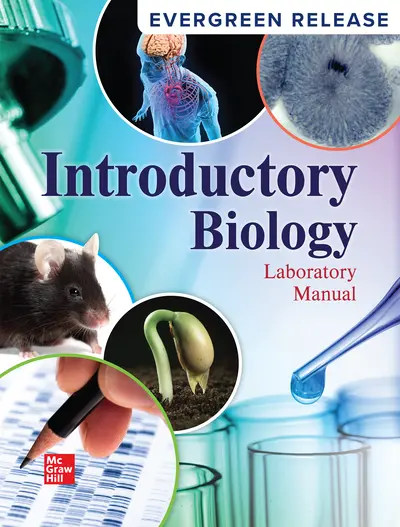
The laboratory exercises in Introductory Biology Laboratory Manual cover the entire field of biology from an evolutionary perspective. There is a breadth of coverage that can be adapted to a variety of course orientations and designs, including a unit specifically for courses requiring human-focused labs. This lab manual can be customized to only include the specific exercises needed school-by-school.


All exercises have been tested for student interest, preparation and completion times, feasibility, and reliability of results. Directions to students are clear and follow common laboratory standards and practices.

This title includes functionality within the McGraw Hill eBook that will allow students to print text content. Enabling self-print ensures that students can access and print the most up-to-date content, complete with any new Evergreen updates. By providing students with access to the McGraw Hill eBook either standalone or within our Connect platform, students will have the ability to access this print functionality without the added cost of print materials.

McGraw Hill eBooks and digital platforms use an Evergreen delivery model with a release-centered process that makes it easy to keep courses fresh, engaging, and relevant.

Release Notes provide detailed information about new and updated content delivered with each release.

Your account requires validation. Please contact your sales representative.

UNIT I The Cell
1. Scientific Method
2. Measuring with Metric
3. Microscopy
4. Chemical Composition of Cells
5. Cell Structure and Function
6. How Enzymes Function
7. Cellular Respiration
8. Photosynthesis
UNIT II Genetics
9. Mitosis: Cellular Reproduction
10. Meiosis: Sexual Reproduction
11. Patterns of Inheritance
12. Human Genetics
13. DNA Biology and Technology
UNIT III Evolution
14. Evidence of Evolution
15. Natural Selection
UNIT IV Microbiology
16. Introduction to Microbiology
17. Bacteria and Protists
18. Fungi
UNIT V Plant Evolution and Diversity
19. Nonvascular Plants and Seedless Vascular Plants
20. Seed Plants
21. Organization of Flowering Plants
22. Water Absorption and Transport in Plants
23. Control of Plant Growth and Responses
24. Reproduction in Flowering Plants
UNIT VI Animal Evolution and Diversity
25. Essentials of Invertebrates
26. Invertebrates
27. Invertebrate Coelomates
28. The Vertebrates
UNIT VII Comparative Animal Biology
29. Animal Organization
30. Basic Mammalian Anatomy I
31. Chemical Aspects of Digestion
32. Basic Mammalian Anatomy II
33. Homeostasis
34. The Nervous System and Senses
35. Musculoskeletal System I
36. Musculoskeletal System II
37. Development
UNIT VIII Ecology
38. Effects of Pollution on Ecosystems
39. Sampling Ecosystems
UNIT IX Human Biology
40. Scientific Method
41. Cell Structure and Function
42. Body Tissues
43. Organization of the Body
44. Cardiovascular System
45. Energy Requirements and Nutrition
46. Homeostasis
47. Nervous System and Senses
48. Reproduction and Development
49. Mitosis and Meiosis
Appendices
A- Preparing a Laboratory Report
B- Metric System
Index

Accessibility

Creating accessible products is a priority for McGraw Hill. We make accessibility and adhering to WCAG AA guidelines a part of our day-to-day development efforts and product roadmaps.

For more information, visit our accessibility page, or contact us at accessibility@mheducation.com

Need support?   We're here to help - Get real-world support and resources every step of the way.

Top