* The estimated amount of time this product will be on the market is based on a number of factors, including faculty input to instructional design and the prior revision cycle and updates to academic research-which typically results in a revision cycle ranging from every two to four years for this product. Pricing subject to change at any time.

Instructor Quick Actions

Get eBook Access Get access as soon as you validate!
Request a Print Sample Get a copy as soon as validated.
Contact a Rep Find a local rep best suited for you.
Find Rep

Product Information

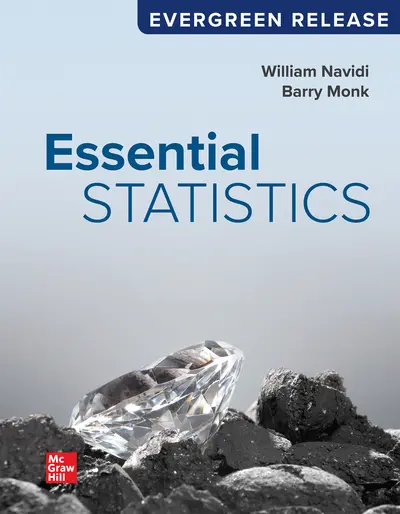
Essential Statistics is designed for an introductory course in statistics. The mathematical prerequisite is basic algebra. In addition to presenting the mechanics of the subject, the authors have endeavored to explain the concepts behind them in a straightforward, clear, and engaging writing style. As practicing statisticians, the authors have done everything possible to ensure that the material is accurate and correct. This text will enable instructors to explore statistical concepts in depth yet remain easy for students to read and understand.

1. Basic Ideas
2. Graphical Summaries of Data
3. Numerical Summaries of Data
4. Probability
5. Discrete Probability Distributions
6. The Normal Distribution
7. Confidence Intervals
8. Hypothesis Testing
9. Inferences on Two Samples
10. Tests with Qualitative Data
11. Correlation and Regression

About the Author

William Navidi

William Navidi received a B.A. in mathematics from New College, an M.A in mathematics from Michigan State University, and a Ph.D. in statistics from the University of California at Berkeley. Dr. Navidi is a professor of applied mathematics and statistics at the Colorado School of Mines in Golden, Colorado. He began his teaching career at the County College of Morris in Dover, New Jersey. He has taught mathematics and statistics at all levels, from developmental through the graduate level. Dr. Navidi has written two engineering statistics textbooks for McGraw-Hill and has authored more than 50 research papers, both in statistical theory and in a wide variety of applications, including computer networks, epidemiology, molecular biology, chemical engineering, and geophysics.

Barry Monk

Barry Monk received a B.S. in mathematical statistics, an M.A. in mathematics specializing in optimization and statistics, and a Ph.D. in applied mathematics, all from the University of Alabama. Dr. Monk is a professor of mathematics at Middle Georgia State University in Macon, Georgia, where he has been employed since 2001. Dr. Monk was asked to serve as program coordinator of mathematics after only two years at Macon State College; he led the development of the bachelor's degree in mathematics program and the organization of the Southeastern Scholarship Conference on E-Learning for more than 10 years. He has been teaching introductory statistics since 1992 in the classroom and online.

Ways of reading

  • No information about appearance modifiability is available.
  • Not all of the content will be readable as read aloud speech or dynamic braille.
  • Has alternative text descriptions for images.
  • No information about prerecorded audio is available.

Conformance

This publication claims to meet EPUB Accessibility 1.1 Web Content Accessibility Guidelines (WCAG) 2.2 Level AA.

Navigation

  • Table of contents to all chapters of the text via links
  • Index with links to referenced entries
  • Elements such as headings, tables, etc for structured navigation

Rich content

  • Math formulas in accessible format (MathML)
  • Information-rich images are described by extended descriptions

Hazards

  • No information is available.

Accessibility summary

  • Boxed sidebars are marked as complementary regions (asides) to aid navigation. In-text references to figures, sections, and pages are linked for easy access however, there are no back links provided. Tables are properly marked up for screen reader compatibility, including summaries for complex tables. Where features that are usually not announced by screen readers (SR), such as punctuation or styling, are essential for understanding the content those features are called out in SR-only text.

Legal considerations

  • No information is available.

Additional accessibility information

  • Color is not the sole means of conveying information
  • Page breaks included

Need support?   We're here to help - Get real-world support and resources every step of the way.

Top