* The estimated amount of time this product will be on the market is based on a number of factors, including faculty input to instructional design and the prior revision cycle and updates to academic research-which typically results in a revision cycle ranging from every two to four years for this product. Pricing subject to change at any time.

Instructor Quick Actions

Get eBook Access Get access as soon as you validate!
Request a Print Sample Get a copy as soon as validated.
Contact a Rep Find a local rep best suited for you.
Find Rep

Product Information

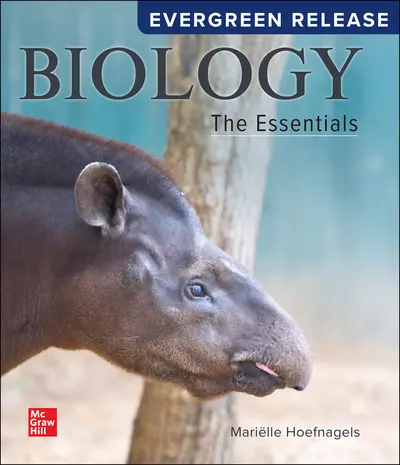
Biology: The Essentials epitomizes what the market has come to recognize as Mariëlle Hoefnagels’s distinct and student-friendly writing style. Mariëlle presents up-to-date information through What's the Point?, Why We Care, Burning Questions, Get the Picture, and Scientific Literacy features, which are pedagogical tools designed to demonstrate to readers that biology is everywhere. Survey the Landscape and Pull It Together concept maps illustrate the connections within each unit and chapter. Biology: The Essentials offers a broader and more conceptual introduction to biology, simplifying the more complex biological content to the essential elements that introductory students need.

McGraw Hill eBooks and digital platforms use an Evergreen delivery model with a release-centered process that makes it easy to keep courses fresh, engaging, and relevant.

Release Notes provide detailed information about new and updated content delivered with each release.

Your account requires validation. Please contact your sales representative.

Unit 1: Science, Chemistry, and Cells
1. Scientific Study of Life
2. The Chemistry of Life
3. Cells
4. The Energy of Life
5. Photosynthesis
6. Respiration and Fermentation
Unit 2: DNA, Inheritance, and Biotechnology
7. DNA Structure and Gene Function
8. DNA Replication, Binary Fission, and Mitosis
9. Sexual Reproduction and Meiosis
10. Patterns of Inheritance
11. DNA Technology
Unit 3: Evolution and Diversity
12. Forces of Evolutionary Change
13. Evidence of Evolution
14. Speciation and Extinction
15. Evolution and Diversity of Microbial Life
16. Evolution and Diversity of Plants
17. Evolution and Diversity of Animals
Unit 4: Ecology
18. Populations
19. Communities and Ecosystems
20. Preserving Biodiversity
Unit 5: Plant Anatomy and Physiology
21. Plant Form and Function
22. Reproduction and Development of Flowering Plants
Unit 6: Animal Anatomy and Physiology
23. Animal Tissues and Organ Systems
24. The Nervous System and the Senses
25. The Endocrine System
26. The Skeletal and Muscular Systems
27. The Circulatory and Respiratory Systems
28. The Digestive and Urinary Systems
29. The Immune System
30. Animal Reproduction and Development

About the Author

Mariëlle Hoefnagels

Mariëlle Hoefnagels is Professor Emerita in the School of Life Sciences at the University of Oklahoma, where she taught courses in introductory biology, mycology, and science writing. She also frequently gave presentations on study skills and related topics to student groups across campus. She received the University of Oklahoma General Education Teaching Award, the Longmire Prize (the Teaching Scholars Award from the College of Arts and Sciences), and the Holden Faculty Award (to recognize outstanding faculty who teach freshmen and sophomores). She was also awarded honorary memberships in several student honor societies. Dr. Hoefnagels received her BS in environmental science from the University of California at Riverside, her MS in soil science from North Carolina State University, and her PhD in plant pathology from Oregon State University. Her dissertation work focused on the use of bacterial biological control agents to reduce the spread of fungal pathogens on seeds. In addition to authoring Biology: The Essentials and Biology: Concepts and Investigations, her scholarly publications focused on creating investigative teaching laboratories and integrating technology into introductory biology classes. She also maintains a blog on teaching nonmajors biology.

Ways of reading

  • No information about appearance modifiability is available.
  • Not all of the content will be readable as read aloud speech or dynamic braille.
  • Has alternative text descriptions for images.
  • No information about prerecorded audio is available.

Conformance

This publication claims to meet EPUB Accessibility 1.1 Web Content Accessibility Guidelines (WCAG) 2.2 Level AA.

Navigation

  • Table of contents to all chapters of the text via links
  • Index with links to referenced entries
  • Elements such as headings, tables, etc for structured navigation

Rich content

  • Math formulas in accessible format (MathML)
  • Chemical formulas in accessible format (MathML)
  • Information-rich images are described by extended descriptions

Hazards

  • No information is available.

Accessibility summary

  • For pedagogical reasons, certain images may not meet required contrast ratios. Boxed sidebars are marked as complementary regions (asides) to aid navigation. In-text references to figures, sections, and pages are linked for easy access however, there are no back links provided. Tables are properly marked up for screen reader compatibility, including summaries for complex tables. Where features that are usually not announced by screen readers (SR), such as punctuation or styling, are essential

Legal considerations

  • No information is available.

Additional accessibility information

  • Page breaks included

affordability icon

Affordability

Reduce course material costs for your students while still providing full access to everything they need to be successful. It isn't too good to be true - it's Inclusive Access.

Need support?   We're here to help - Get real-world support and resources every step of the way.

Top