* The estimated amount of time this product will be on the market is based on a number of factors, including faculty input to instructional design and the prior revision cycle and updates to academic research-which typically results in a revision cycle ranging from every two to four years for this product. Pricing subject to change at any time.

Instructor Quick Actions

Get eBook Access Get access as soon as you validate!
Request a Print Sample Get a copy as soon as validated.
Contact a Rep Find a local rep best suited for you.
Find Rep

Product Information

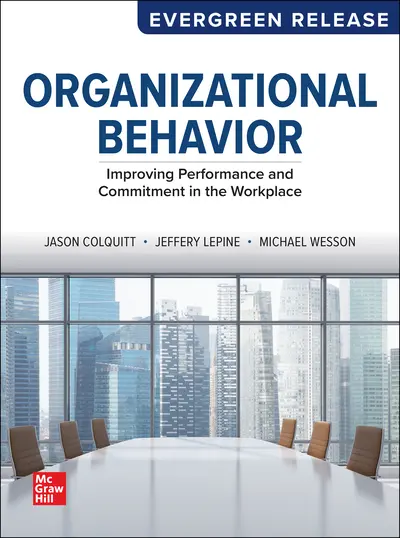
Colquitt, LePine, and Wesson’s, Organizational Behavior continues to offer a novel approach that uses an integrative model to illustrate how individual, team, leader, and organizational factors shape employee attitudes—and how those attitudes impact job performance and organizational commitment. This model reminds students where they are, where they've been, and where they're going while elevating two topics that receive less coverage in other books: job performance and organizational commitment. The text also continues to include features that encourage students to see OB concepts playing out all around them, such as OB on Screen, OB at the Bookstore, and OB Assessments.

McGraw Hill eBooks and digital platforms use an Evergreen delivery model with a release-centered process that makes it easy to keep courses fresh, engaging, and relevant.

Release Notes provide detailed information about new and updated content delivered with each release.

Your account requires validation. Please contact your sales representative.

PART 1: INTRODUCTION TO ORGANIZATIONAL BEHAVIOR
1.  What Is Organizational Behavior? 
2.  Job Performance 
3.  Organizational Commitment

PART 2: INDIVIDUAL MECHANISMS
4.  Job Satisfaction
5.  Stress
6.  Motivation
7.  Trust, Justice, and Ethics
8.  Learning and Decision Making 

PART 3: INDIVIDUAL CHARACTERISTICS
9.  Personality and Cultural Values
10. Ability 

PART 4: GROUP MECHANISMS
11. Teams: Characteristics and Diversity
12. Teams: Processes and Communication
13. Leadership: Power and Negotiation
14. Leadership: Styles and Behaviors
 
PART 5: ORGANIZATIONAL MECHANISMS
15. Organizational Structure
16. Organizational Culture 

About the Author

Jason A. Colquitt

Jason A. Colquitt is the Franklin D. Schurz Professor in the Department of Management & Organization at the University of Notre Dame’s Mendoza College of Business. He previously served as a faculty member at the University of Georgia and the University of Florida. Professor Colquitt received his Ph.D. from Michigan State University’s Eli Broad College of Business and earned his B.S. in Psychology from Indiana University. His research interests include justice, trust, work meaning, and personality. He has published almost fifty articles on these and other topics in Academy of Management Journal, Academy of Management Review, Journal of Applied Psychology, and Organizational Behavior and Human Decision Processes, among other outlets. He is a past Editor-in-Chief of Academy of Management Journal and previously served as an Associate Editor for that journal. Professor Colquitt is currently serving on the editorial boards of Academy of Management Journal, Academy of Management Review, and Administrative Science Quarterly. He is a recipient of the Society for Industrial and Organizational Psychology’s Distinguished Early Career Contributions Award and the Cummings Scholar Award for early to mid-career achievement, sponsored by the Organizational Behavior division of the Academy of Management. He also authors one of the top-selling organizational behavior textbooks, now in its seventh edition.

Jeffery A. LePine

Jeffery A. LePine is the PetSmart Chair in Leadership in the Department of Management at Arizona State University’s W.P. Carey School of Business. He received his PhD in Organizational Behavior from the Eli Broad Graduate School of Management at Michigan State University. He also earned an MS in Management from Florida State University and a BS in Finance from the University of Connecticut. He has taught organizational behavior, human resource management, and management of groups and teams at undergraduate and graduate levels.

Michael J. Wesson

Michael J. Wesson is Professor of Management in Auburn University’s Raymond J. Harbert College of Business. He received his PhD from Michigan State University’s Eli Broad Graduate School of Management. He also holds an MS in human resource management from Texas A&M University and a BBA from Baylor University. He was previously on faculty at Texas A&M University. He has taught organizational behavior and human resource management–
based classes at the undergraduate, graduate, executive, and doctoral levels. He has received awards for teaching excellence both at the college and university levels. He is currently chair of the management department at Harbert. Michael’s research interests include organizational justice, leadership, organizational entry (employee recruitment, selection, and socialization), person–organization fit, and compensation and benefits. His articles have been published in journals such as Journal of Applied Psychology, Personnel Psychology, Academy of Management Review, and Organizational Behavior and Human Decision Processes. He has served on several editorial boards and has been an ad hoc reviewer for many others. He is active in the Academy of Management and the Society for Industrial and Organizational Psychology. Prior to returning to school, Michael worked as a human resources manager for a Fortune 500 firm. He has served as a consultant to the automotive supplier, health care, oil and gas, and technology industries in areas dealing with recruiting, selection, onboarding, compensation, and turnover. Michael spends most of his time trying to keep up with his wife, Liesl, and son, Dylan. He is a self-admitted food and wine snob, supporter of the performing arts, and a college sports addict.

Ways of reading

  • No information about appearance modifiability is available.
  • Not all of the content will be readable as read aloud speech or dynamic braille.
  • Has alternative text descriptions for images.
  • No information about prerecorded audio is available.

Conformance

This publication claims to meet EPUB Accessibility 1.1 Web Content Accessibility Guidelines (WCAG) 2.2 Level AA.

Navigation

  • Table of contents to all chapters of the text via links
  • Index with links to referenced entries
  • Elements such as headings, tables, etc for structured navigation

Rich content

  • Information-rich images are described by extended descriptions

Hazards

  • The publication contains no hazards.

Accessibility summary

  • Boxed sidebars are marked as complementary regions (asides) to aid navigation. In-text references to figures, sections, and pages are linked for easy access however, there are no back links provided. Tables are properly marked up for screen reader compatibility, including summaries for complex tables. Where features that are usually not announced by screen readers (SR), such as punctuation or styling, are essential for understanding the content those features are called out in SR-only text.

Legal considerations

  • No information is available.

Additional accessibility information

  • Color is not the sole means of conveying information
  • Page breaks included

affordability icon

Affordability

Reduce course material costs for your students while still providing full access to everything they need to be successful. It isn't too good to be true - it's Inclusive Access.

Need support?   We're here to help - Get real-world support and resources every step of the way.

Top