ISBN10: 1264785526 | ISBN13: 9781264785520

ISBN10: 1264785526
ISBN13: 9781264785520

* The estimated amount of time this product will be on the market is based on a number of factors, including faculty input to instructional design and the prior revision cycle and updates to academic research-which typically results in a revision cycle ranging from every two to four years for this product. Pricing subject to change at any time.

Instructor Quick Actions

Get eBook Access Get access as soon as you validate!
Request a Print Sample Get a copy as soon as validated.
Contact a Rep Find a local rep best suited for you.
Find Rep

Product Information

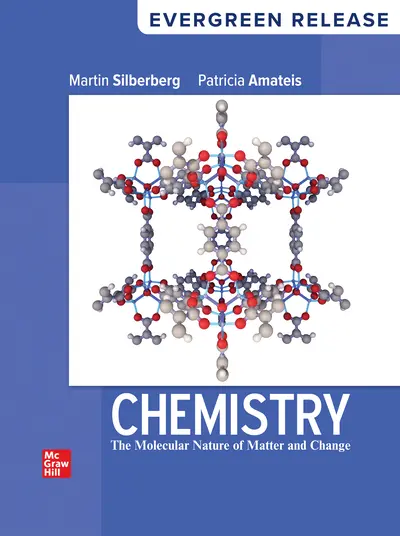
Silberberg's Chemistry: The Molecular Nature of Matter andChange maintains its standard-setting position amonggeneral chemistry textbooks by evolving further to meet theneeds of educators and learners. The text uses the mostaccurate molecular illustrations, consistent step-by-stepworked problems, and an extensive collection ofend-of-chapter problems. Revisions throughout the textmake it more readable and succinct, the artwork moreteachable and modern, and the design more focused andinviting. Improvements to both visualizing chemical modelsand how to logically solve problems, updates to ChemicalConnections essays showing real world applications, andrevised study aids at the end of each chapter continue tomake Chemistry: The Molecular Nature of Matter andChange a market leader. The text is strengthened by itsoffering in ALEKS, featuring Custom Question Authoring,Video Assignments, Virtual Labs, and more!

1. Keys to the Study of Chemistry: Definitions, Units, andProblem Solving
2. The Components of Matter
3. Stoichiometry of Formulas and Equations
4. Three Major Classes of Chemical Reactions
5. Gases and the Kinetic-Molecular Theory
6. Thermochemistry: Energy Flow and Chemical Change
7. Quantum Theory and Atomic Structure
8. Electron Configuration and Chemical Periodicity
9. Models of Chemical Bonding
10. The Shapes of Molecules
11. Theories of Covalent Bonding
12. Intermolecular Forces: Liquids, Solids, and Phase Changes
13. The Properties of Mixtures: Solutions and Colloids
14. Periodic Patterns in the Main-Group Elements
15. Organic Compounds and the Atomic Properties of Carbon
16. Kinetics: Rates and Mechanisms of Chemical Reactions
17. Equilibrium: The Extent of Chemical Reactions
18. Acid-Base Equilibria
19. Ionic Equilibria in Aqueous Systems
20. Thermodynamics: Entropy, Free Energy, andReaction Direction
21. Electrochemistry: Chemical Change and Electrical Work
22. The Elements in Nature and Industry
23. Transition Elements and Their Coordination Compounds
24. Nuclear Reactions and Their Applications


Available Online Only
1. Advanced Topics: Chapter 7A Quantum Theory andAtomic Structure
2. Advanced Topics: Chapter 16A Kinetics: Rates andMechanisms of Chemical Reactions
3. Advanced Topics: Chapter 20A Thermodynamics: Entropy,Free Energy, and Reaction Direction

About the Author

Martin Silberberg

Martin S. Silberberg received his B.S. in chemistry from the City University of New York in 1966 and his Ph.D. in chemistry from the University of Oklahoma, in 1971.  He then accepted a research position at the Albert Einstein College of Medicine, where he studied the chemical nature of neurotransmission and Parkinson's disease.  In 1977, Dr. Silberberg joined the faculty of Simon's Rock College of Bard (Massachusetts), a liberal arts college known for its excellence in teaching small classes of highly motivated students.  As Head of the Natural Sciences Major and Director of Premedical Studies, he taught courses in general chemistry, organic chemistry, biochemistry, and nonmajors chemistry.  The close student contact afforded him insights into how students learn chemistry, where they have difficulties, and what strategies can help them succeed.  In 1983, Dr. Silberberg decided to apply these insights in a broader context and established a text writing and editing company.  Before writing his own text, he worked on chemistry, biochemistry, and physics texts for several major college publishers.  He resides with his wife and child in Massachusetts.  For relaxation, he cooks, sings, and walks in the woods.

Patricia Amateis

Patricia Amateis graduated with a B.S. in Chemistry Education from Concord University in West Virginia and a PhD in Analytical Chemistry from Virginia Tech. She has been on the faculty of the Chemistry Department at Virginia Tech for 28 years, teaching General Chemistry and Analytical Chemistry. For the past 13 years, she has served as Director of General Chemistry, responsible for the oversight of both the lecture and lab portions of the large General Chemistry program. She has taught thousands of students during her career and has been awarded the University Sporn Award for Introductory Teaching, the Alumni Teaching Award, and the William E. Wine Award for a history of university teaching excellence. She and her husband live in Blacksburg, Virginia and are the parents of three adult children. In her free time, she enjoys biking, hiking, competing in the occasional sprint triathlon, and playing the double second in Panjammers, Blacksburg’s steel drum band.

Need support?   We're here to help - Get real-world support and resources every step of the way.

Top