The Imposter Phenomenon: Why Accomplished People Doubt Themselves and What to Do About It
Even highly capable professionals can discount achievement, question competence, and anticipate failure. Understanding why this happens is the first step toward managing the impostor phenomenon effectively.
- Higher Education
- Article
- Blog
- Leadership Today

Have you ever stepped into a new role or situation and wondered, “Am I really good enough? Do I really belong here?” You are not alone. Many capable and accomplished people experience intense self-doubt despite clear evidence of competence. This experience is commonly referred to as the impostor phenomenon (IP).
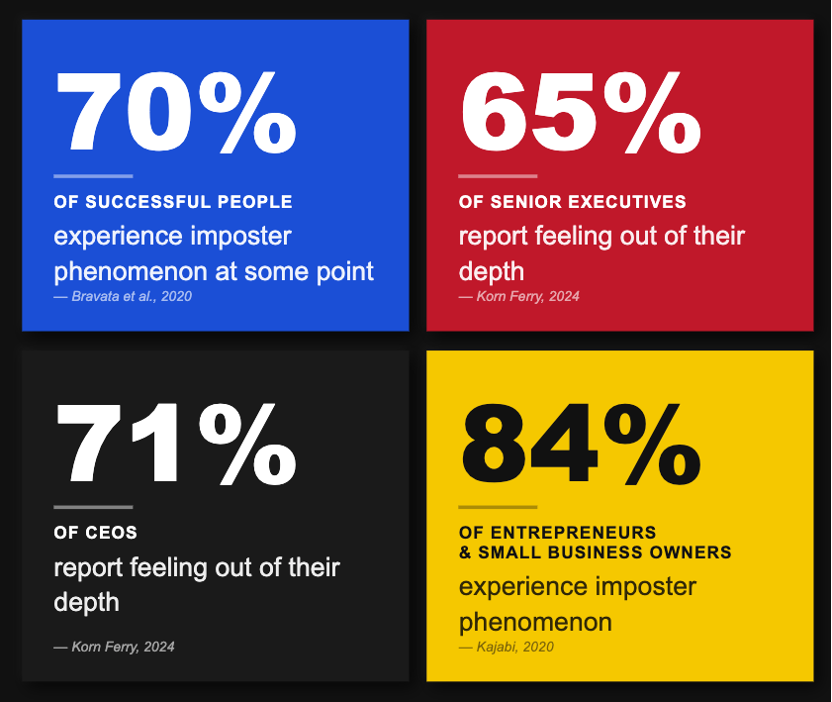
These feelings can arise regardless of position, level of experience, or workplace context and often lead people to attribute their success to luck or timing rather than ability. IP is far from rare; research shows that over 70% of successful people experience it at some point in their lives.
IP is not a medical condition, and it is not simply self-doubt. IP reflects patterns of thoughts, feelings, and behaviors that develop in response to context and experience.1
Understanding the Impostor Phenomenon
Originally defined by Pauline Rose Clance and Suzanne A. Imes in 1978, IP refers to a recurring pattern of self-doubt in which high achieving individuals question their accomplishments and fear exposure as a fraud.2
Patterns of insecurity often begin with self-doubt, progress to intellectual paralysis, and ultimately result in emotional paralysis. The impostor phenomenon is the modern label assigned to that progression.
Except for hardcore narcissists, all humans have insecurities. Insecurity is not evidence of inadequacy. It is evidence of humanity. The decisive question is not whether one experiences self-doubt. It is whether one grants self-doubt authority over action.
Despite objective evidence of competence, individuals caught in the IP cycle continue to discount their achievements and anticipate failure. IP has been documented across genders, roles, and career stages.3
IP can appear in leadership contexts, with 65% of senior executives and 71% of CEOs describing feelings of being out of their depth, and 84% of entrepreneurs and small business owners reporting impostor-related self-doubt. Together, these findings suggest that IP can affect people across a wide range of professional roles and levels of responsibility.1,3,4,5
Who Experiences the Impostor Phenomenon? You are not alone…
If you experience IP, you are not imagining it. Younger individuals report higher levels than older adults, which may reflect differences in experience and familiarity with workplace norms. First-generation college students and those entering professional roles commonly describe feeling as though they do not fully fit or belong. Early career professionals may feel as though they are performing rather than belonging, and that uncertainty can lead them to question whether they are ready to lead. In contrast, when people develop a sense of belonging in their roles, they are often more willing to contribute fully and grow into leadership over time.6
IP is a condition that can be managed and transcended. The following are musings from an influential role model, a thought-leader, and a poet:
- "No one can make you feel inferior without your consent." — Eleanor Roosevelt
- "If an inferiority is conscious, there is a chance to correct it. But if it’s repressed and isolated from consciousness, it never gets corrected." — Carl Jung
- "Every man has his secret sorrows which the world knows not."— Henry Wadsworth Longfellow
At what point does the impostor phenomenon become an impediment to judgment, performance, achievement, and fulfillment? More importantly, what can be done about it?
Strategies for Managing IP
Create an action plan to address the Impostor Phenomenon. Incorporate any or all of the following strategies into your plan.
- Gain complete clarity regarding who you are, what you stand for, and what you represent: This is not a theoretical exercise. It’s a prerequisite to presenting yourself as a genuine, credible, and thoughtfully developed individual.
- Separate facts from feelings: Feelings are real, but they are not always accurate. Measure yourself against evidence, outcomes, and demonstrated capability rather than temporary narratives generated by self-doubt.
- Talk with trusted family and friends: Share your feelings with people who can offer encouragement, perspective, and reassurance when self-doubt begins to take hold.
- Reflect on your accomplishments: Keep a record of your achievements, positive feedback, and milestones. Revisit that evidence regularly to remind yourself of what you have accomplished.
- Enlist a coach or mentor: Connect with someone through your organization or professional network who understands your strengths and can help you work through impostor feelings.
- Build undeniable competence: Genuine expertise remains one of the most effective antidotes to imposter phenomenon. Commit to continuous learning, deliberate practice, and mastery of your craft until confidence rests on substance rather than hope.
- Focus on Service: Think about how important your message or service is. Concentrate on how you can help others in meaningful ways.
- Engage in leadership development: Participate in leadership development opportunities. These experiences can strengthen confidence in your skills while also increasing your visibility to your manager and others in leadership positions.
- Continue building your expertise: Develop your knowledge and skills over time and as a way of life to prepare for future opportunities. Greater preparation and deeper expertise can reinforce confidence and help reduce feelings of IP.
- Act despite uncertainty: Few accomplished people proceed with complete confidence. They proceed with sufficient confidence. Progress belongs not to those who eliminate doubt, but to those who refuse to grant it authority over action.
THE IMPORTANCE OF SELF IMAGE
Despite publishing eleven books and becoming one of the most celebrated writers of her generation, Maya Angelou admitted: "I have written eleven books, but each time I think, 'Uh oh, they are going to find out now. I have run a game on everybody, and they are going to find me out.'"
Author Neil Gaiman described attending a gathering of exceptionally accomplished individuals and feeling that he did not belong. During the event he confided those feelings to another attendee, only to discover later that the man was Neil Armstrong, the first person to walk on the Moon. Armstrong reportedly shared similar feelings of not belonging, reinforcing Gaiman's conclusion that self-doubt often accompanies achievement rather than disproves it.
Self-doubt is a poor judge of capability. It told Maya Angelou she was a fraud after eleven books. It whispered to Neil Armstrong that he did not belong after walking on the Moon. Fortunately, neither granted it authority. Nor should you.
Icons in every field of endeavor have experienced the imposter phenomenon and managed it successfully. For example, Dolly Parton spoke openly about self-doubt even after achieving enormous professional success. She described periods in which she questioned whether she was good enough or belonged at the level she had reached. She talked about feeling intimidated when she was surrounded by highly successful people.
Through sense of purpose, concern for others, talent, determination and courage, Dolly Parton prevailed and overcame the imposter syndrome. A letter written by organized labor celebrates her life and legacy:
Organized labor is celebrating the life and legacy of an artist who championed working women and carried a union card for almost 60 years. Workers everywhere knew what Parton meant when she sang about “barely gettin’ by, it’s all takin’ and no givin’,” and complained, “They just use your mind and they never give you credit. It’s enough to drive you crazy if you let it.”
Dolly Parton knew what it was like to struggle as she fought for working families throughout her whole career. From providing free books to kids, to giving working women a ‘9 to 5’ anthem, she was an icon and inspiration. Before she was an icon, Dolly was a working musician, and she never forgot the musicians who helped bring her music to life. By standing firm for solidarity and treating every player with dignity, she elevated the entire profession.
Her legacy of joy and creativity had an indescribable impact on the world. As a singer, songwriter, performer, business leader and all-around visionary, Dolly Parton’s talent is revered across generations. Her love of people is known to the world, and she is beloved in return by countless millions.
She put books in the hands of millions of children through the Imagination Library, stood up for people being treated unfairly, and modeled understanding and respect for all people regardless of position, power, or influence. Dolly Parton is a national treasure and a patron saint to working people everywhere who declare, “After all, her song ‘9 to 5’ is our anthem.”7
ASSIGNMENT
Discuss the Impostor Phenomenon with others. Who has experienced it personally? What has been helpful in overcoming IP? Share experiences and suggestions.
LEARN MORE ABOUT IMPOSTER PHENOMENON
Atkin, Kate (2025). The Imposter Phenomenon. Pearson.
Cokley, Kevin (2024). The Impostor Phenomenon: Psychological Research, Theory, and Interventions. American Psychological Association.
Stoddard, J. (2023). Imposter No More: Overcome Self-Doubt and Imposterism to Cultivate a Successful Career. Balance.
- Bravata, D. M., Watts, S. A., Keefer, A. L., Madhusudhan, D. K., Taylor, K. T., Clark, D. M., & Hagg, H. K. (2020). Prevalence, predictors, and treatment of impostor syndrome: a systematic review. Journal of general internal medicine, 35(4), 1252-1275.
- Clance, P. R., & Imes, S. A. (1978). The imposter phenomenon in high achieving women: Dynamics and therapeutic intervention. Psychotherapy: Theory, Research & Practice, 15(3), 241.
- KPMG (2020) Women’s leadership summit report.
- Kajabi. (2020, November 23). Kajabi releases study on impostor syndrome in the business community. GlobeNewswire.
- Korn Ferry (2024). Workforce 2024 Global Insights Report.
- Jansen, K., & Rawlings, M. (2022). Determining leadership potential: Powerful insights to winning at the talent game. Routledge.
- Nichols, John. (2026) “Dolly Parton Was a Proud Union Sister.” The Nation.

George Manning is a professor emeritus of psychology at Northern Kentucky University. He is a consultant to business, industry, and government, serving such clients as the AMA, AT&T, General Electric, IBM, Duke Energy, the United Auto Workers, Young Presidents’ Organization, the U.S. Navy, and the National Institutes of Health. He lectures on economic and social issues, including quality of work-life, workforce values, and business ethics. He maintains an active program of research and writing in organizational psychology. His current studies and interests include the changing meaning of work, leadership ethics, and coping skills for personal and social change.