250 Years of the Pursuit of Happiness
Why did Jefferson replace "property" with "happiness"? The answer reveals the soul of America and a challenge for the next 250 years.
- Higher Education
- Article
- Blog
- Leadership Today
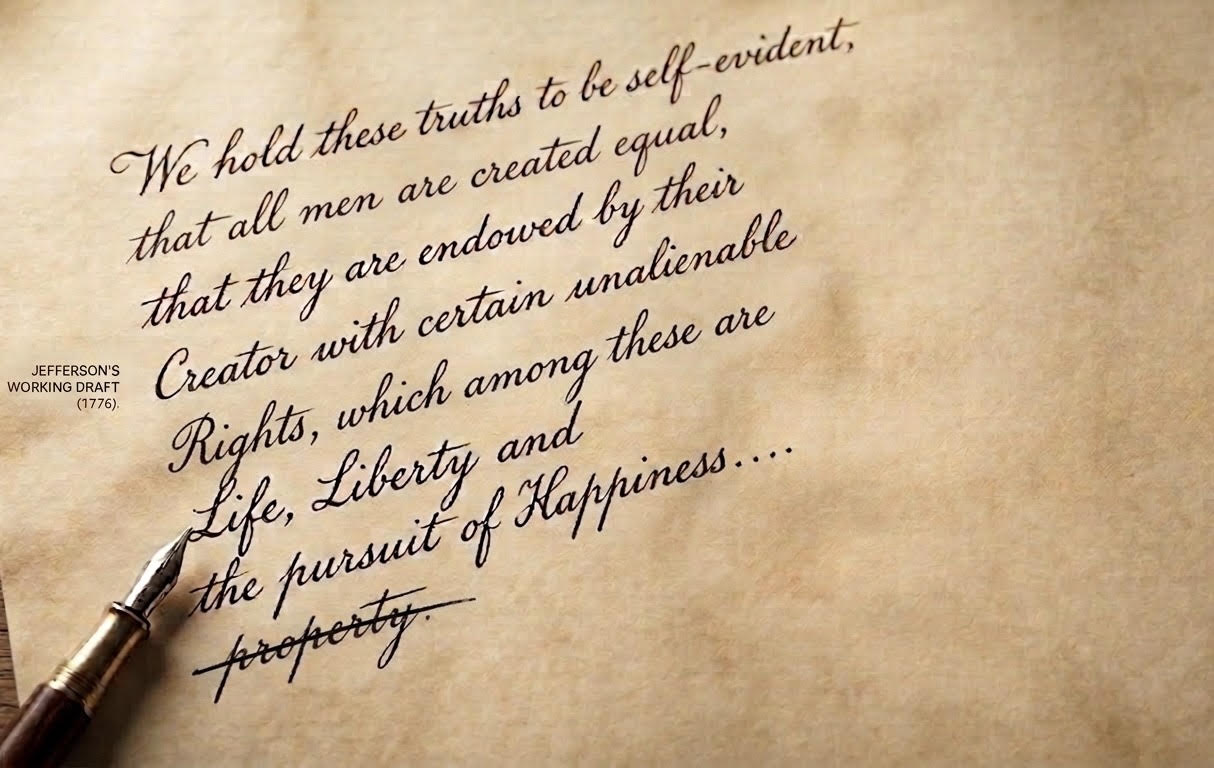
On July 4, 1776, Thomas Jefferson chose three words that would echo across the centuries: the pursuit of happiness.
We can wonder whether he knew what he was setting in motion.
Those three words would become more than a political principle. They would become one of the defining ideas of the American experiment.
Jefferson's choice was deliberate. John Locke, whose political philosophy strongly influenced the founders, had argued that governments exist to protect the natural rights of life, liberty, and property. Jefferson made a remarkable substitution. He replaced "property" with "the pursuit of happiness."
It was a subtle change. It proved to be a profound one.
Happiness
The beauty of Jefferson's phrase is that he never defined happiness. He left every generation with the responsibility—and the privilege—of answering that question for itself.
The idea itself was hardly new. For more than two thousand years, philosophers had wrestled with the meaning of happiness. Aristotle saw it not as pleasure but as eudaimonia—human flourishing achieved through virtue and purposeful living. Marcus Aurelius saw it as the product of reflection and right living. Medieval thinkers viewed ultimate happiness as union with God. Enlightenment philosophers shifted the conversation toward liberty as the backdrop and condition for happiness, arguing that governments should protect people's freedom to seek fulfillment according to their own conscience.
The great philosophers of the past never defined happiness as a mere positive affect or emotion, ranging from a subtle sense or pleasantness to a giddy exuberance. To the deeper analysts of human life, happiness is not just a mood, but a mode of living and being.
Jefferson inherited that long conversation and transformed the pursuit of this mode of being into a political ideal.
Over the next 250 years, Americans would give "happiness" many meanings.
For some, it meant opportunity.
For others, it meant owning land, building a business, raising a family, or educating their children.
For immigrants arriving with little more than hope, it became the promise that the future did not have to resemble the past.
During the twentieth century, it evolved into what became known as the American Dream—a belief that through hard work and perseverance, ordinary people could improve their lives.
More recently, many have expanded the definition to include purpose, creativity, meaningful work, positive relationships, and personal fulfillment.
Perhaps that was Jefferson's greatest insight. By refusing to define happiness, he ensured that the idea could evolve with each generation and each person.
The history of the pursuit of happiness is really the history of changing ideas about what it means to live a good life. Ancient philosophers emphasized virtue, medieval thinkers emphasized salvation, enlightenment philosophers emphasized liberty, and contemporary thinkers often combine happiness with peace of mind and psychological well-being.
The Pursuit
Jefferson was not promising happiness. He was declaring that every person has the freedom to pursue it without unjust interference from government. And in eighteenth century English usage, to pursue happiness was not to chase it or seek it so much as to engage in a practice of it as an activity or, as we’ve mentioned, a mode of living.
Many Americans in the nineteenth and early twentieth centuries willingly—or out of necessity—worked extraordinarily long hours, sometimes 70 or even 80 hours a week, believing that hard work could build a better life.
Did Jefferson foresee that those three words would become more than a political principle—that they would help define a culture and its people? Perhaps Jefferson did not create the American Dream. But he gave it one of its most enduring expressions.
The first 250 years posed a profound question: Are people free to pursue happiness? America answered yes—through every immigrant who arrived with little more than hope and built a life their parents could scarcely have imagined.
Jefferson did not invent ambition, nor did he articulate what others would later think of as the American Dream. But he gave both a moral and political foundation. By declaring that every individual possessed the right to pursue happiness, he elevated the quest for a better life from a mere personal aspiration to a national ideal.
He planted an idea.
An idea that tomorrow could be better than today.
An idea that ordinary people were not bound by the circumstances of their birth.
An idea that hard work, education, enterprise, and ingenuity could transform lives.
An idea that people could begin again.
Think about what then happened over 250 years. America became a nation of inventors, entrepreneurs, scientists, artists, philanthropists, explorers, and builders. It founded great universities, pioneered medical breakthroughs, explored space, connected the world through the internet, and now leads at the dawn of the age of artificial intelligence. Millions were lifted into prosperity, not because happiness was guaranteed, but because people believed they had the freedom to pursue something better.
Shadows and Rays
Every great ideal casts both a ray and a shadow. The pursuit of happiness can become a shallow pursuit of status. The pursuit of achievement can become petty comparison. The pursuit of pleasure can become a short-term thrill. The pursuit of prosperity can create greedy desires. Success alone cannot guarantee contentment. Yet these tensions do not diminish Jefferson's insight. They simply remind us that happiness is richer than wealth and more enduring than success.
Values Shape the Pursuit of Happiness
The proper pursuit of happiness includes fulfilling one’s values. If happiness means different things to different people, what explains those differences? One answer lies in our values. Values shape the pursuit of happiness. They influence the choices we make, the goals we set, and the meaning we find in our lives.
Values are animation elements. In Latin, the word “anima” means breath or soul. Without values, a person is soulless. In The Nature of Human Values, Milton Rokeach identifies two kinds of values: terminal and instrumental. Sample terminal values are family wellbeing, career success, and personal growth. Sample instrumental values are being honest, being helpful, and being responsible.
Personal Values
All aspects and institutions of society require leaders who are competent, caring, and value based—committed to certain ideals and goals. A useful model and tool that addresses this issue is The Study of Values by Gordon Allport, Philip Vernon, and Gardner Lindsey, based on Eduard Spranger’s Types of Men. This helps explain diversity in the pursuit of happiness and helps explain the greatness of a culture that values all six value orientations.
A description of each value orientation follows:
- Theoretical. The purpose of the theoretical person is to know the truth above all other goals. In the pursuit of truth, the theoretical person prefers a cognitive approach, one that looks for identities and differences, as opposed to the beauty or utility of objects. This person's needs are to observe, reason, and understand. Because the theoretical person’s values are empirical, critical, and rational, this individual is an intellectual and frequently is a scientist or a philosopher. Major concerns of such a person are to order and systematize knowledge and to understand the meaning of life.
- Economic. The economic person is interested in what is useful. Based originally on the satisfaction of bodily needs and self-preservation, the interest in usefulness extends to the practical affairs of the business world—the production and marketing of goods and the accumulation of wealth. This type of person is enterprising and efficient, reflecting the stereotype of the average businessperson. The economic person wants education to be practical and regards unapplied knowledge as wasteful. Great feats of engineering and application result from the demands economic people make on people in science.
- Aesthetic. The aesthetic person finds highest satisfaction in form, harmony, and beauty. The value of each single experience is judged from the standpoint of grace, symmetry and fitness. The aesthetic person regards life as a procession of events, with each impression to be enjoyed for its own sake. An aesthetic person may or may not be a creative artist, but finds a chief interest in the artistic expression of life. The aesthetic person tends toward individualism and idealism in personal relations.
- Social. The highest value for this type of person is love. The altruistic or philanthropic aspect of love is the interest of the social person. The social person prizes other people as ends in and of themselves, and not as tools or means to other goals. Therefore, the social person is kind, sympathetic, and helpful toward others. Such a person may find economic and political values to be cold and inhumane. The social person regards love instead of power as the most suitable form of human relationship. In the purest form, social values are totally unselfish.
- Political. The political person is interested in power and influence. Whatever the vocation, the political person seeks to be a Machtmensch, an individual who is powerful. Leaders in any field usually will have a high interest in power and status. Because competition and struggle play a large part in all of life—between the sexes, between groups, between nations, and between individuals—many philosophers view power as the most universal and fundamental of human motives. In certain people, however, the desire for direct expression of power is uppermost.
- Religious. The highest value of this type of person is spiritual peace. A religious person may or may not belong to an organized religion; people are religious if they seek to comprehend the cosmos as a whole and to relate themselves to its embracing totality. Religious people have as their goal the creation of the highest and most satisfying value experience. Some people who are religious focus on events, people, and experiences in this world; that is, they experience meaning in the affirmation of life and active participation therein. They see something divine in every event. On the other hand, some religious people are transcendental mystics, with a few seeking to unite themselves with a higher reality by withdrawing from life. This type is ascetic, and like the holy men of India, finds inner peace and unity through meditation. In many individuals, the affirmation and negation of human existence alternate to yield the greatest value satisfaction.
No one value orientation or mix of orientations is inherently better than another. Effective leaders understand their own dominant values while recognizing that organizations and societies are strongest when all six perspectives are represented.
Leadership Assignment
After reading the six values above, make a “graphic presentation” of your personal value orientation. This can be useful in choosing a career and appreciating the perspective of others.
(Your personal value orientation)

(Sample Graph)
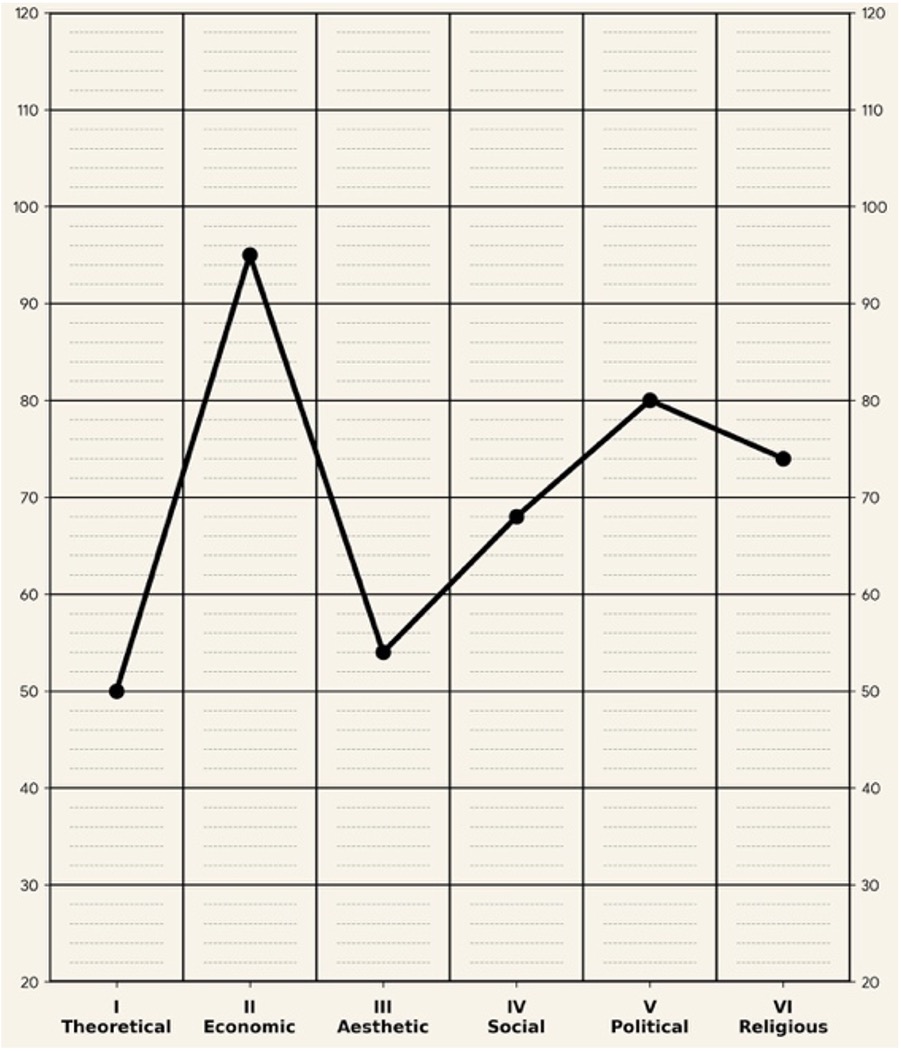
Remember that different values can enrich an individual, group, organization, and society. In this spirit, use the following thought as a guide: Our errors and our controversies in the sphere of human relations often arise from looking on people as though they could be altogether bad or altogether good.
Conclusion
As America celebrates its 250th anniversary, perhaps the most pressing question is not whether the pursuit of happiness has served us well. History suggests that it has.
The more interesting question is what the next 250 years will ask of us.
The first 250 years demonstrated what free people can build when they are allowed to pursue their dreams. The next 250 years may not require us to pursue happiness more vigorously. They may simply ask us to define it more wisely.
While Jefferson left us no definition of happiness, he left us something far more valuable: the freedom to discover it for ourselves.
That may be why those three words still resonate after 250 years.
Suggested Readings
The Righteous Mind by Jonathan Haidt
The Everyday Patriot by Tom Morris
The Declaration of Independence, The Constitution of the United States, and The Bill of Rights

George Manning is a professor emeritus of psychology at Northern Kentucky University. He is a consultant to business, industry, and government, serving such clients as the AMA, AT&T, General Electric, IBM, Duke Energy, the United Auto Workers, Young Presidents’ Organization, the U.S. Navy, and the National Institutes of Health. He lectures on economic and social issues, including quality of work-life, workforce values, and business ethics. He maintains an active program of research and writing in organizational psychology. His current studies and interests include the changing meaning of work, leadership ethics, and coping skills for personal and social change.