Pathfinder Perspectives: Looking Beyond the Screen

Educator perspectives on screen time, student attention, and learning in the age of AI


Tags: Global Insights Report, Pathfinder, Blog, Article, Corporate

Every day, educators see how technology is shaping the way students learn, connect, and engage with the world around them. While digital tools have opened new opportunities for learning, many educators are also grappling with a growing challenge: helping students build the focus, resilience, and critical thinking skills needed to succeed in an increasingly connected world.

As our CEO Philip Moyer recently wrote, the screen time debate is not simply about whether technology belongs in the classroom. It's about understanding the difference between digital experiences designed to capture attention and those designed to support learning.

The findings from McGraw Hill's 2026 Global Education Insights Report underscore why this conversation matters. Based on a survey of more than 1,300 K-12 and higher education educators across 19 countries, the report found that spending too much time on screens was reported by educators globally as the largest obstacle to student success.

To better understand what these trends look like inside real classrooms, we spoke with recipients and honorees of the McGraw Hill Pathfinder Award, a program established in 2022 to recognize educators who bring innovation, creativity, and inventiveness to teaching and learning.

Their perspectives provide valuable, firsthand insights into how technology is shaping learning today. Learn how screen time is impacting their students, the challenges that technology presents in their classrooms, and why they believe human connection in the classroom matters more than ever.

Competing for Focus in an Always-On World

In the 2026 Global Education Insights Report, screen time ranked as a higher concern globally for Higher Ed instructors, who ranked it #1, vs. PreK–12 teachers, who ranked it #2 behind challenges outside of school. Our Pathfinder Award winners and honorees help explain why screen time is such a challenge in college classrooms:

"Students are constantly competing with social media, which can reduce their ability to think critically, reflect, and engage in meaningful learning. While technology provides valuable learning opportunities, it can also make it more difficult for students to remain fully present during class." - Dr. Narissra Maria Punyanunt-Carter

In addition to social media, streaming platforms, and endless digital content competing for students' focus both in and outside the classroom, educators have also noticed a shift: students increasingly expect to access information, feedback and information quickly as a result of rapid stimulation from online activity:

"I've noticed that students, more than in the past, often expect immediate feedback and want information to make sense right away. Instant gratification has become an increasingly sought-after expectation in higher education from the student perspective. While technology can absolutely enhance learning, it must be used intentionally and accompanied by a growth mindset, as well as reinforced through traditional practice, review, and repetition." – Caycee Tyler

The Cost of Constant Connectivity

Beyond decreased attention spans, educators also described growing concerns about students' emotional well-being, resilience, and ability to navigate challenges.

The report found that 68% of educators globally are concerned about students' mental health, while managing student behavior and mental health remains educators' top challenge for the second consecutive year. 

"I see students who are more globally aware and socially conscious than any generation before them, yet more anxious and less tolerant of ambiguity and failure. Today's learners are driven by a digital environment that offers constant comparison and instant feedback but fewer opportunities to practice recovering from setbacks in a low-stakes manner.  Perhaps resilience isn't commonly thought of as a classroom competency, but we as educators can deliberately engineer more opportunities through supported struggle." - Dr. Arindam Sarkar

These themes echo observations shared by CEO Philip Moyer in his recent thought leadership article, where he noted that one of the biggest lessons from the screen time debate is that educational technology must be designed differently: to support focus, critical thinking, and meaningful learning rather than constant stimulation.

The Power of Purposeful Technology

Despite concerns about screen time, educators were careful to distinguish between technology that distracts and technology that helps students learn. Many shared examples of technology improving accessibility, increasing engagement, and providing personalized support.

For Sonja Capers, 2026 Pathfinder Winner, Paterson Public Schools, devices can be especially valuable for multilingual learners and students with special needs: 

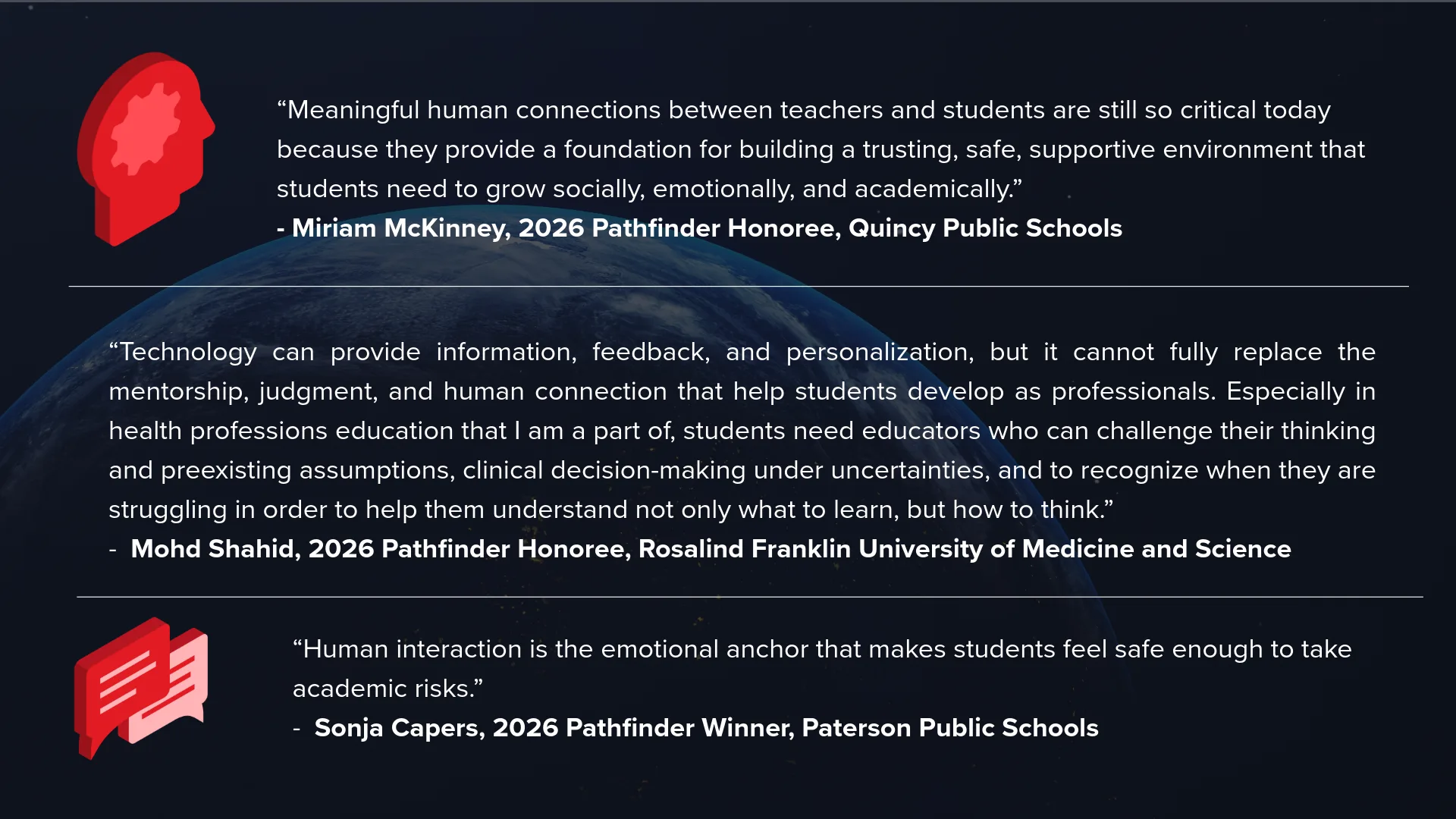
"Increased device time has boosted student engagement because it served as a safety net when used with adult guidance. It gave them immediate access to vocabulary tools and audio scaffolds, if unblocked by district, making them more independent learners and agile digital navigators." - Sonja Capers

Dr. Melissa Collins, 2024 Pathfinder Winner, John P. Freeman Optional School, noted that purposefully designed digital tools can support academic growth when used intentionally and in moderation: 

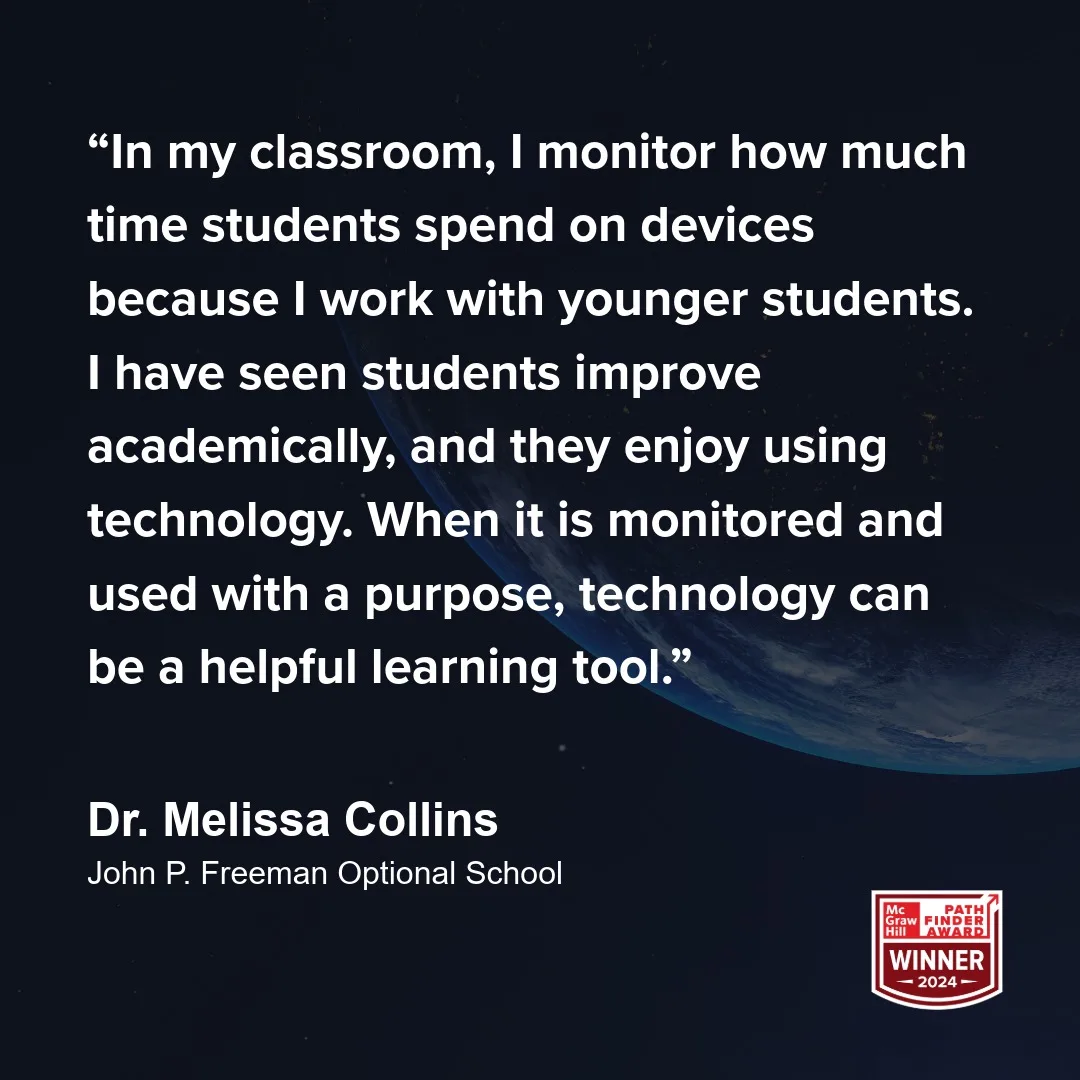
"In my classroom, I monitor how much time students spend on devices because I work with younger students. I have seen students improve academically, and they enjoy using technology. When it is monitored and used with a purpose, technology can be a helpful learning tool." - Dr. Melissa Collins

Why Human Connection Matters More Than Ever

While educators recognize the value of technology and AI, they overwhelmingly believe the most important aspects of learning remain fundamentally human, a view supported by findings from the Report where 72% of surveyed educators do not expect in-person instructional time to decline over the next decade.

A Different Path Forward

The perspectives shared by our Pathfinder Award winners and honorees remind us that the future of learning is not about choosing between technology and human connection. It is about using each where it matters most.

By focusing on purpose over screen time alone, educators can illuminate a path forward where technology enhances learning, human connection remains at the center, and every student is equipped to thrive.

And according to educators around the world, that's a future worth building. 

Related link: