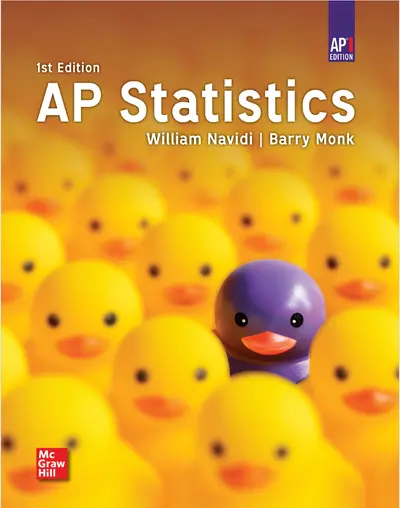
Navidi, AP Statistics, ©2027, 1e

Grades: 9 - 12

AP Statistics features the most current statistics and data, enhanced visual support, and a precise alignment to the updated AP Statistics framework. The program is organized to support the five units in the Course and Exam Description with complete coverage of the AP Topics and Statistical Practices. Case Studies and real-world data sets connect statistics to students’ everyday lives to spark curiosity and empower students to see how statistics solves real-world problems.

Program Details

This thoughtfully crafted program is designed to inspire and empower students on their journey to mastering the latest AP Statistics Framework. At the heart of AP Statistics are three guiding principles: Clarity, Quality, and Accuracy. From the first introduction of a topic to its application on the AP Exam, the program provides a seamless learning path supported by high-quality exercises, real-world examples, and AP style practice questions. Special features like AP Skills Practice and Writing in AP Statistics empower students to master the skills and task verbs essential for success on the AP Exam, addressing common challenges with confidence-building strategies. 
  • Unit and chapter content are in lock-step alignment to the organization of the course and the AP Framework’s topics, practices, and skills. 
  • The high school student-friendly design is welcoming and accessible. 
  • Multiple, engaging features offer students the chance to revisit and practice key concepts, helping them overcome common challenges with confidence. 
  • AP-style multiple choice and free response questions are available at the end of each chapter and unit to give students continuous practice with exam-style questions. 
  • Chapter- and lesson-level tools provide targeted instruction and exploration of the AP Statistical Practices. 
  • Extensive writing skills practice prepares students to excel on the Free Response Questions on the AP exam. 
  • Hands-on, real-world, data-based activities for individuals, pairs, and groups encourage collaboration and application of concepts. 
  • An AP Teacher Manual includes correlations, chapter pacing guides, support for AP Skills Practice and writing for the exam, and differentiation support including EL learners.
  • Dynamic digital resources include an interactive eBook, adaptive SmartBook, two complete AP Practice Exams, and Kahoot! activities to add gamification to the instruction.

Introduction: What Can We Learn from Statistics?

Unit 1: Exploring One-Variable Data and Collecting Data

  • Chapter 1: Exploring One-Variable Data
  • Chapter 2: Collecting Data

Unit 2: Probability, Random Variables, and Probability Distributions

  • Chapter 3: Two-Variable Categorical Data and Probability
  • Chapter 4: Random Variables and Probability Distributions

Unit 3: Inference for Categorical Data: Proportions

  • Chapter 5: Inference for a Population Proportion
  • Chapter 6: Inference for the Difference Between Two Population Proportions
  • Chapter 7: Chi-Square Tests

Unit 4: Inference for Quantitative Data: Means

  • Chapter 8: Inference for a Population Mean or Population Mean Difference
  • Chapter 9: Inference for the Difference Between Two Population Means

Unit 5: Regression Analysis

  • Chapter 10: Regression Analysis

William Navidi is a Professor Emeritus of Applied Mathematics and Statistics at the Colorado School of Mines in Golden, Colorado. He received a Bachelor’s degree in Mathematics from New College, a Master’s degree in Mathematics from Michigan State University, and a Ph.D. in Statistics from the University of California at Berkeley. Bill began his teaching career at the County College of Morris, a two-year college in Randolph, New Jersey. He has taught mathematics and statistics at all levels, from developmental through the graduate level. Bill has written two Engineering Statistics textbooks for McGraw Hill.

Barry Monk is a Professor of Mathematics at Middle Georgia State University in Macon, Georgia. He holds a Bachelor of Science in Mathematical Statistics, a Master of Arts in Mathematics (specializing in Optimization and Statistics), and a Ph.D. in Applied Mathematics, all from the University of Alabama. He has been teaching introductory statistics since 1992 in both classroom and online settings. He also holds a minor in Creative Writing and brings a storyteller’s attention to making statistics accessible and relevant to students across disciplines.

Sarah M. Johnson (AP Contributor) is a veteran educator and AP Statistics instructor who has been teaching Mathematics and Statistics at Grand Blanc High School in Grand Blanc, Michigan, for more than 22 years. She began teaching AP Statistics early in her career and now serves as an AP Professional Learning Consultant for the College Board’s Midwest Region, providing professional development and support to teachers nationwide. Sarah has contributed extensively to the AP Statistics program in multiple roles, including AP Statistics Table Leader, AP Rubric Team Member, AP Reader, AP Multiple Choice Item Author, AP Advocate, AP Pilot Reader, and National Delegate to the Academic Assembly of the College Board.

Jared Derksen (AP Contributor) lives with his family in sunny Southern California. He has a Bachelor's and Master's degrees in pure mathematics. He has taught mathematics students from 7th grade through college since 1991, focusing on AP Statistics beginning in 1998. Jared became an AP Reader in 2004. As a content creator, he has written material for The College Board and most recently he joined DeAnna McDonald as the co-author of McGraw Hill’s 5 Steps to a 5 for AP Statistics.

David G. Pepino (AP Contributor) serves as the Mathematics Department Chair at Bishop Eustace Preparatory School and has been teaching since 2000. He holds a background in mathematics and economics, a master’s degree from Villanova University, and has completed graduate studies in education at the University of Pennsylvania. David founded the school’s chapter of the National Mathematics Honor Society, Mu Alpha Theta, and has chaired the Middle States Evaluation committees for Assessment and Evidence of Student Learning as well as Curriculum, Instruction, and Assessment.

Jeff Eicher, Jr. (AP Contributor) is a Data Science professor at Eastern University. Before transitioning to teaching undergraduate and graduate students, he taught statistics and AP Statistics for 11 years to high school students, along with Math 2, Geometry, Math 3, Pre-Calculus, and AP Calculus. He was part of the College Board's Instructional Design Team in 2018-19 and has been an AP Statistics exam reader for 8 years. He served as a National Math and Science Initiative mentor, tutor, and content creator for 3 years. He is currently pursuing his PhD in Applied Data Science.

Nicholas Reeves (AP Contributor) grew up in Albuquerque and Santa Fe, NM and earned Education and Theology degrees in 2000 and 2004 from Hardin-Simmons University in Abilene, TX. He received his Master of Science degree in Statistics from Texas A&M University in 2016. A certified high school mathematics teacher, Nick has been teaching at Lubbock High School in Lubbock, TX, since 2007, teaching AP Statistics since 2010. Nick has been an Exam Reader for AP Statistics for 7 years and was named Lubbock High Teacher of the Year in 2019. He enjoys taking the experiences and interests of his students and turning them into statistical situations for his class to study.