* The estimated amount of time this product will be on the market is based on a number of factors, including faculty input to instructional design and the prior revision cycle and updates to academic research-which typically results in a revision cycle ranging from every two to four years for this product. Pricing subject to change at any time.

Instructor Quick Actions

Get eBook Access Get access as soon as you validate!
Request a Print Sample Get a copy as soon as validated.
Contact a Rep Find a local rep best suited for you.
Find Rep

Product Information

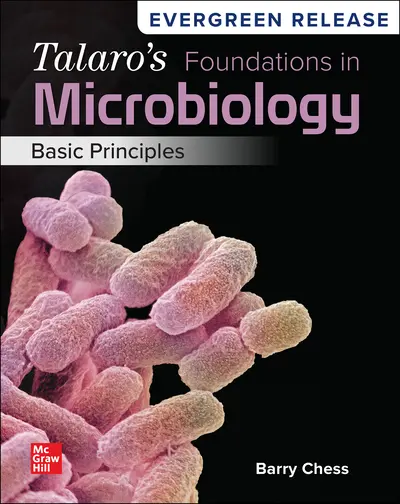
Talaro’s Foundations in Microbiology: Basic Principles is an allied health microbiology text with a taxonomic approach to the disease chapters. It offers an engaging and accessible writing style through the use of case studies and analogies to thoroughly explain difficult microbiology concepts.

1 The Main Themes of Microbiology2 The Chemistry of Biology3 Tools of the Laboratory: Methods of Studying Microorganisms4 A Survey of Prokaryotic Cells and Microorganisms5 A Survey of Eukaryotic Cells and Microorganisms6 An Introduction to Viruses, Viroids, and Prions7 Microbial Nutrition, Ecology, and Growth8 An Introduction to Microbial Metabolism: The Chemical Crossroads of Life9 An Introduction to Microbial Genetics10 Genetic Engineering and Genetic Analysis11 Physical and Chemical Agents for Microbial Control12 Drugs, Microbes, Host—The Elements of Chemotherapy13 Microbe–Human Interactions: Infection, Disease, and Epidemiology14 An Introduction to Host Defenses and Innate Immunities15 Adaptive, Specific Immunity, and Immunization16 Disorders in Immunity17 Procedures for Identifying Pathogens and Diagnosing Infections

About the Author

Barry Chess

Barry Chess has taught microbiology at Pasadena City College for more than twenty years. Prior to that, while studying at the California State University and the University of California, he conducted research into the expression of genes involved in the development of muscle and bone.

At PCC, beyond his usual presence in the microbiology laboratory and lecture hall, Barry has taught majors and non-majors biology, developed a course in human genetics, helped to found a biotechnology program on campus, and regularly supervises students completing independent research projects in the life sciences.Over the past several years, his interests have focused on innovative methods of teaching that lead to greater student success. He has written and reviewed cases for the National Center for Case Study Teaching in Science and contributed to the book Science Stories You Can Count On: 51 Case Studies with Quantitative Reasoning in Biology. Barry has presented papers and talks on the effective use of case studies in the classroom, the use of digital tools to enhance learning, and for several years served as a scientific advisor for the American Film Institute. In addition to Laboratory Applications in Microbiology, Barry is coauthor of the lecture text Foundations in Microbiology, now in its tenth edition. He is a member of the American Association for the Advancement of Science, and the American Society for Microbiology, and the Skeptics Society. Barry was profiled in the book, What Scientists Actually Do, where he was illustrated as a young girl with pigtails, about to stick a fork into an electrical outlet.

Accessibility

Creating accessible products is a priority for McGraw Hill. We make accessibility and adhering to WCAG AA guidelines a part of our day-to-day development efforts and product roadmaps.

For more information, visit our accessibility page, or contact us at accessibility@mheducation.com

Need support?   We're here to help - Get real-world support and resources every step of the way.

Top