* The estimated amount of time this product will be on the market is based on a number of factors, including faculty input to instructional design and the prior revision cycle and updates to academic research-which typically results in a revision cycle ranging from every two to four years for this product. Pricing subject to change at any time.

Instructor Quick Actions

Contact a Rep Find a local rep best suited for you.
Find Rep

Product Information

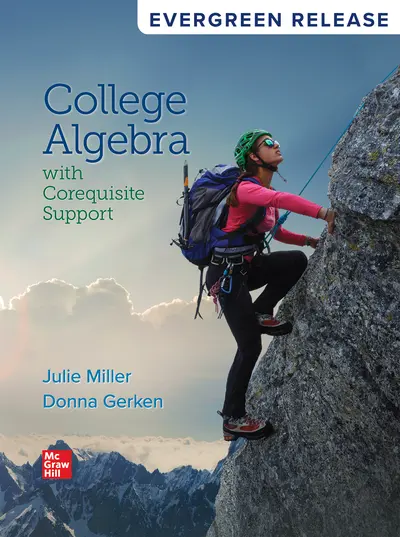
College Algebra with Corequisite Support, by Julie Millerand Donna Gerken, is designed specifically for corequisitestudents. Based on feedback from instructors, it integratessupport-level and college algebra concepts with options forcomprehensive or just-in-time review. Features includeexpanded examples with detailed steps, increased examplecounts, and “For Review” boxes for prerequisite concepts.Accompanied by videos, online homework, lecture notes,and a corequisite skills workbook, it offers a flexible,seamless learning experience tailored to diverse teachingand learning styles.

R: Review of Prerequisites
R.1 Operations on Fractions
R.2 The Set of Real Numbers
R.3 Simplifying Numerical Expressions
1: Linear Equations and Inequalities
1.1 Algebraic Expressions and Models
1.2 Linear Equations in One Variable
1.3 Applications of Linear Equations in One Variable
1.4 Union and Intersections of Sets
1.5 Linear and Compound Inequalities
1.6 Absolute Value Equations
1.7 Absolute Value Inequalities
2: Polynomials
2.1 Integer Exponents and Scientific Notation 
2.2 Operations on Polynomials
2.3 Greatest Common Factor and Factoring by Grouping
2.4 Factoring Trinomials 
2.5 Factoring Polynomials 
3: Quadratic Equations 
3.1 Introduction to Radicals and Their Simplification
3.2 Multiplying Radicals and Rationalizing the Denominator
3.3 Complex Numbers 
3.4 Solving Quadratic Equations by Factoring 
3.5 Solving Quadratic Equations by Using the Square Root Property
3.6 Solving Quadratic Equations by Using the Quadratic Formula
4: More Expressions and Equations
4.1 Multiplication and Division of Rational Expressions
4.2 Addition and Subtraction of Rational Expressions
4.3 Rational Equations 
4.4 Applications of Rational Equations
4.5 Rational Exponents 
4.6 Radical Equations and Equations with Rational Exponents
4.7 Equations in Quadratic Form
5: Functions and Relations
5.1 The Rectangular Coordinate System and Graphing Utilities
5.2 Circles
5.3 Functions and Relations
5.4 Linear Equations in Two Variables and Linear Functions
5.5 Applications of Linear Equations and Modeling 
6: Transformations and Analysis of Functions
6.1 Transformations of Graphs
6.2 Symmetry and Piecewise-Defined Functions
6.3 Average Rate of Change, Difference Quotient, and Function Behavior
6.4 Algebra of Functions and Function Composition
7: Polynomial Functions 
7.1 Quadratic Functions and Applications
7.2 Introduction to Polynomial Functions
7.3 Division of Polynomials and the Remainder and Factor Theorems
7.4 Zeros of Polynomials 
7.5 Polynomial Inequalities and Applications
8: Rational Functions
8.1 Introduction to Rational Functions
8.2 Graphs of Rational Functions
8.3 Rational Inequalities 
8.4 Variation
9: Exponential and Logarithmic Functions
9.1 Inverse Functions
9.2 Exponential Functions 9.3 Logarithmic Functions 9.4 Properties of Logarithms
9.5 Exponential Equations and Applications
9.6 Logarithmic Equations and Applications
9.7 Modeling with Exponential and Logarithmic Functions
10: Systems of Equations and Inequalities
10.1 Graphs of Systems of Linear Equations in Two Variables
10.2 Systems of Linear Equations in Two Variables and Applications
10.3 Systems of Linear Equations in Three Variables and Applications
10.4 Partial Fraction Decomposition
10.5 Systems of Nonlinear Equations in Two Variables
10.6 Inequalities and Systems of Inequalities in Two Variables
10.7 Linear Programming 11: Matrices and Determinants and Applications
11.1 Solving Systems of Linear Equations Using Matrices
11.2 Inconsistent Systems and Dependent Equations
11.3 Operations on Matrices
11.4 Inverse Matrices and Matrix Equations
11.5 Determinants and Cramer's Rule
12 (Online): Analytic Geometry
13 (Online): Sequences, Series, Induction, and Probability

About the Author

Julie Miller

Julie Miller is from Daytona State College, where she has taught developmental and upper-level mathematics courses for 20 years. Prior to her work at Daytona State College, she worked as a software engineer for General Electric in the area of flight and radar simulation. Julie earned a bachelor of science in applied mathematics from Union College in Schenectady, New York, and a master of science in mathematics from the University of Florida. In addition to this textbook, she has authored several course supplements for college algebra, trigonometry, and precalculus, as well as several short works of fiction and nonfiction for young readers.
My father is a medical researcher, and I got hooked on math and science when I was young and would visit his laboratory. I can remember using graph paper to plot data points for his experiments and doing simple calculations. He would then tell me what the peaks and features in the graph meant in the context of his experiment. I think that applications and hands-on experience made math come alive for me and I’d like to see math come alive for my students.

Donna Gerken

Accessibility

Creating accessible products is a priority for McGraw Hill. We make accessibility and adhering to WCAG AA guidelines a part of our day-to-day development efforts and product roadmaps.

For more information, visit our accessibility page, or contact us at accessibility@mheducation.com

Need support?   We're here to help - Get real-world support and resources every step of the way.

Top