ISBN10: 1264973454 | ISBN13: 9781264973453

ISBN10: 1264973454
ISBN13: 9781264973453
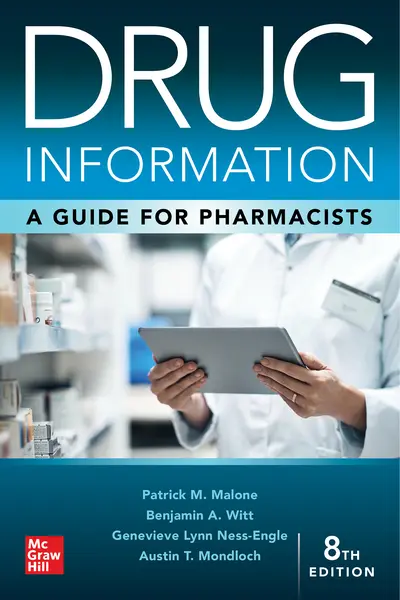
By Patrick M. Malone, Benjamin A. Witt, Austin T Mondloch and Genevieve Lynn Engle

Step 1. Download Adobe Digital Editions to your PC or Mac desktop/laptop.

Step 2. Register and authorize your Adobe ID (optional). To access your eBook on multiple devices, first create an Adobe ID. Then, open Adobe Digital Editions, go to the Help menu, and select "Authorize Computer" to link your Adobe ID.

Step 3. Open Your eBook. Use Adobe Digital Editions to open the file. If the eBook doesn’t open, contact customer service for assistance.

Everything you need to navigate drug information—all in one place

The go-to resource for mastering drug information in today’s fast-paced healthcare environment, Drug Information: A Guide for Pharmacists provides students and practitioners with the tools they need to research, interpret, evaluate, collate and disseminate drug information in the most effective and efficient manner possible.

Featuring high-yield bullet points, highlighted key concepts, and real-world case studies, the content is streamlined and easy to navigate. The trusted text covers the topics pharmacists rely on most: developing effective responses and recommendations, evaluating drug literature, evaluating biostatistics, improving medication and patient safety, improving/guiding formulary management within a hospital/health-system, and understanding investigational drugs.

This eighth edition addresses professional challenges, such as legal and ethical responsibilities, best practices for responding to drug information requests, and guidance on determining what information is appropriate to share. New to this edition is the coverage of artificial intelligence throughout the book and the addition of materials on non-traditional drug information roles.

Drug Information: A Guide for Pharmacists, Eighth Edition features: 

Valuable learning aids, including key concepts at the beginning of each chapter, learning objectives, discussion points, multiple-choice questions, and suggested readings
Case studies and practical examples throughout the text and appendices
New emphasis on the use of artificial intelligence throughout
New materials on non-traditional drug information roles (e.g., consulting, pharmaceutical industry, poison control) 
Updated and expanded chapters on drug literature evaluation covering newer concepts, such as adaptive clinical trials
Chapters on peer review and media relations
Information on the most commonly used references and apps for practitioners
Essential coverage of the legal and ethical aspects of drug information practice 
Evidence-based medicine, clinical practice guidelines, and much more

Accessibility

Creating accessible products is a priority for McGraw Hill. We make accessibility and adhering to WCAG AA guidelines a part of our day-to-day development efforts and product roadmaps.

For more information, visit our accessibility page, or contact us at accessibility@mheducation.com

Need support?   We're here to help - Get real-world support and resources every step of the way.

Top