AI in Accounting Education: Building Skills That Transfer to the Workforce
AI is reshaping accounting. See how McGraw Hill equips students with the critical thinking and practical AI skills today's profession demands.
- Higher Education
- Article
- Blog
- Accounting Ledger
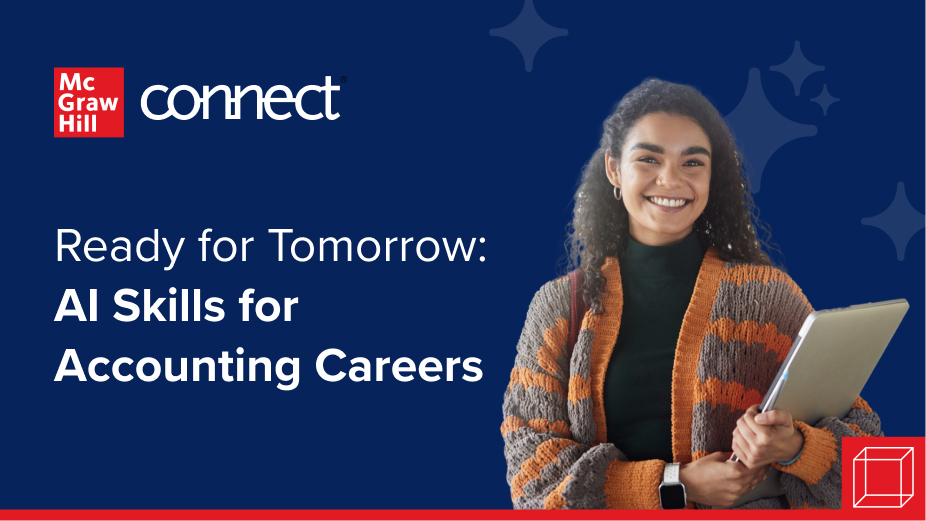
The accounting profession is changing fast, and AI is at the center of that transformation. Today's students won't just need to know debits and credits; they'll need to know how to work alongside AI tools, evaluate AI outputs, and think critically when technology gets it wrong. McGraw Hill has been building exactly those skills into accounting education across a wide range of titles. Here is a snapshot of the AI-powered learning assets now available by franchise/title.
Wild’s AI Error Detection Cases - these activities have students analyze a chatbot's response and identify where the error was made. Rather than letting students loose with AI unsupervised, this approach channels AI into a structured critical thinking exercise.
In Edmonds: Output Validation and Prompt Design students evaluate AI outputs for hallucinations and inaccuracies, then practice uploading real company data, with Target's annual report, into an LLM to ask financial questions and verify the results. They learn both how to use AI and how to evaluate its output.
Spiceland and Thomas Financial Accounting: Auto-Graded AI Assignments Every chapter includes auto-graded AI assignments where students use AI as a practical accounting tool -- generating charts, identifying errors, analyzing ratios, gathering real company data, and even coding in HTML to create self-quizzes. Each assignment pairs an AI-based component with a traditional problem-solving component.
Also available for these titles is the Learning Coach, a conversational AI tutor that guides students through complex concepts step by step. It reviews key ideas, asks comprehension questions, and provides coaching until students truly understand the material -- not just recognize it.
Richardson Franchise: Gen AI Labs provide alternate versions of existing textbook labs and offer a way for students to complete them using Gen AI. These labs teach students to use AI as an assistant for addressing accounting questions -- laying the foundation for building AI agents in their future careers.
Spilker Tax: AI and Critical Thinking Questions Available in every chapter, these end-of-chapter problems challenge students to think critically about how AI can be applied to real-world tax problem solving, fostering digital literacy alongside technical knowledge.
Jones Tax: Research and AI Analysis Problems Found in chapters 5 through 18, these problems direct students to evaluate GenAI output for accuracy and explain their reasoning, helping promote practical skills for any future accounting professional.
Whittington Auditing: Applying AI Assignments Students develop prompts and analyze AI outputs in auditing contexts, strengthening critical thinking and practical problem-solving skills in a professionally relevant setting.
Across Many Titles:
AI Reader - Built directly into the eBook and SmartBook, the AI Reader provides alternative explanations and simplified breakdowns of challenging topics, paired with customized quizzes to help students master course content.
Ask Sharpen is a GenAI-powered study buddy built into the Sharpen app. Students can ask questions and receive concise, personalized answers along with custom study activities like videos, quizzes, and flashcards tailored to their knowledge gaps. Students can prompt Ask Sharpen to do things like "Teach me about the accounting cycle" or "Test me on long-term assets," creating personalized study sets on the fly.
Gen AI Prep in Connect helps students build foundational AI literacy through ready-to-assign modules on effective prompting, responsible AI use, and evaluating AI-generated output.
SIMskills Badges: Foundational Skills in Generative AI offers students an optional, self-paced path to earn a shareable AI credential. Students can purchase the course on their own and build practical Gen AI skills they can apply in school, work, and future careers.
The Bottom Line
McGraw Hill's AI assets for accounting are about equipping students with the judgment, skills that transfer, and confidence to thrive in an AI-driven profession. From error detection to prompt design, from conversational tutoring to hands-on labs, these tools meet students where they are and prepare them for where the profession is going.
Interested in learning more? Contact your McGraw Hill representative.