
Powering AI: Who Pays for Data Centers?
AI runs on electricity, water, and real estate, not just code. Explore the hidden environmental and community costs powering today's digital economy.
- Higher Education
- Article
- Blog
- Ferrell Business in the News
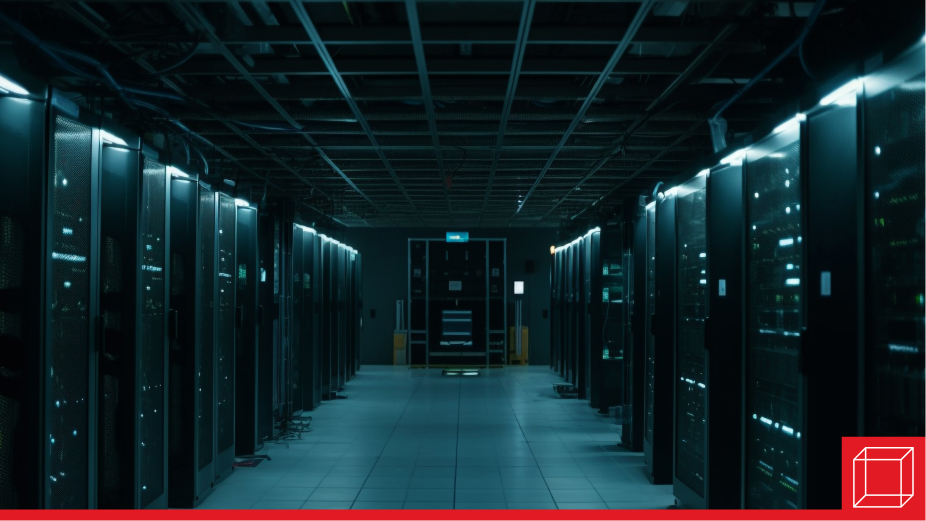
The resources behind cloud computing, streaming, and artificial intelligence (AI) are anything but virtual. Behind online activities are enormous buildings filled with servers, networking equipment, cooling systems, and backup power supplies. Data centers have become essential infrastructure for the digital economy. As AI increases demand for computing power, however, businesses and policymakers face an increasingly difficult question: How should society balance the economic value created by data centers against their environmental and community costs?
A Business Boom with Uneven Benefits
For communities competing to attract technology investment, data centers can look appealing. A large data center may represent billions of dollars in private investment, create construction work, expand the local tax base, and generate revenue from valuable real estate and computer equipment. Local governments may use that revenue to support schools, roads, and other public services.
However, the economic benefits may not be as large or as widely shared as communities expect. Some research shows that metropolitan areas tend to receive greater economic benefits from data centers than rural communities. Metropolitan areas have established networks of contractors, engineers, and skilled workers that allow spending from a data center to circulate through the surrounding economy. Rural communities may lack those resources. Data centers also require relatively few workers once construction is completed, with many facilities employing fewer than 100 permanent employees. Additionally, large data centers can consume large amounts of electricity, and some research has found that electricity prices may increase in areas where the effect of data center entry can be clearly measured.
This creates a public-policy question. If a community provides tax incentives to attract a data center and utilities must build new infrastructure to serve it, who should pay for those costs? The answer can determine whether residents receive a net benefit from the project or help subsidize an investment that primarily benefits a technology company and its customers.
AI Turns up the Power
AI systems require exceptional amounts of computing power. Generative AI is particularly energy-intensive because models must first be trained using powerful computing hardware and then continue consuming electricity when people use them. A generative AI training cluster may require seven or eight times as much energy as a typical computing workload. As millions of people and businesses incorporate AI into everyday activities, the cumulative energy demand from using these systems may become even more significant.
This creates what researchers describe as an environmental sustainability paradox. AI can help address environmental problems while simultaneously creating new environmental pressures. AI can improve climate forecasting, optimize renewable energy systems, monitor biodiversity, support precision agriculture, and make electric grids more efficient, yet the computing infrastructure needed to provide those benefits requires electricity, water, specialized hardware, and raw materials.
Improving the efficiency of AI systems may not completely solve the problem either. If greater efficiency makes AI less expensive and easier to use, businesses and consumers may simply use more of it, creating a rebound effect in which efficiency gains are offset by increased consumption.
Water Makes the Cloud a Local Issue
Electricity is only part of the resource debate. Servers generate heat and must be cooled continuously. Large data centers can consume as much as 5 million gallons of water per day, comparable to the water use of a community of 10,000 to 50,000 people. Water demand varies greatly depending on the data center's size, cooling technology, location, and climate. Those differences make location especially important.
The water footprint also extends beyond water used directly at the facility. Electricity generation can consume water, and semiconductor manufacturing requires significant amounts of ultrapure water. As a result, evaluating a data center's environmental impact requires looking at its broader supply chain, not just what happens inside the building.
Social Responsibility Meets the Bottom Line
The controversy surrounding data centers shows how business decisions can create value for some stakeholders while imposing costs on others. Technology companies and their customers receive computing capacity, investors may benefit from growing demand for AI and cloud services, local governments may collect additional tax revenue, and construction companies and suppliers may gain business. On the other hand, other stakeholders may face higher electricity prices, greater pressure on water supplies, noise from cooling equipment and backup generators, additional demand on the electric grid, or environmental effects associated with energy production and hardware manufacturing.
The ethical question therefore extends beyond whether a data center complies with existing laws. Corporate social responsibility asks businesses to consider how their decisions affect employees, customers, communities, suppliers, investors, and the environment.
Public officials face a related challenge: establishing rules that encourage innovation while protecting stakeholder interests. Communities can examine tax incentives, electricity pricing arrangements, infrastructure costs, water availability, cooling systems, renewable energy commitments, and expected employment before approving a project.
Computing a More Sustainable Future
For business leaders, perhaps the most important lesson is that the cloud is not really in “the cloud.” Digital services depend on physical infrastructure located in real communities and using real resources. As demand for AI and other digital services grows, companies will increasingly have to consider not just how much computing power they can obtain, but how responsibly that computing power is produced.
In the Classroom
This article can be used to discuss artificial intelligence, technological change, and the environmental effects of business activity (Chapter 1: The Dynamics of Business and Economics) and sustainability, stakeholder interests, and corporate responsibilities to the environment and local communities (Chapter 2: Business Ethics and Social Responsibility).
Discussion Questions
- What benefits do data centers provide to businesses that use cloud computing and other digital services?
- What environmental resources can be affected by the construction and operation of data centers?
- What is the environmental sustainability paradox associated with artificial intelligence?
This article was developed with the support of Kelsey Reddick for and under the direction of O.C. Ferrell, Linda Ferrell, and Geoff Hirt.
Apoorva Chouksey, Aneha K. Rajan, Vikas Gurjar, Rajnarayan Tiwari, and Pradyumna Kumar Mishra, "The Green Paradox: The Climate, Environmental, and Sustainability Implications of Artificial Intelligence," Global Environmental Change Advances, March 2026, https://www.sciencedirect.com/science/article/pii/S2950138525000178
Miguel Yañez-Barnuevo, "Data Centers and Water Consumption," Environmental and Energy Study Institute, June 25, 2025, https://www.eesi.org/articles/view/data-centers-and-water-consumption
Adam Zewe, "Explained: Generative AI's Environmental Impact," MIT News, January 17, 2025, https://news.mit.edu/2025/explained-generative-ai-environmental-impact-0117
Georgia Institute of Technology, "Data Centers Are Booming. Who Benefits?" Georgia Tech Research News, July 9, 2026, https://news.research.gatech.edu/2026/07/09/data-centers-are-booming-who-benefits

O.C. Ferrell is the James T. Pursell Sr. Eminent Scholar in Ethics and Director of the Center for Ethical Organizational Cultures in the Raymond J. Harbert College of Business, Auburn University. He was formerly Distinguished Professor of Leadership and Business Ethics at Belmont University and University Distinguished Professor at the University of New Mexico. He has also been on the faculties of the University of Wyoming, Colorado State University, University of Memphis, Texas A&M University, Illinois State University, and Southern Illinois University. He received his Ph.D. in marketing from Louisiana State University.