
Artificial Intelligence and the Future of Accounting
Artificial intelligence (AI) relates to machine (computer) learning that is able to perform activities and tasks that typically require human intelligence such as decisions, visual perception, and speech recognition. Generative AI uses artificial intelligence to produce new content including text, images, audio, code, and more.
- Higher Education
- Ferrell Business in the News
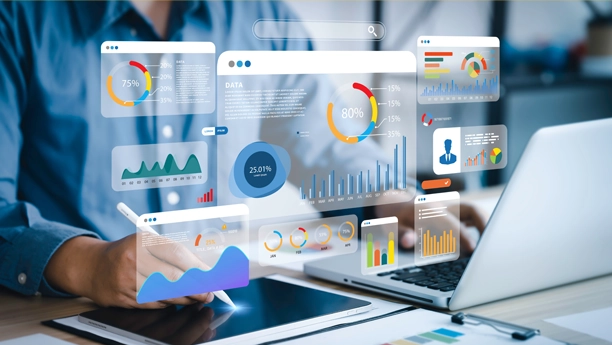
AI technologies, including generative models, are often used in tandem with automation to handle repetitive, rules-based tasks such as data entry, invoice processing, and account reconciliation. In the accounting profession, these capabilities are transforming how financial information is processed, analyzed, and reported.
Surveys of tax and accounting firms show rapid growth in experimentation with and use of AI tech, including generative tools for research, document summarization, and drafting. At the same time, professionals remain cautious about quality, ethics, and client confidentiality.
How Can Accounting Benefit from AI?
AI is good at repeatable work that consumes time but does not require human judgment. Data intake and cleanup, such as extracting data from receipts, matching payments, and preparing trial balances, can now be done by AI software. Reconciliations and reporting can also be automated, with AI comparing ledger balances, flagging variances, and producing reports. AI can also be good at reading and interpreting standards, contracts, or filings and then producing summaries, comparisons, and checklists. AI can quickly review large amounts of data, recognize patterns, and even make predictions, all much faster than a person could.
One potential use for AI is helping accountants stay current on accounting standards. Long, text-heavy updates from standard setters take time to read and understand. Generative tools can read standard updates, highlight what changed, explain new concepts, and identify areas of concern. They can even suggest next steps like system updates, training, and auditor engagement.
How Jobs Will Change
There are likely to be fewer entry-level, rules-based tasks for employees to accomplish as automation handles data entry, coding, and reconciliation. However, that does not mean the profession can be replaced by AI. Outlook data still show growth in accounting and audit roles over the decade, driven by work that combines technology with human judgment. New roles will likely emphasize advisory and analysis, systems and controls design, data quality and integration, client communication, and change management. Firms are already considering AI literacy and data skills when hiring. AI will free up time from rote jobs and allow more time working with clients on consulting and strategy.
Risks of AI in Accounting
While AI is fast and efficient in many applications, it is not without its flaws. Human critical thinking, judgement, decision-making, and analysis are still critical to the profession.
Generative tools sometimes produce confident but wrong answers, a phenomenon called hallucination. Accountants must always verify outputs against source documents. Additionally, bias and data quality problems can create misleading results if the system learns from flawed information. Security and privacy remain top concerns since tools often process sensitive financial data. Overreliance is another danger because professionals may accept outputs too readily without applying their own judgment. Understanding the limitations of an AI system is essential for responsible use.
A newer development called agentic AI is taking these technologies a step further. Unlike generative AI, which responds to single prompts, agentic AI can make plans, act on its own, and adjust its approach. This type of AI could eventually manage more complex accounting workflows. However, with this higher level of independence comes greater risk. If an agentic system misinterprets instructions, acts on incorrect data, or operates without proper oversight, errors could multiply quickly.
Responsible adoption requires structure and governance that define approved use cases, data handling rules, testing, and monitoring. Training programs can teach staff how to craft prompts, check sources, and escalate concerns.
The Future Is Now
AI is not a futuristic concept but rather something that is currently reshaping how accountants work. Accountants who learn to use AI responsibly and develop skills in data analysis, communication, and ethics will likely be better prepared for the changing landscape of the profession.
In the Classroom
This article can be used to discuss the nature of accounting and the importance of integrity in accounting (Chapter 14: Accounting and Financial Statements).
Discussion Questions
- Describe some of the benefits and risks of using AI in accounting.
- Why is it important for accountants to verify AI-generated information against source documents, and what could happen if they fail to do so?
- How can accounting students prepare themselves for an AI-powered future?
This article was developed with the support of Kelsey Reddick for and under the direction of O.C. Ferrell, Linda Ferrell, and Geoff Hirt.
Ariana LoBianco, Kevin Jialin Sun, PhD, CFA and Xin Zhao, "How Artificial Intelligence May Impact the Accounting Profession," The CPA Journal, May/June 2025, https://www.cpajournal.com/2025/09/08/how-artificial-intelligence-may-impact-the-accounting-profession/
"How Will AI Affect Accounting Jobs?" Thomas Reuters, June 10, 2025, https://tax.thomsonreuters.com/blog/how-will-ai-affect-accounting-jobs-tri/
Sarah Ovaska, "Agentic AI Poised to Change the Way CPAs Work," Journal of Accountancy, June 1, 2025, https://www.journalofaccountancy.com/issues/2025/jun/agentic-ai-poised-to-change-the-way-cpas-work/
Wei Hock Lee, "How Artificial Intelligence Can Transform Accounting," EY, June 16, 2025, https://www.ey.com/en_sg/insights/assurance/how-artificial-intelligence-can-transform-accounting

Geoffrey A. Hirt of DePaul University previously taught at Texas Christian University and Illinois State University, where he was chairman of the Department of Finance and Law. At DePaul, he was chairman of the Finance Department from 1987 to 1997 and held the title of Mesirow Financial Fellow. He developed the MBA program in Hong Kong and served as director of international initiatives for the College of Business, supervising overseas programs in Hong Kong, Prague, and Bahrain, and was awarded the Spirit of St. Vincent DePaul award for his contributions to the university. Dr. Hirt directed the Chartered Financial Analysts (CFA) study program for the Investment Analysts Society of Chicago from 1987 to 2003. He has been a visiting professor at the University of Urbino in Italy, where he still maintains a relationship with the economics department. He received his Ph.D. in finance from the University of Illinois at Champaign-Urbana, his MBA at Miami University of Ohio, and his BA from Ohio Wesleyan University.