The Externalities Effect of Child Firearm Fatalities in the States
The wider social costs of gun violence and policy implications.
Tags
Blog
Article
Econ Everyday
Higher Education
Market Failures and Externalities
Public Goods, Public Choice, & Gov. Failure
Article Type: Blog
Share:
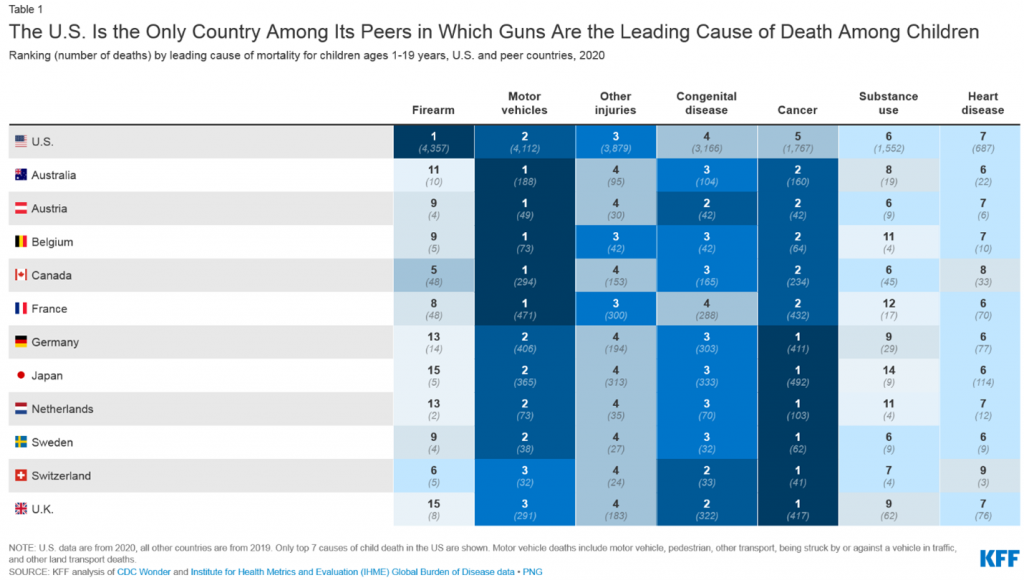
A study published on July 8th, 2022 by the Kaiser Family Foundation (KFF) analyzed how gun fatalities among children and teens in the country compared to eleven other similar countries, and reported that the U.S. was leading in the number of child firearm deaths among peer nations as summarized in the table below:
Other key findings from the KFF study are summarized below:
In 2020, for children aged 1 to 19,
Total firearms deaths = 4,510 children
Total firearms deaths in United States = 4,357 children (or ~97%)
Total firearms deaths in 11 other similar countries = 153 children (or ~3%)
For other peer countries, motor vehicle accidents and cancer were the leading cause of death for this age group.
While Canada has the second highest child firearm death after U.S., in absolute terms, there were 48 child firearm deaths in Canada: 4,357 child firearm deaths, U.S.
The Council on Foreign Relations reviewed the U.S. Gun policy against six other countries: Australia, Canada, Israel, Japan, Norway and the United Kingdom. And reported that while the U.S. population is only five percent of the world’s, it has forty-six percent of the world’s civilian-owned guns, ranking as the first in firearms per capita, given the Second Amendment of the Constitution on the right to bear arms. The Gun Control Act of 1968 prohibits individuals under 18 years from purchasing firearms, however, to-date, 22 states have raised the minimum age for purchasing firearms to 21 years – a visual is provided by Everytown for Gun Safety. Gun ownership by state visual is provided by World Population Review. Consequently, meaningful, effective, and safe gun legislation post-mass shootings have been elusive. The governments of Australia, Canada, and the United Kingdom, however, tighten gun laws in response to mass shootings.
Can these child firearm fatalities in the United States be prevented?
Is there a market failure in the firearms market?
Who is responsible for child firearm fatalities – the government or the private citizens/firms?
Who can help in reducing the child firearm fatalities – the government or the private citizens/firms?
These questions are politically charged in our society. Will the responses be different from an economics viewpoint? In economics, the concept of unintended consequences are called “externalities” where a private benefit or a private cost incurred by an individual (or a firm) does not take into account the side effect it has on its immediate surrounding in terms of a social benefit or a social cost. Examples of positive externalities include increasing street lighting in a neighborhood, while an oil-pipe leak in a manufacturing plant reflects negative externalities. As such, externalities are the causes of market failure in a mixed-economic system like the United States Economy.
Select TWO countries’ government response to mass shootings from the Council of Foreign Affairs article, summarize TWO key takeaways you had about the response and share your findings with a classmate or two.
Compare/contrast the visuals from “Everytown for Gun Safety” and “World Population Review” and discuss whether raising the minimum age for purchasing firearms to 21 years at the federal level would reduce firearm fatality rates and subsequently increase public safety nationwide?
Since social/private/marginal cost (i.e., the loss of innocent lives) far outweighs the social/private/marginal benefit (i.e., preventing firearm fatalities),explain whether
The government should intervene to reduce the economic market for firearm manufacturers/retailers/sellers and buyers OR
Require manufacturers/retailer/sellers to use the Coase Theorem to ensure that buyers are aware of firearm safety, responsibility and accountability, OR
Should the government, private suppliers of firearms and buyers work together via education/gun safety campaign to reduce firearm fatalities in the country?
Self-reflection:After reading or listening to the news about child firearm fatalities like a mass shooting in a school,
What is your initial reaction?
What can you do (or have been doing) to raise awareness or discuss preventive measures about firearm fatalities
With your peers?
At your institution?
At your local or state government levels? Do explain.
Cities impose noise fines to improve quality of life and curb pollution.
Regional Page Available
It looks like you're outside the United States. Do you want to see your regional version of this page?
Education Topics
Education Topics/Courses
Education Topics/Courses/Econ Everyday
Education Topics/Courses/Econ Everyday/Market Failures and Externalities
Asset Format Type
Asset Format Type/Blog
Asset Format Type/Blog/Article
Education Topics/Courses/Econ Everyday/Public Goods, Public Choice, & Gov. Failure
Business Unit
Business Unit/Higher Education
highered
2026-11-19T16:18:57.849Z
highered The Externalities Effect of Child Firearm Fatalities in the States The wider social costs of gun violence and policy implications. The Externalities Effect of Child Firearm Fatalities in the States The wider social costs of gun violence and policy implications. Tags Blog Article Econ Everyday Higher Education Market Failures and Externalities Public Goods, Public Choice, & Gov. Failure More Article Type: Blog March 21, 2023 Share: A study published on July 8th, 2022 by the Kaiser Family Foundation (KFF) analyzed how gun fatalities among children and teens in the country compared to eleven other similar countries, and reported that the U.S. was leading in the number of child firearm deaths among peer nations as summarized in the table below: Other key findings from the KFF study are summarized below: In 2020, for children aged 1 to 19, Total firearms deaths = 4,510 children Total firearms deaths in United States = 4,357 children (or ~97%) Total firearms deaths in 11 other similar countries = 153 children (or ~3%) For other peer countries, motor vehicle accidents and cancer were the leading cause of death for this age group. While Canada has the second highest child firearm death after U.S., in absolute terms, there were 48 child firearm deaths in Canada: 4,357 child firearm deaths, U.S. The Council on Foreign Relations reviewed the U.S. Gun policy against six other countries: Australia, Canada, Israel, Japan, Norway and the United Kingdom. And reported that while the U.S. population is only five percent of the world’s, it has forty-six percent of the world’s civilian-owned guns, ranking as the first in firearms per capita, given the Second Amendment of the Constitution on the right to bear arms. The Gun Control Act of 1968 prohibits individuals under 18 years from purchasing firearms, however, to-date, 22 states have raised the minimum age for purchasing firearms to 21 years – a visual is provided by Everytown for Gun Safety. Gun ownership by state visual is provided by World Population Review. Consequently, meaningful, effective, and safe gun legislation post-mass shootings have been elusive. The governments of Australia, Canada, and the United Kingdom, however, tighten gun laws in response to mass shootings. Can these child firearm fatalities in the United States be prevented? Is there a market failure in the firearms market? Who is responsible for child firearm fatalities – the government or the private citizens/firms? Who can help in reducing the child firearm fatalities – the government or the private citizens/firms? These questions are politically charged in our society. Will the responses be different from an economics viewpoint? In economics, the concept of unintended consequences are called “externalities” where a private benefit or a private cost incurred by an individual (or a firm) does not take into account the side effect it has on its immediate surrounding in terms of a social benefit or a social cost. Examples of positive externalities include increasing street lighting in a neighborhood, while an oil-pipe leak in a manufacturing plant reflects negative externalities. As such, externalities are the causes of market failure in a mixed-economic system like the United States Economy. Discussion Questions: Review Table 1 above and read the KFF Study to explain what TWO things stood out to you and why. Select TWO countries’ government response to mass shootings from the Council of Foreign Affairs article, summarize TWO key takeaways you had about the response and share your findings with a classmate or two. Compare/contrast the visuals from “Everytown for Gun Safety” and “World Population Review” and discuss whether raising the minimum age for purchasing firearms to 21 years at the federal level would reduce firearm fatality rates and subsequently increase public safety nationwide? Since social/private/marginal cost (i.e., the loss of innocent lives) far outweighs the social/private/marginal benefit (i.e., preventing firearm fatalities),explain whether The government should intervene to reduce the economic market for firearm manufacturers/retailers/sellers and buyers OR Require manufacturers/retailer/sellers to use the Coase Theorem to ensure that buyers are aware of firearm safety, responsibility and accountability, OR Should the government, private suppliers of firearms and buyers work together via education/gun safety campaign to reduce firearm fatalities in the country? Self-reflection:After reading or listening to the news about child firearm fatalities like a mass shooting in a school, What is your initial reaction? What can you do (or have been doing) to raise awareness or discuss preventive measures about firearm fatalities With your peers? At your institution? At your local or state government levels? Do explain. Sources| Kaiser Family Foundation: https://www.kff.org/global-health-policy/issue-brief/child-and-teen-firearm-mortality-in-the-u-s-and-peer-countries/; Council of Foreign Affairs: https://www.cfr.org/backgrounder/us-gun-policy-global-comparisons; ATF: https://www.atf.gov/firearms/qa/does-customer-have-be-certain-age-buy-firearms-or-ammunition-licensee; Everytown for Gun Safety: https://everytownresearch.org/rankings/law/minimum-age-to-purchase/; World Population Review: https://worldpopulationreview.com/state-rankings/gun-ownership-by-state; EconLib: https://www.econlib.org/library/Enc/Externalities.html; Investopedia: https://www.investopedia.com/terms/m/marketfailure.asp, https://www.investopedia.com/terms/m/mixed-economic-system.asp, https://www.investopedia.com/terms/c/coase-theorem.asp About the Author Sunita Kumari
The wider social costs of gun violence and policy implications.
Market Failures and Externalities, Blog, Econ Everyday, Article, Public Goods, Public Choice, & Gov. Failure, Higher Education