Inside Teacher Assistant: A New Approach to Supporting Instructional Decision-Making

How the teams behind McGraw Hill’s new AI-powered tool are redefining personalized learning and setting a thoughtful standard for responsible technology in K–12 education


Tags: Personalized Learning, Artificial Intelligence (AI), Article, Teaching Assistant, Blog, Corporate

Teachers ask thoughtful, moment‑to‑moment questions every day: What do my students need next? How is this lesson really landing? What’s the best resource to use right now? As instructional materials become more robust and student data more readily available, educators are increasingly expected to translate insight into timely, personalized instructional action.

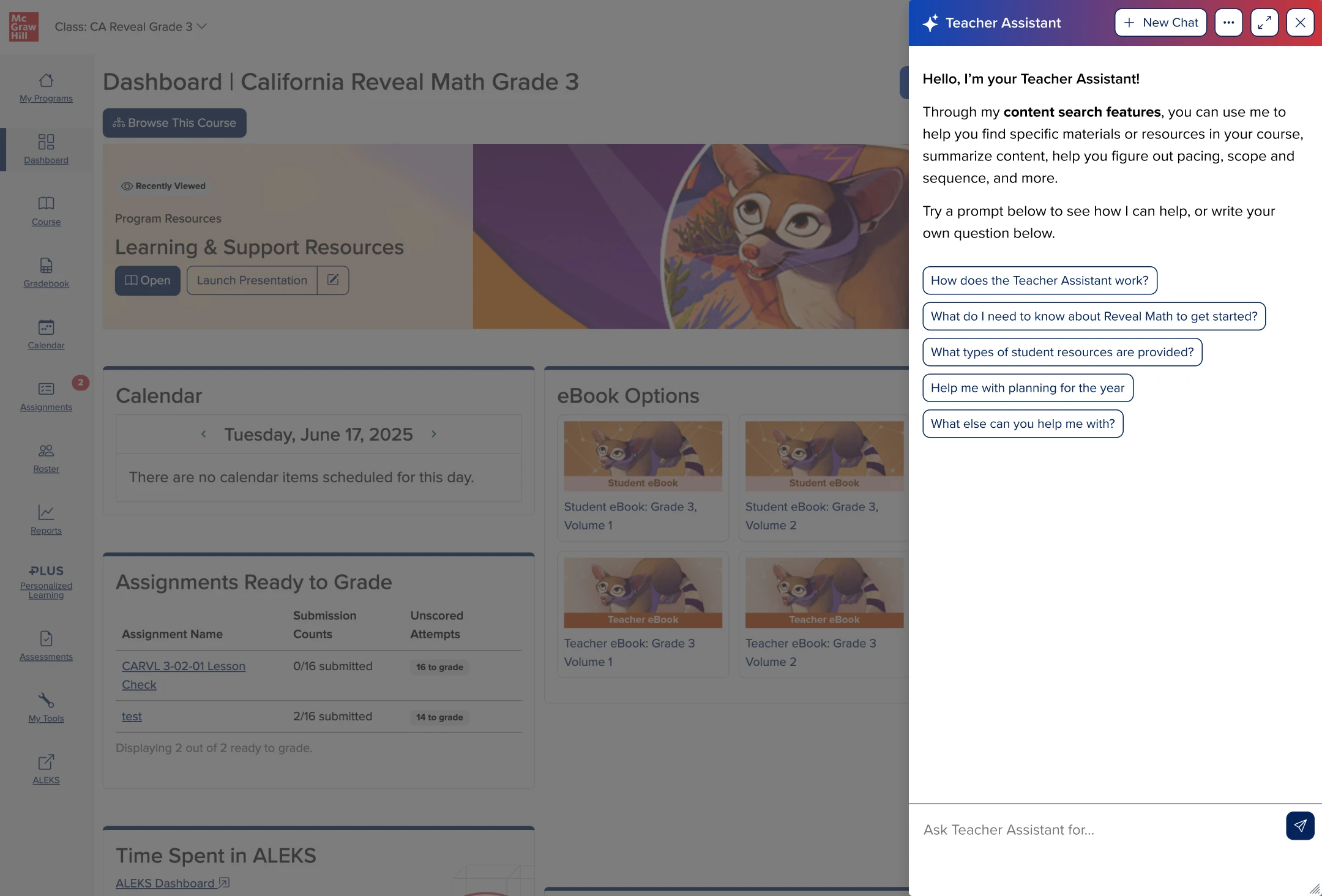
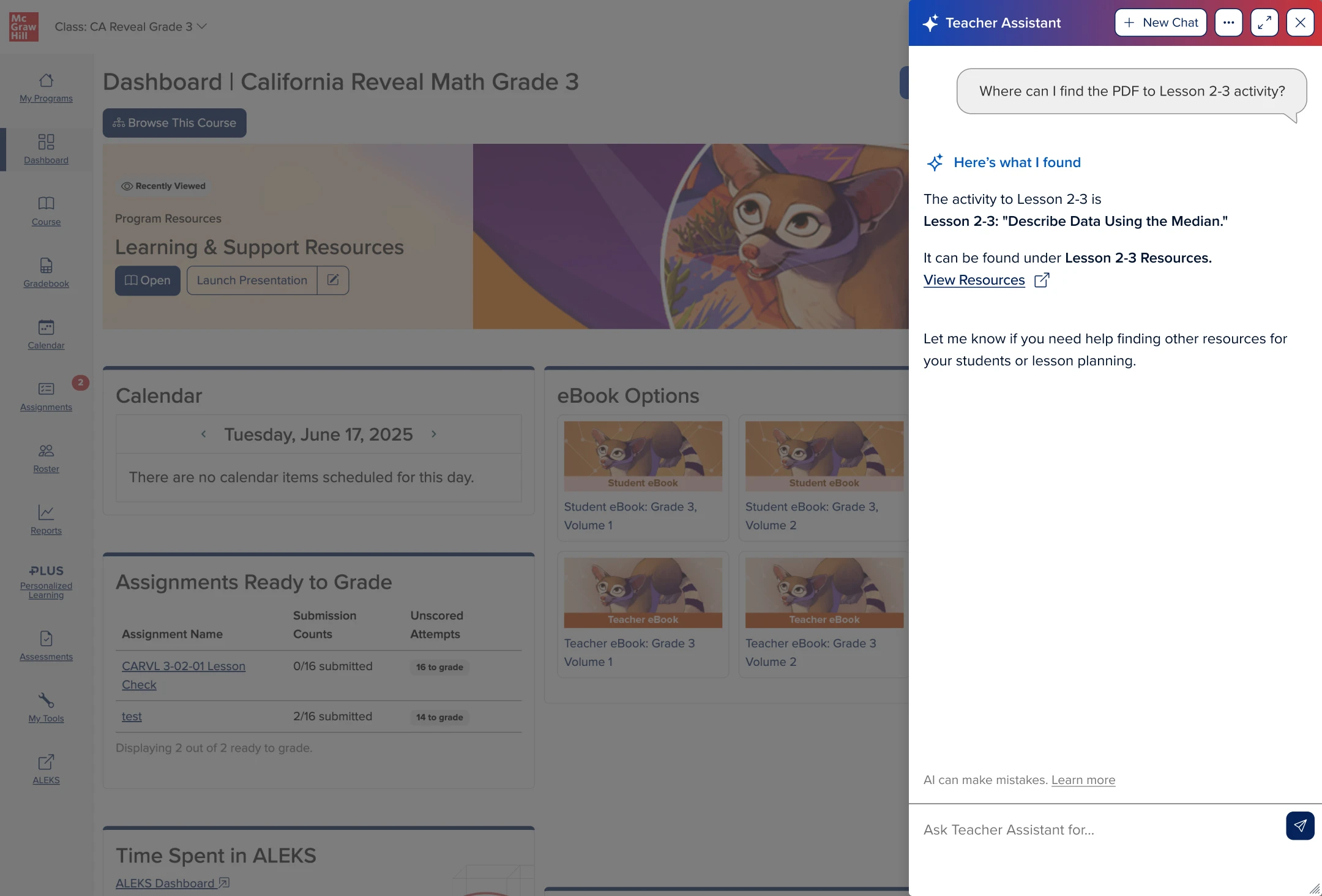
Teacher Assistant introduces a new AI-powered way to help educators meet that challenge. Built directly into McGraw Hill’s K–12 digital learning solutions, it connects curriculum resources with student data through natural-language interactions that support lesson planning, pacing, and personalization. Grounded in instructional design and shaped by ongoing teacher feedback, the tool reflects McGraw Hill’s strategic approach to AI: strengthening educator expertise and unlocking more value from high-quality curriculum. To better understand the vision behind Teacher Assistant and how it’s evolving in real classrooms, we spoke with Shawn Francis, Senior Director of AI, Assessment, and Personalization Product Management for McGraw Hill School. 

What challenge were you seeing in classrooms that led the team to build Teacher Assistant, and why did it feel like the right moment to introduce an AI-powered solution?

One of the biggest challenges we identified through our research is that teachers often struggle to understand all of the resources that are available in their core curriculum. With comprehensive state standards to cover, there is a lot there, and getting oriented—especially when adopting a new program—can be difficult. Feedback from our field-facing teams reinforced this, sharing that educators frequently struggle to understand where to find various support materials.  

At the same time, teachers often have more questions about the student performance data than a data visualization alone can easily answer, and not all teachers feel comfortable engaging with complex data tools. Even well-designed performance reports cannot anticipate every question a teacher might have about their students. 

Taken together, these challenges made it clear that this was the right moment for an AI-powered solution, one that could help teachers quickly surface relevant instructional assets and contextualize them with data, without adding complexity or requiring deeper data experience. 

Why did the team believe AI could add value to how teachers experience and use McGraw Hill’s instructional materials?

Personalization, assessment, and data naturally work together. We can only personalize learning based on the data we have about how students are performing, and AI allows us to do that work in much more dynamic ways than we have ever been able to before. With our collaborations with assessment companies, like Pearson, as well as new tools like Observational Checklist to collect offline data, our teachers have more robust data than ever before—and AI offers additional opportunities for us to help teachers make sense of that data and take action in their classrooms. 

Most often, our AI tools are focused on personalized learning within instruction. Teacher Assistant gives teachers a way to dynamically personalize their experience with our programs based on what their students need right now, including things we do not always anticipate in advance. Having a tool that can support that kind of decision-making in the moment is what makes it so valuable.

How is McGraw Hill ensuring Teacher Assistant is implemented responsibly and aligned with instructional design and best practices?

For us, responsible implementation starts with how the tool is designed. A huge part of that work is anchoring Teacher Assistant in standards, skills, and the scope of the course, so it reinforces our pedagogical approaches, rather than pulling teachers outside the design of the program.

We work very closely with academic design and product teams to ensure the responses Teacher Assistant provides align with how the curriculum was intended to be used. That is a key difference between Teacher Assistant and many standalone AI tools, which do not have curriculum awareness and require teachers to navigate another platform and learn an entirely new workflow. That alignment is critical to ensuring high-quality, responsible use in classrooms. By integrating AI directly into the instructional experience, Teacher Assistant reduces friction for educators, eliminating the need to move between tools to get recommendations, while ensuring guidance is shaped by instructional designers and grounded in lesson goals. This combination of curricular alignment, thoughtful design, and ease of use is critical to supporting high-quality, responsible use in classrooms. 

How does teacher feedback continue to shape how Teacher Assistant is evolving?

We gather feedback in multiple ways, from passive signals like analytics and AI monitoring that show how teachers use Teacher Assistant, to direct input through surveys, focus groups, and field conversations. Together, this helps us understand what’s working, where teachers need more support, and whether we’re focused on the right problems.

That feedback has clarified where Teacher Assistant delivers the most immediate value and where it needs to grow. Teachers’ prompts consistently reflect how often educators are making decisions that require quick access to curriculum context and student performance insights. In testing, Teacher Assistant supported those moments and sparked ideas for additional uses, including creating on-the-fly student groups. Through chat analysis, we also learned teachers wanted more help crafting effective prompts, which led to a more conversational agent that helps refine requests and surface the right resources. Data interpretation has emerged as a key entry point, allowing us to support teachers’ questions in the moment and help them respond instructionally.

As someone deeply involved in this work, what makes you proud to be building AI-powered tools like Teacher Assistant at McGraw Hill?

It’s a privilege to put these tools into the hands of educators and to learn how they respond and use them in classrooms. Being able to watch something come alive in practice, learn from how teachers engage with it, and then use that insight to make it even better is incredibly energizing. That combination of collaboration, momentum, and real classroom impact is what makes this work feel special.

Watch Teacher Assistant in action: