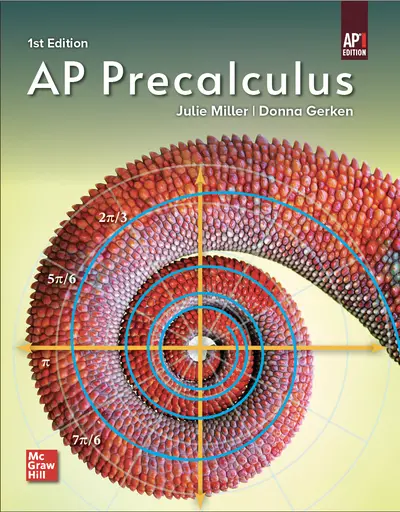
Miller, AP Precalculus, ©2027, 1e

Grades: 9 - 12

AP Precalculus provides students with a clear and logical presentation of basic concepts and scaffolds support to develop the critical-thinking and problem-solving skills needed for success on the AP Exam. With an accessible, example-driven approach delivered through a clear, precise writing style, AP Precalculus promotes deep understanding for AP students of any background.

Program Details

Precalculus is currently the fastest growing AP course. For some students, it is the entrance into the higher mathematics needed for careers in science, technology, engineering, and mathematics. AP Precalculus provides students with a clear and logical presentation of basic concepts and scaffolds support to develop the critical-thinking and problem-solving skills needed for success on the AP Exam. The AP® Precalculus curriculum and instructional resources feature coherent alignment and a balanced focus of approach to mathematical instruction. With an accessible, example-driven approach delivered through a clear, precise writing style, AP Precalculus promotes deep understanding for AP students of any background.
  • Instruction fully aligned to the College Board framework with focus on AP Learning Objectives and Mathematical Practices supports conceptual understanding
  • Content organized around units in the AP Framework with a rigor and depth that promotes procedural fluency
  • A robust prerequisite knowledge chapter paired with extensive print and online AP-style exam practice at the chapter, unit, and course level ensures students master foundational skills
  • Print and digital AP Practice Exams to ensure thorough practice and preparation
  • A Teacher Manual includes an "AP Units and Topics" feature including a Pacing Guide, Course and Exam information, lesson plans, and sample syllabus
  • Other digital teacher resources include suggested activities, teaching tips for every chapter and lesson and customizable PowerPoint Presentations
  • Chapter R: Review of Prerequisites

UNIT 1: Polynomial and Rational Functions

  • Chapter 1: Functions and Relations
  • Chapter 2: Polynomial and Rational Functions

UNIT 2: Exponential and Logarithmic Functions

  • Chapter 3: Exponential and Logarithmic Function
  • Chapter 4: Sequences, Series, and Rates of Change

UNIT 3: Trigonometric and Polar Functions

  • Chapter 5: Trigonometric Functions
  • Chapter 6: Analytic Trigonometry
  • Chapter 7: Trigonometry Applied to Polar Coordinate Systems

UNIT 4: Functions Involving Parameters, Vectors, and Matrices

  • Chapter 8: Analytic Geometry
  • Chapter 9: Applications of Trigonometric Functions
  • Chapter 10: Matrices and Determinants and Applications
  • Chapter 11: Vectors
  • Chapter 12: Preview of Calculus (online only)

Julie Miller is from Daytona State College, where she taught developmental and upper-level mathematics courses for 20 years. Prior to her work at DSC, she worked as a software engineer for General Electric in the area of flight and radar simulation. Julie earned a Bachelor of Science in applied mathematics from Union College in Schenectady, New York, and a Master of Science in mathematics from the University of Florida. In addition to this textbook, she has authored textbooks in developmental mathematics, trigonometry, and precalculus, as well as several works of fiction and nonfiction for young readers.

Donna Gerken was a professor at Miami Dade College where she taught developmental courses, honors classes, and upper-level mathematics classes for decades. Throughout her career she has been actively involved with many projects at Miami Dade, including those on computer learning, curriculum design, and the use of technology in the classroom. Donna’s Bachelor of Science in mathematics and Master of Science in mathematics are both from the University of Miami.