Emerge McGraw Hill Literacy logo

Emerge! Author Spotlight:
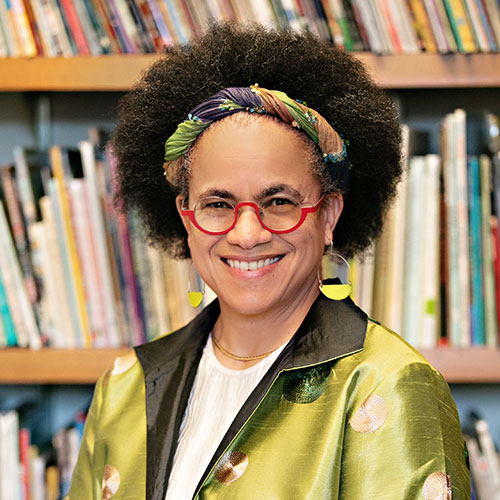
Dr. Michelle H. Martin

On fostering a love of literature for every student within an evidence-based science of literacy instructional framework

We believe the people behind a program matter as much as the program itself. That's why we're launching a series of introductions to the researchers, educators, and children's literature experts whose expertise, passion, and lived experience shaped every page of Emerge!.

First up in our Emerge! author spotlight series is Dr. Michelle H. Martin, the Beverly Cleary Endowed Professor for Children and Youth Services at the University of Washington's Information School, and one of the leading voices in children's literature, diversity, and community literacy. A celebrated author, essayist, book critic, and founder of the nonprofit Read-a-Rama, Dr. Martin brings to Emerge! a career-long commitment to ensuring every child sees themselves reflected in the stories they read. We sat down with her to talk about what it takes to build a lifelong reader, and why the books we put in children's hands are never just books:

What are some strategies for student engagement that consistently convert reluctant or struggling readers into avid readers

Self-selected reading. When you're reading what you love, what you're passionate about, what you want to learn about, you're going to be a lot more likely to enjoy it, and readers who enjoy what they're reading tend to read more.

High-interest reading matters too – not just reading you get to select, but reading that represents your passions. I once had a camper who loved sharks, so I found every shark book I could — beautiful pictures, great illustrations, lots of information — because he had an almost encyclopedic knowledge of sharks.

There's also "just right" reading. As readers are building those foundational skills, like recognizing letters and learning to decode, they need texts that are not too hard, not too easy, but that will continually stretch them toward more complex texts. That sweet spot matters.

And then there's connecting what you read to what you do and reading about things that map onto your daily life and activities. We also found that communities of readers make a difference. That shark lover, paired with a child who loved whale sharks? They would feed each other's passions.

Finally, I remember my second-grade teacher, Mrs. Reamer, who read aloud to us every day after recess — a passage from a book she loved. It calmed us down, got us ready for learning, and we would beg for just one more chapter. She had a knack for stopping not at the end of a chapter, but she would create cliffhangers by stopping at the most exciting parts. So the next day, kids came in asking, what's going to happen? Getting kids hooked on stories is one of the most powerful ways to move a struggling reader toward becoming an avid one.

Why is representation important in children's literature? What elements of a student's identity and experience should they see reflected in the texts they read?

My answer to this is relatively simple: they should not have to choose.

We have intersectional identities. I am not just a female. I'm also a South Carolinian, a swimmer, someone who loves to cook and loves to sing. The books children read should, in all their variety, be able to reflect back all of those experiences.

I should be able to read Soul Food Sunday and see a grandparent cooking with their grandchild. I should be able to read Brown Girl Dreaming and see a child who grew up in South Carolina and sees herself as a writer.

When I was a child reading Dick and Jane, very little there reflected my life experience. Children should not have to feel like they can only claim one piece of their background, one slice of who they are. If you take the sum total of everything a child reads throughout a year, they should see lots of reflections of who they are, whether that's linguistic, experiential, or simply their neighborhood.

I think Emerge! has done a great job of giving kids those experiences in all their wonderful variety  Kids don’t have to choose.

As someone who studies children's literature, how do rich, diverse texts serve as the engine for all three elements of the Science of Literacy: reading, writing, and comprehension and knowledge building?

I teach students in the Master of Library and Information Science program at the University of Washington, and I can always tell the students in my programs who “ate books,” as I like to say, or are voracious readers. Those students are also typically some of my strongest writers. Reading and writing go together. And not surprisingly, they're often some of my most brilliant talkers, because they've absorbed content, interesting details, rich ideas from their reading, and they're writing about them. The reading brings it in; the writing puts it out.

When students choose high-interest, self-selected texts, they often develop deep knowledge of particular topics or extensive knowledge across many topics. My husband is a voracious reader, of mostly nonfiction and especially history, and he can talk to anybody about anything. When I ask him how he knew some random fact, he says, “Because I read more than the funny papers.”

Reading is taking words in and creating meaning. Writing is using what you know to produce words and meaning. When you are doing both around content that matters to you (content you can actually use) it's so much more meaningful than decoding for the sake of decoding.

And when some of those texts also represent your life, your family, your lived experience, your home language, how much more of an affirmation is that? Reading, writing, and knowledge building really ought to go together to build a strong literacy foundation. The texts that anchor all three should reflect the full range of who our students are.

When you think about the read-alouds in Emerge!, what were the non-negotiables? What needed to be true about the literature selections to ensure every student walked away feeling like a reader?

A few things. First, it had to be genuinely interesting to a wide variety of children. Children's literature without conflict is boring! And most kids are reluctant to keep reading something they find boring.

It also needed to build knowledge in some way, whether that's about a particular animal, a child's disability, a place, or a historical period.

And not every text makes a good read-aloud. I love The Stinky Cheese Man, but it doesn't work as a read-aloud, because so many essential details are in the illustrations, and you need to see them up close. Read-aloud ability was important.

One thing I've really loved about Emerge! is that multilingual learners are not an afterthought. Considerations of their needs are baked into the program. Learners from different backgrounds, different walks of life, different neurodiversities: all of that is considered. Audience was front and center as I was making selections or flagging texts that weren't the right fit.

What’s the connection between music and learning to read?

So I wanna talk a little bit about the connection between music and learning to read. How can music support early readers? Well, let me ask you this. Finish my sentences or finish my starts of songs. Mary had a you know what that is, little lamb. Jack and Jill went up the hill. Twinkle, twinkle. Patty cake, patty cake. Alright? Probably everybody on here can, finish what those starts are. I was born in the sixties. What decade were you born in? And these are building blocks of at least an American childhood, maybe broader than that as well, maybe in different languages. But these are familiar songs that, you know, that for most of us were integral to our childhoods. It might be because it's you know, they're on YouTube videos or in Bubble Guppies or something like that now, but many of us were sung these songs by parents or caregivers to calm us down, to get us to sleep, to get us interested, and to get us engaged. So, why is it that we know these songs or rhymes or ditties? These are building blocks of the story of our lives. So, you know, we really think about, I think, about humans as being musical creatures. And it doesn't really matter if you can carry a tune, if you are rhythmical. This is sort of a part of the human experience. And even if we don't necessarily, you know, don't consider ourselves songbirds, you can help a child to, to get into a different frame of mind with, hush, little baby, don't you cry, to get their attention without raising your voice. Hey. Oh. And they know that they echo back. Hey. Oh. Or teaching something that you can teach without teaching by doing a repeat song. There was a moose. There was a moose. He liked to drink a lot of juice. He liked to drink a lot of juice. It might be that you can, help a child to learn something that they have to get under their belts that they just will have to know in their lives through song. For instance, my child's name is Amelia Ali Martin Hair, and she was really struggling with learning how to spell her name when she was, I don't know, five or six. And so we made up this song, a m e l I a h o l l e y m a r t I n h a r e. And so it wasn't a problem after that. So if a, b, c, d, e, f, g can teach us the letters of the alphabet, why not use that same tool to build and increase literacy competency? It's always available to you. You don't have to have an instrument or take anything with you. It really doesn't matter if you can sing or not. And there are lots and lots of songs that can support literacy that don't require you to be able to carry a tune or have rhythm. So I would challenge any educator, teacher, parent, or, you know, anybody who's working with children on literacy. I would challenge you not just in the classroom, but outside of the classroom, and not just playing other people's music, like putting on something for on the radio or plugging in a in a CD or video, but to integrate music that comes from you and that comes from your students. Because kids are musical as well. They'll they'll make up ditties if you, give them that opportunity. So give that a try and see what music can do that maybe regular old speech doesn't accomplish.

You co-founded Read-a-Rama on the principle of "100% engagement, 100% of the time." What does that look like inside a K–5 classroom?

Dead time will kill your program. 100% engagement means nobody's bored: there are activities and texts that are engaging for children at all times. I realize camp is not school; I totally get that. But a lot of children who don't succeed in school don't succeed because they are either not challenged enough or challenged too much. Having that just-right engagement matters enormously.

Read-a-Rama is also so much fun! Music and movement are game changers, and I cannot emphasize this enough. The teachers and librarians I've trained through Read-a-Rama tell me that integrating music into the classroom changes everything. It doesn't matter if you're a musician or can carry a tune. It's about getting kids moving and engaged.

Another important tenant is that Read-a-Rama is always about building relationships between children and adults around books and stories.

I heard Jason Reynolds speak at the American Association of School Librarians recently, and something he said has stayed with me: Children know who loves them, and they know who don't. When a child knows that you care about them, that you want them to succeed, that you are providing resources and experiences to help them get there, a lot of the other things tend to take a backseat. 

What was the first book you remember loving as a child?

The first book I remember loving as a child, I was trying to get my hands on my ratty copy, but I couldn't find it. It's called The Soda Pop Man, and it was about delivery a guy who a man who delivers soda pop on his cart to all the farms in the area, and there is a breakdown. His motorbike breaks down, and he decides to get this little goat that is at the family. The goat really likes the soda pop because it's bubbly. It, like, tickles his nose. And so this, his payment after he becomes the motor for the motorbike, is that he gets to have soda pop every day. I just thought that was fascinating that a goat, you know, who you think about eating and drinking anything would love soda pop. So that was my one of my favorite books as a child, and I still have a ratty copy here somewhere. But I also remember my favorite poem as a child from the Childcraft, books. There would be these volumes that were kinda like encyclopedias, but it had all kinds of poetry and whatnot, and it was Ela Telephony. Eletelephony. Once there was an elephant who tried to use a telephone no. No. I mean, elephone who tried to use a telephone. Dear me, I'm not certain quite that now I've even got it right. However, the the more he tried to set it free, the louder buzz the telefee. I fear I'd better drop the song of telephop and tele thong. I mean, I learned that when I was five. Like, the power of poetry and those sort of musical language kinds of things are just incredible.

Learn more about how Dr. Martin shaped Emerge!

Dr. Michelle Martin is the lead literature reviewer for Emerge! She partnered with our team to identify, review, and select the texts used in Emerge!, based on the quality of the texts, student engagement and relevance, connections to key topics, and fostering a love of reading. 

Top