Laughing With, Not At, Microbiology
A Personal Essay
- Higher Education
- Article
- Blog
- Microbiology Today

I have often written about my favorite pedagogical strategies: Understanding student demographics, explicit teaching how to learn, using Just-in-Time Teaching and Peer Instruction, incorporating McGraw Hill’s Prep resources, and so on. All worthwhile topics, certainly. But today, I want to turn to one of the most effective tools I have seen in the classroom: humor.
I am no comedian, and it would be counterproductive if I tried to be one. Instead, I use mostly subject-related humor, along with a healthy dose of vulnerability and stories about mistakes I have made—and continue to make—as I study science. It helps that I am a natural doofus. I occasionally show up to class wearing two different shoes. During one lab session I noticed my students giggling and whispering while I was giving a very smart lecture on Gram-staining. Finally I stopped my brilliant soliloquy and said “WHAT?!” The room erupted in laughter and some brave soul said - your shirt is inside out!
These moments might seem trivial, but they serve a purpose. Our students often arrive in class intimidated by the material and by the person standing at the front of the room, who has multiple degrees and is obviously very smart.
Let’s talk about that very smart thing.
I began my teaching career after five years of postdoctoral research in the US and Europe. What I perpetrated on my students during my first year should probably be prosecuted as instructional malpractice. Thankfully, I believe the statute of limitations has expired.
I even taught a once-a-week evening class that lasted three and a half hours. During that first year, I lectured for three solid hours, interrupted only by two 15-minute breaks. I can only imagine that my students spent those breaks outside, lying on the grass and questioning their life choices.
I was petrified. To compensate, I became the sage on the stage, flooding the zone with information, demonstrating that I was very smart. When students asked questions, I died a little inside. (As an aside, I once met a seasoned instructor who told me she. never. allowed. students. to. ask. questions.)
After a summer of reflection, I realized that something had to change. I needed to get on the horse and learn how to teach.
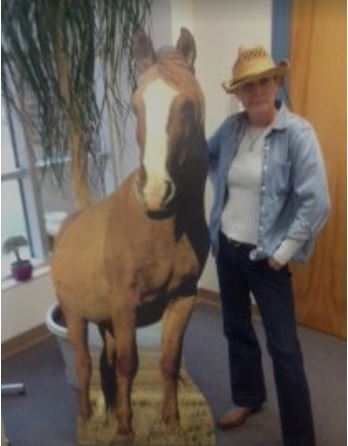
Exhibit A: The author and her cardboard horse.
As a matter of fact, let’s talk about Exhibit A. It captures a moment when I used humor to address a real classroom problem.
Every instructor knows the phenomenon of a class that just isn’t gelling. Despite our stern admonitions, the students are not studenting, and the results of the first exam confirm our suspicions.
In one such class, I decided that stern admonitions were not working. On the day we were going to review the first exam, I brought an Amazon-procured, life-size cardboard horse to class, still in its flat-pack packaging.
My students’ hackles were already raised when I walked into my (solidly midwestern) classroom looking like this. I yanked the horse out of the packaging, gave it one mighty shake, watched it spring into its three-dimensional self, and set it on the carpet at the front of the room.
Then I announced, loudly, “Git On The Horse!”
I was born in Eastern Kentucky, so I came by the accent honestly.
“Git on the darned horse!”
And then I laughed. And then they laughed.
It worked.
Students later told me that this was the moment they realized I was for them. I wasn’t there to judge them for struggling with difficult material. I was there to help them learn how to navigate it. The horse became a symbol of the awkward, sometimes uncomfortable process of learning something new—and of my willingness to climb into that process alongside them.
Of course, we want our students to recognize our expertise. But expertise alone does not make us effective teachers. In fact, our expertise can become a barrier when we forget how intimidating unfamiliar concepts can be to someone encountering them for the first time. (Researchers have a term for this - it is called expert bias. It refers to our blindness to how difficult a topic might be because it was so long ago when we struggled with it.)
There is some irony. At least once a semester, a student will come into our office and gush about how smart Dr. Fill-in-the-Blank is.
“He is so smart! He knows so much, and most of us don’t understand what he’s talking about. That’s how smart he is.”
I bite my tongue. I know Dr. Fill-in-the Blank. He’s a bud of mine. But I suspect he is not so smart if he doesn’t know how to communicate difficult concepts to students who are not science majors.
I do say the first part of that thought out loud. The second part stayed in my head.
Starting in my second year of teaching, I became more comfortable being a doofus in front of my classes. I also began exploring educational research on humor and learning. What I observed in my own classroom seemed to have a scientific basis: laughter could help break down the barriers between an instructor and students who felt intimidated by the material.
Spontaneous laughter did something that even the most carefully planned icebreaker (awkward!) could not. It created a moment of shared humanity. For a few seconds, the very smart instructor was no longer an intimidating figure at the front of the room. We were all simply people, learning together.
I began to think of laughter as opening a small channel through which students could become more receptive to what came next. That was my observation, at least. But what did the research say?
What the Research Tells Us
Research suggests that laughter and humor can contribute to psychological well-being, reduce stress, and support learning. The evidence is not a license to turn every lecture into a comedy routine; rather, it offers a reason to take humor seriously as one tool in our teaching practice.
In a July 2025 article from Stanford School of Medicine, Angel Cleare and Sharon Brock describe research connecting laughter with health benefits, including potential reductions in anxiety and depression and improvements in memory. They discuss how laughter may influence cortisol, a stress hormone, and how stress can affect the hippocampus, a brain region important to learning and memory. These findings offer useful context for understanding why a less threatening learning environment may matter.
The connection to education is explored more directly in Zak Stambor’s 2006 Monitor on Psychology article, “How Laughing Leads to Learning.” Stambor describes the experience of Erin Wright, a nursing student who identified as math-phobic and initially dreaded biostatistics. With a professor who brought levity into the classroom, Wright’s anxiety diminished, and she gained confidence applying statistical concepts to medical research.
The lesson is not that humor makes difficult material easy. It is that humor may help students approach difficult material with less fear and greater willingness to engage.
Savage, Lujan, Thipparthi, and DiCarlo make this connection in their review, “Humor, Laughter, Learning, and Health! A Brief Review,” published in Advances in Physiology Education in 2017. The authors discuss how effective humor can attract and sustain attention, reduce anxiety, encourage participation, and increase motivation. They also point out that teaching is not simply about delivering content; it is about building relationships and strengthening human connections.
Importantly, the authors point to two characteristics of effective classroom humor: it should be relevant to the course content, and it should not disparage others. Self-deprecating humor can be especially useful because it demonstrates that an instructor can acknowledge mistakes without losing credibility.
This distinction matters. Humor is not an end in itself, and laughter is not proof that learning has occurred. A joke that distracts from the material, embarrasses a student, or makes someone feel excluded can undermine the very connection we hope to build. The goal is not to make students laugh at all costs. It is to use humor thoughtfully to help them feel comfortable enough to participate, ask questions, and persist when the material gets hard.
This from Ron Berk, the professor featured in Stambor’s article: ”Most professors think like professors, and you can't do that," Berk says. "What I do and how I teach is all about the students," he says. "It has nothing to do with me. I'm tapping into their multiple intelligence needs and their culture so that they can understand the material in their terms.”
That, to me, is a statement about humility.
Taking Off the Very Smart Cape
I have come to believe that humor works best when it grows out of a genuine commitment to students. I do not need to be a comedian. I do not need to have a clever punchline for every concept in microbiology. And I certainly do not need to pretend that I have never made a mistake.
Instead, I can use humor to make difficult material feel more approachable, acknowledge my own imperfections, and show students that struggling is a normal part of learning science.
When students laugh with me, the classroom can become a place where they are less afraid to admit what they do not know. That matters because learning requires vulnerability. Students must be willing to ask questions, expose misunderstandings, revise their thinking, and try again.
The cardboard horse did not teach microbiology. It did something more modest, but still important: it helped students see that I was willing to go to absurd lengths to communicate with them. It gave us a shared moment from which we could move forward.
We can know our content inside and out and still fail to teach it effectively if we cannot connect with the people in front of us. Our expertise matters, but so does our willingness to meet students where they are.
So take off the very smart cape. Make a science-related joke. Laugh at your own mistakes. If the moment calls for it, bring a cardboard horse.

Dr. Cowan started teaching microbiology at Miami University in 1993. Her specialty is teaching microbiology for pre-nursing/allied health students at the university’s Middletown campus, a regional open-admissions campus. She started life as a dental hygienist. She then went on to attain her PhD at the University of Louisville and later worked at the University of Maryland’s Center of Marine Biotechnology and the University of Groningen in the Netherlands. Her first love is teaching – both doing it and studying how to do it better. She is past chair of the Undergraduate Education Committee of the American Society of Microbiology (ASM). Her current research focuses on the student achievement gap associated with economic disparities, as well as improving communication in the health care setting.