Teaching Students to Think Before They Know the Terminology
Teach accounting backward. Start with judgment, not journal entries. Here's why flipping the sequence produces students who actually think like accountants.
- Higher Education
- Article
- Blog
- Accounting Ledger
The core pain in intro accounting hasn't changed. We want students reasoning like accountants by the end of the semester, not just executing procedures. But the reasoning depends on vocabulary they don't have on day one. So the usual sequence is mechanics first, judgment later.
We've been running the sequence backwards in our own classrooms and want to share what we have learned.
Problem first, terminology second
The class opens with a situation students already know how to reason about, no accounting required. For example, a friend wants to borrow money to start a business, or a group of friends takes a trip and must split the costs. No accounting terms have entered the conversation yet.
For fifteen minutes, students reason through the situation using the intuition they already brought to class. What's the risk? Who benefits? What information would you want before deciding? Then we introduce the accounting terminology for what they just did. Cost allocation has a formal definition, but it also has a shape they now recognize because they did it. The same holds for accruals, materiality, or whatever concept the chapter covers.
Students spend the opening of class thinking, not decoding. The terminology sticks because it names something they have already reasoned out for themselves.
Why now
Problem-based learning has been an effective teaching strategy for decades. The pattern is durable: students who wrestle with an authentic problem before instruction retain more, transfer better to new situations, and stay more engaged. What's new is that AI has sharpened the argument.
Anthropic released a 2025 study of about 574,000 real student conversations with its AI. Roughly half of the time, students were asking it to produce the answer rather than help them get to one. An MIT Media Lab study the same year (Kosmyna et al., 2025) put EEG caps on students writing essays with an LLM, with search, or with no help. The more assistance students had, the less their brains lit up.
This matches what shows up in professional AI work. AI is a magnifier of the person using it, not a substitute for them. In the hands of someone who already understands the problem, it accelerates good work. Without that grounding, it produces convincing slop. If we teach students to reach for AI before they can think through a problem themselves, we're just training them to produce slop faster. We want to teach them to work the problem first, so AI becomes a magnifier of what they already understand.
Meanwhile, AI adoption in accounting firms roughly doubled in one year. The tasks most exposed to automation are the ones we tend to drill in the intro course. If we spend a semester training students to do what AI already does, we're preparing them for a version of the job that continues to shrink.
Biases and AI in the room
Two other pieces round this out. The first is cognitive bias: anchoring, confirmation bias, availability, and sunk cost. A nineteen-year-old can grasp these in a class period, and once they can name them, they can spot them in a case, news story, or even their own reasoning. Several of our cases lean deliberately into a specific bias and ask students to identify the bias after they've already fallen for it.
The second is AI in the classroom. Some of our cases have students work the problem themselves, then explicitly compare their reasoning to what AI produces. AI makes plausible-sounding mistakes on accounting problems more often than students expect. Watching those mistakes happen in class has been some of the best teaching we've done in a long time. It builds AI literacy and accounting judgment simultaneously.
Where this lives
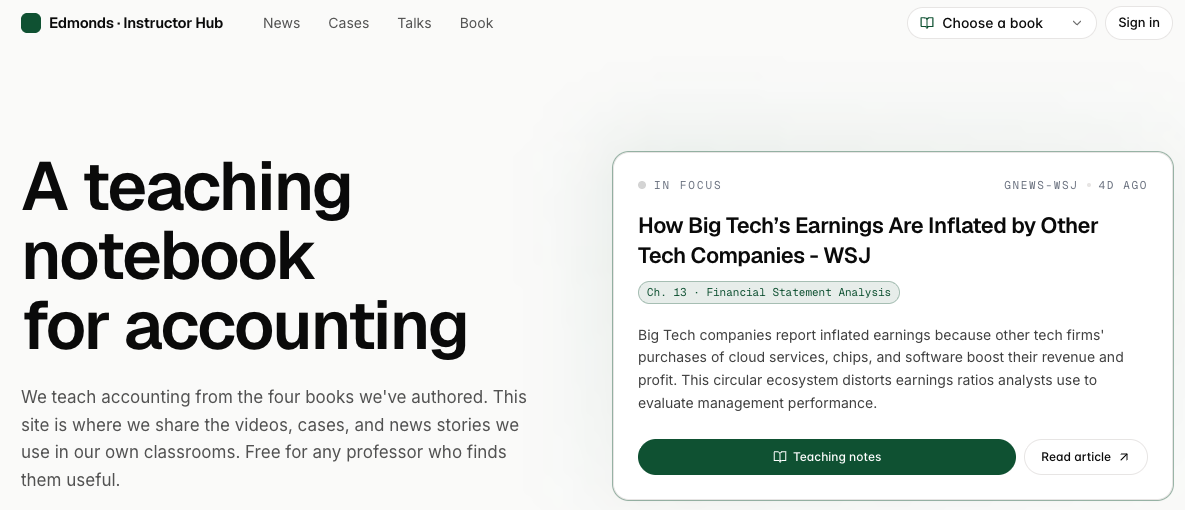
You can find these cases and more on edmondshub.com. The cases are the heart of what we teach. Additionally, the site includes a feed of current articles in the press tagged to specific chapters and learning objectives, with teaching descriptions and discussion prompts ready to go. Whatever you are teaching this week, chances are there is a story on the feed that ties to it.
The site is free, open to anyone, no sign-in required to browse. Check it out, and if you have any thoughts or ideas, we would love to hear your feedback.

Chris Edmonds, PhD, is the Alumni and Friends Professor at the UAB Collat School of Business. Dr. Edmonds research interests include municipal debt pricing, the impact of organizational form on decision making, and accounting education. He has written numerous articles that have appeared in publications, including The Accounting Review, Auditing: A Journal of Practice and Theory, Journal of Accounting and Public Policy, Advances in Accounting, Review of Quantitative Finance and Accounting, Issues in Accounting Education, and Advances in Accounting Education. As an educator, Dr. Edmonds is renowned for his innovative approach to teaching and developing introductory accounting courses, both online and in person. He has been invited to speak at conferences and universities on best teaching practices and has delivered over 50 professional teaching workshops. He has also published four introductory accounting textbooks with McGraw Hill. Dr. Edmonds has received numerous awards for his dedication to teaching, including the UAB President's Outstanding Teaching Award, UAB Faculty Student Success Award, UAB Transformative Online Course Award, Collat School of Business Graduate Student Teaching Award, UAB Loudell Ellis Robinson Classroom Teaching Award, UAB Disability Support Recognition Award, and the Virginia Tech Favorite Faculty Award. He has also been nominated for the AAA/J Michael and Mary Anne Cook Award. Before entering academia, Dr. Edmonds worked as a software developer, creating solutions to put newspapers online. He obtained an MBA from UAB and a PhD in accounting from Virginia Polytechnic Institute and State University.

Mark A. Edmonds, PhD, CPA, is an assistant professor in the Department of Accounting and Finance at the University of Alabama at Birmingham. He has taught principles and advanced accounting classes in face-to-face, flipped, and online formats. Dr. Edmonds began his career providing assurance services for the internationally recognized accounting firm Ernst & Young. At the conclusion of his professional service, he obtained his PhD from Southern Illinois University Carbondale. He serves as the education adviser on the board of the Institute of Internal Auditors Birmingham Chapter. Dr. Edmonds's research focuses on alternative learning strategies and auditor decision making.

Jennifer Echols Edmonds, PhD, is an associate professor at the University of Alabama at Birmingham (UAB) Collat School of Business. Her primary teaching areas are financial and managerial accounting. She's experienced teaching in the undergraduate, MAC, and MBA programs and currently serves as a course coordinator for the managerial accounting sequence at UAB. She has received the UAB Loudell Ellis Robinson Classroom Teaching Award and UAB Provost’s Transformative Online Course Award. She has been awarded teaching grants from Deloitte, UAB, and Virginia Tech. She created teaching resources for incorporating International Financial Reporting Standards into intermediate accounting. The teaching resources were published online at the American Accounting Association. Dr. Edmonds is also active in the research community and serves as an associate editor of Advances in Accounting. She has published articles and prominent journals such as Journal of Accountancy and Public Policy, Advances in Accounting, Research and Accounting Regulation, and The CPA Journal. Dr. Edmunds received a bachelor's degree in accounting from Birmingham-Southern College and completed her master's and PhD degrees in accounting at Virginia Polytechnic Institute and State University.