
What Ford’s Mechanic Shortage Reveals about Skilled Labor
A difficult training process leads to small talent pools.
- Higher Education
- Blog
- Article
- Understanding Business
- Chapter 1 Taking Risks & Making Profits
- Chapter 9 Production & Operations Management
- Chapter 10 Motivation
- Chapter 11 Human Resource Management
- Chapter 12 Labor Management & Unions
- Labor Relations
- Manufacturing & Packaging
- Operations Management
- Transportation
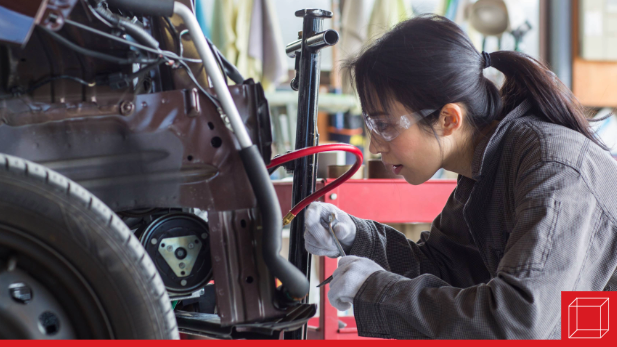
Across the U.S. economy, employers say they can’t find enough skilled workers even when the jobs pay well. Manufacturing, construction, and repair trades all report shortages for positions with lucrative salaries but few experienced candidates. The auto industry is a clear example. Dealerships tied to Ford say thousands of service bays sit unused because there aren’t enough qualified mechanics, even though top earners can make six figures. But there’s a reason those high-paying jobs are hard to fill: not many mechanics make it through the lengthy and risky process required to reach that level.
Becoming a dealership mechanic takes years, and the path is uneven from the start. New mechanics often begin with trade school debt and low hourly wages. They are typically expected to buy their own tools, which can cost tens of thousands of dollars over time. Early work centers on routine maintenance rather than complex repairs, limiting both pay and skill development. Compensation is based on a “flat-rate” system where workers are paid per job rather than per hour, making income unpredictable when work slows or repairs take longer than expected. Injuries are common, and time away from work usually means no pay. Many mechanics leave before reaching advanced certifications and the pay increases that come with them.
As a result, dealerships compete fiercely for the small pool of experienced workers who have made it through the system. While a handful of senior technicians earn high incomes, they represent the end of a narrow pipeline that sheds workers at nearly every stage. Employers experience the shortage through idle service bays and lost revenue from repairs they cannot complete. Workers experience it as years of financial uncertainty before reaching stability, if they get there at all. The outcome is a labor market where high wages exist on paper, but the structure of the job makes it difficult for people to reach them.
Questions:
Why do auto dealerships have a difficult time finding qualified mechanics?
Do you think auto dealers or manufacturers should subsidize training for mechanics? Why or why not?

