
Durkheim, Solidarity, and Modern Political Division
As societal unity feels strained, Durkheim’s lessons on solidarity and collective conscience may hold the key to bridging divides. Let’s explore the way forward.
- Higher Education
- Blog
- Article
- Sociology in the News
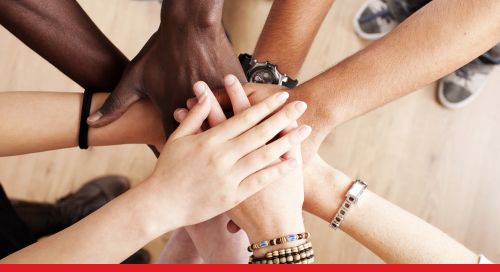
Do you ever feel like we as humans are more divided than ever? We seem to have lost a feeling of unity - a feeling of solidarity. Recent news of political violence has led to speculation about whether the United States will even continue as a country or be plunged into another civil war (Frenkel and Thompson 2025). You’re not alone if you’re worried about societal unity. In fact, this was one of the first issues studied by sociologists. Emile Durkheim was concerned about the transition of societies from rural, agricultural, and homogeneous communities where people had much in common to urban, industrial, and diverse communities where people had completely different values and norms.
Durkheim wanted to understand how this societal shift affected societal solidarity, or in other words societal unity and cohesiveness. He argued that in older societies the unity that existed was “mechanical solidarity”, based on a sense of sameness or similarity (Durkheim [1893] 1984). People in medieval villages often shared the same cultural background, religion, norms, values, and often even family. This sameness produced solidarity.
When people moved to cities they were suddenly in a brand new environment surrounded by strangers from many different cultural backgrounds. The mechanical solidarity of the past began to disappear, but society didn’t unravel - it continued on as it had before. Durkheim explained this through the division of labor, arguing that society had become like a body. Each organ in the body performs a different specialized task but all are necessary for the body to function properly. The division of labor in modern society means that some people grow food, some people make clothes, some people practice medicine, but we all need each other. We are interdependent. Durkheim described this interdependent unity as “organic solidarity” (Durkheim [1893] 1984).
But in our modern society, it often doesn’t feel like we have solidarity - mechanical or organic. As of 2024, 80% of Americans say that the country is greatly divided when it comes to the most important values - the highest number on record since polls began in 1993 (Jones 2024). In an even more recent survey, 59% percent of Americans say political violence is a very big problem, and an additional 28% see it as somewhat of a problem - 87% total seeing it as a problem (Montgomery 2025). At the same time, 11% of Americans say that political violence is sometimes justified, and nearly double this amount (19%) of younger adults agree that political violence is sometimes justified (Montgomery 2025).
What has gone wrong? What can Durkheim’s concepts of solidarity teach us about our fractured society?
Durkheim believed that even in modern societies characterized by organic solidarity, there needed to be a collective conscience - shared values. Without these shared values, societies risk falling into a state of anomie - not having shared norms (Dillon 2020). Anomie contributes to a lack of meaning in life which can then manifest in poor mental health, crime, and even suicide. For Durkheim, education was one of the key ways in which modern societies maintained these shared values and norms.
Despite a persistent belief that the opposing party has different values, the good news is that 69% also say that most Americans want the same things out of life - and that proportion is similar between Republicans, Democrats, and Independents (Young, Lohr, and Sawyer 2024). The question is, how can we recognize our interdependence and strengthen the shared values and collective moral conscience that we do have?
Jurgen Habermas, writing almost a century after Durkheim, gave his opinion on how people could strengthen democracies like the United States. “According to Habermas, communication with others with whom we disagree is the only way forward toward the retrieval of a rational democratic society” (Dillon 2020:214). It is times like these, when communication seems the hardest, that it is most important for maintaining a cohesive society.
Discussion Questions
- Some people romanticize the past, including societies characterized by mechanical solidarity. What are the potential downsides of a society characterized by a high level of sameness - shared beliefs, identities, and norms?
- What values do you think are commonly shared among Americans today, regardless of political affiliation?
How can we follow Habermas’s prescription for more communication with others with whom we disagree in modern society?
Dillon, Michelle. 2020. Introduction to Sociological Theory: Theorists, Concepts, and their Applicability to the Twenty-First Century, 3rd Edition. Wiley-Blackwell.
Durkheim, Emile. [1893] 1984. The Division of Labour in Society. Translated by W. D. Halls. The Macmillan Press Ltd.
Durkheim, Emile. [1925] 1961. Moral Education. Translated by E. K. Wilson and H. Schnurer. The Free Press, New York.
Frenkel, Sheera, and Stuart A. Thompson. 2025. “Civil War’ Mentions Surge Online After Kirk Assassination.” New York Times. September 12
Jones, Jeffrey M. 2024. “Americans Agree Nation is Divided on Key Values.” Gallup
Montgomery, David. 2025. “What Americans Really Think About Political Violence.” YouGov
Young, Clifford, Anneleise Azevedo Lohr, and Johnny Sawyer. 2024. “Americans View Country as Deeply Divided, but Believe Most Have Much in Common.” Ipsos