When Teachers Build the Tools: Inside the Making of Our New Literacy Program

We recently caught up with three McGraw Hill employees, who are former educators, to hear how their time in the classroom impacted their work on Emerge!.


Tags: Article, Blog, Emergent Literacy, Corporate

When Emerge! launched in August, it was designed to be both dynamic and deeply personal. The new K–5 English Language Arts curriculum from McGraw Hill is grounded in the science of how children learn to read, powered by real-time data, personalized learning technology, and—crucially—shaped by insights from renowned literacy experts, thousands of teachers and administrators, and even students themselves.

Those insights also came from within. Many McGraw Hill employees who had a hand in creating Emerge! once stood at the front of classrooms, and they used their experiences as educators to ensure the curriculum truly serves teachers and learners.

We recently caught up with three of those employees to hear how their time as educators impacted their work on Emerge!.

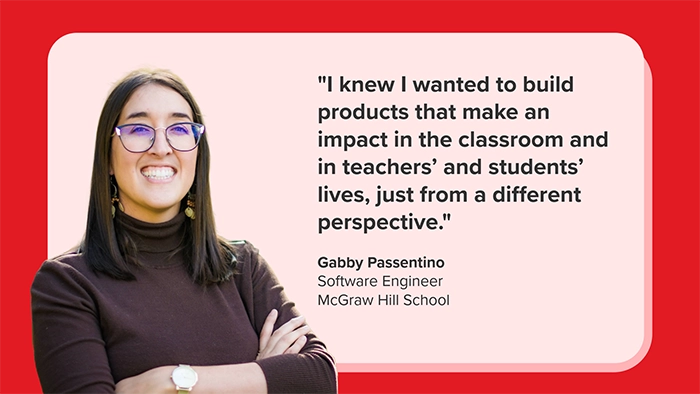
As a teacher, I used so many different products over the years that I felt like ed tech was something I aligned with. I knew I wanted to build products that make an impact in the classroom and in teachers’ and students’ lives, just from a different perspective.”

When teachers using Emerge! are spared the task of differentiating reading assignments or when students excitedly collect virtual gems for completing their work, they can thank Gabby Passentino. As a software engineer at McGraw Hill, she and her team help build the features that bring the curriculum to life. That work impacts everything from the way learners interact with digital materials to the tools that make teachers’ jobs easier.

Before McGraw Hill, Passentino taught high school math, and she draws on those experiences often. She evaluates potential new projects through an educator’s lens, asking herself: Would this have worked in my classroom? Would it be disruptive? Is it worth building, and will it serve millions of teachers, not just a few? “So much of this job is communication,” she says. “It’s about making sure everyone’s on the same page so we’re building what teachers and students really need.”

Though Emerge! is still new, Passentino hopes it will leave a lasting impact on learners, just like Oregon Trail did on her as a child. Playing the game in her school’s computer lab was the highlight of her day, and she wants Emerge! to spark that same kind of joy. “I hope that when the kids who use Emerge! are in high school or college, they’ll say, ‘Do you remember that literacy program where you could earn gems and buy stuff from your avatar store? That was so fun,’” she says. “That’s what I want kids to remember.”

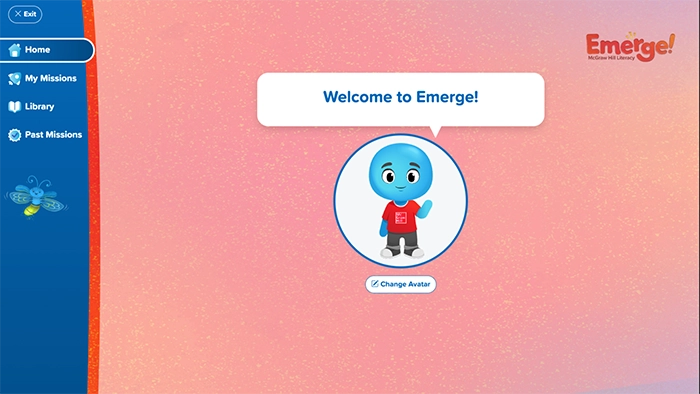
With Emerge!, students can create custom avatars, collect gems, and purchase items from the avatar store.

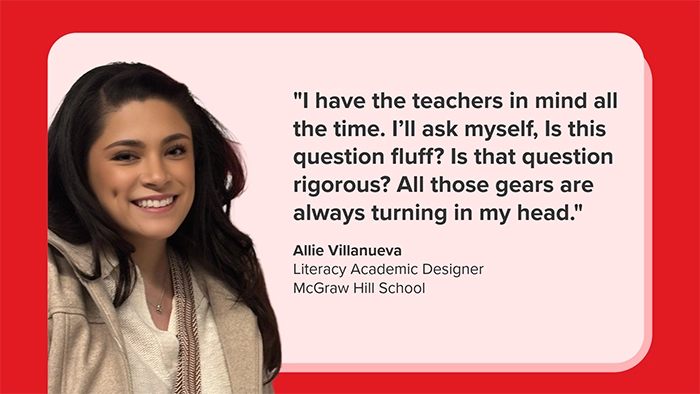
I have the teachers in mind all the time. I’ll ask myself, Is this question fluff? Is that question rigorous, but not too hard where the kids are going to be staring at the teacher, like, ‘What are you talking about?’ Because you don't want that either. All those gears are always turning in my head.

Allie Villanueva joined McGraw Hill as a literacy academic designer in 2023, after four eventful years teaching fourth graders in Katy, Texas. Her first year in the classroom coincided with the start of the pandemic, which meant pivoting to remote learning, navigating new digital platforms and making constant adjustments to keep lessons engaging.

Early on, Villanueva recognized the need for a research-based curriculum. There wasn’t one at her school, so she made her own, often piecing lessons together from scratch. That sparked a love of creating materials that served learners but also supported teachers. “I think [my experiences as a teacher] set me up for where I am right now,” she says.

As an academic designer, Villanueva helped develop Emerge!’s ancillary components; the visual vocabulary cards are a particular point of pride. Her role includes creating content guidelines and ensuring materials are grade-appropriate and engaging, work she approaches through the lens of her classroom experience. “I ask myself what I can do to help students learn that doesn't require the teacher to spend hours thinking of relevant discussion questions,” she says. “That way, they can spend their time actually teaching the content and connecting with their students.”

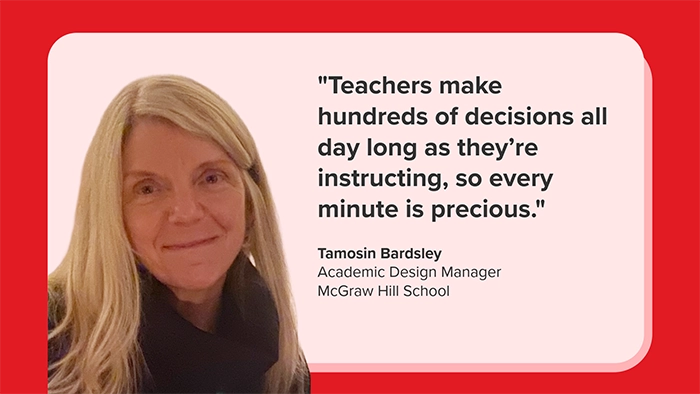
Teachers make hundreds of decisions all day long as they’re instructing, so every minute is precious. I think looking through that educator’s lens at what we’re building—to help teachers use best practices, be efficient and effective—is so important.

During her time as an elementary school teacher in New York City’s public schools, Tamosin Bardsley became adept at reaching students with a wide range of needs. Like Kyle, a first grader who struggled with short vowels until Bardsley introduced him to a computer game that helped the concept click. Or Jessica, a second grader who was proficient in phonics but needed help with comprehension.

Those experiences proved invaluable during the five years she spent developing Emerge!’s Grade 1 reading program. “Once you’re a teacher, you constantly view educational materials through the lens of all the students you’ve taught,” Bardsley says. “It’s almost involuntary. When you’re developing a resource, your first questions are: Is it meaningful? Will it work? Will kids relate to it?"

Equally central to her work was the research. Bardsley and her colleagues—also former educators—spent a full year studying the latest findings on K–5 reading instruction. They talked at length about the research could inform instruction and how Emerge! could best support instructional shifts.

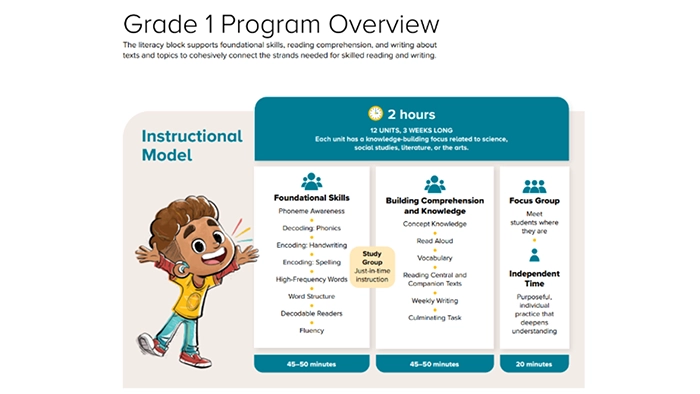
Those discussions inspired many of the features in the Grade 1 reading program, including Study Group, a favorite of Bardsley’s. Here’s how it works: First, the class learns a concept together. Then using student data, the teacher identifies and works with students who need extra support in a subsequent lesson, while the rest of the class decides whether they’re ready to work independently or with a partner. In this model, all students get the amount of instruction they need. This reduces the time students have to sit and listen to concepts they already understand.

Study Group feature in the Grade 1 reading program

It also encourages the development of student agency by allowing students to think about whether they fully understand a concept or need more support. Students take ownership of their learning to move themselves forward.

Learn more about Emerge! at https://www.mheducation.com/prek-12/program/microsites/mcgraw-hill-literacy/browse/emerge.html.