* The estimated amount of time this product will be on the market is based on a number of factors, including faculty input to instructional design and the prior revision cycle and updates to academic research-which typically results in a revision cycle ranging from every two to four years for this product. Pricing subject to change at any time.

Instructor Quick Actions

Get eBook Access Get access as soon as you validate!
Request a Print Sample Get a copy as soon as validated.
Contact a Rep Find a local rep best suited for you.
Find Rep

Product Information

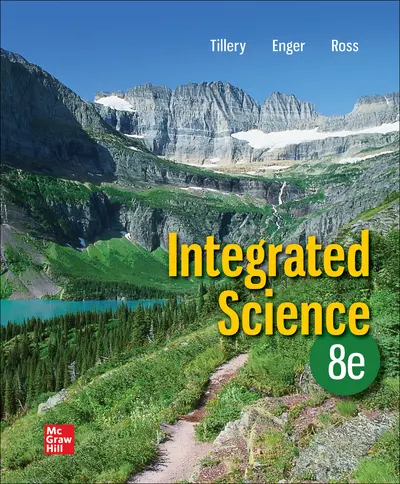
Integrated Science is a straightforward, easy-to-read, but substantial introduction to the fundamental behavior of matter and energy in living and nonliving systems. It is intended to serve the needs of non-science majors who must complete one or

McGraw Hill eBooks and digital platforms use an Evergreen delivery model with a release-centered process that makes it easy to keep courses fresh, engaging, and relevant.

Release Notes provide detailed information about new and updated content delivered with each release.

Your account requires validation. Please contact your sales representative.

Chapter 1 What Is Science?Chapter 2 Motion
Chapter 3 Energy
Chapter 4 Heat and Temperature
Chapter 5 Wave Motions and Sound
Chapter 6 Electricity
Chapter 7 Light
Chapter 8 Atoms and Periodic Properties
Chapter 9 Chemical Reacti

About the Author

Bill W. Tillery

Bill W. Tillery earned a B.A. at Northeastern State University and an M.A. and Ph.D. from the University of Northern Colorado. He is professor emeritus of physics at Arizona State University. Dr. Tillery served as director of the Science and Mathematics Teaching Center at the University of Wyoming and as an assistant professor at Florida State University. Dr. Tillery was honored as Outstanding University Educator at the University of Wyoming and was elected Outstanding Teacher in the Department of Physics and Astronomy at Arizona State University. Dr. Tillery has taught a variety of courses, including general education courses in science and society, physical science, and introduction to physics. He has received more than 40 grants from the National Science Foundation, the U.S. Office of Education, private industry, and private foundations for science curriculum development and science teacher in-service training.

Eldon Enger

Eldon D. Enger received a B.A. and an M.S. from the University of Michigan. He is professor emeritus of biology at Delta College, where he taught biology, zoology, and environmental science and was active in curriculum and course development. Professor Enger is an advocate for variety in teaching methodology and feels that if students are provided with varied experiences, they are more likely to learn. Professor Enger's classes include writing assignments, student presentation of lecture material, debates by students on controversial issues, field experiences, individual student projects, and discussions of local examples and relevant current events. Professor Enger was a Fulbright Exchange Teacher to Australia and Scotland, received the Bergstein Award for Teaching Excellence and the Scholarly Achievement Award from Delta College, and participated as a volunteer in Earthwatch Research Programs.

Frederick C. Ross

Frederick C. Ross received his B.S. and M.S. from Wayne State University. He is professor emeritus of biology at Delta College and has 30 years' teaching experience, including junior and senior high school, during which he has taught biology, cell biology and biological chemistry, microbiology, environmental science, and zoology. Professor Ross has been active in curriculum and course development, including the development of courses in infection control and microbiology, AIDS and infectious diseases, and a PBS ScienceLine course for elementary and secondary education majors in cooperation with Central Michigan University. Professor Ross was involved in the development of the wastewater microbiology technician curriculum offered by Delta College and was actively involved in the National Task Force of Two Year College Biologists (American Institute of Biological Sciences) and in the National Science Foundation College Science Improvement Program.

Accessibility

Creating accessible products is a priority for McGraw Hill. We make accessibility and adhering to WCAG AA guidelines a part of our day-to-day development efforts and product roadmaps.

For more information, visit our accessibility page, or contact us at accessibility@mheducation.com

affordability icon

Affordability

Reduce course material costs for your students while still providing full access to everything they need to be successful. It isn't too good to be true - it's Inclusive Access.

Need support?   We're here to help - Get real-world support and resources every step of the way.

Top