
Organization Administrator User Guide for Manual Rostering Districts
Review the Organization Administrator Manual Rostering User Guide for steps on how to get prepared for the new school year.
- PreK-12
- Customer Support
- School Administrator
- Preschool
- Elementary School
- Middle School
- High School
- Direct Login & Manual-Rostering
- SSO & Manual-Rostering
- Core
- Intervention
- Supplemental
- AP, Honors & Electives
- Career & Technical Education
- Literacy
- Math
- Science
- Social Studies
- Health
- Visual & Performing Arts
- World Languages
- AP Biology
- AP Chemistry
- AP History & Geography
- AP Psychology
- AP Economics
- AP African American Studies
- AP Precalculus
- AP Statistics
- AP Computer Science
- AP Language and Composition
- AP Public Speaking
- AP Music Theory
- 5 Steps to a 5 - AP Test Prep
- Glencoe Health 2022
- Teen Health 2021
- Arrive Math
- Building Blocks 2024
- Building Blocks PreK 2025
- Number Worlds 2024
- SRA Reading Laboratory 2025
- SRA Reading Mastery Transformations
- Achieve3000 Literacy
- Actively Learn
- McGraw Hill Literacy Emerge!
- McGraw Hill Literacy Summit!
- McGraw Hill Literacy Soar!
- Open Court Reading
- Redbird
- StudySync 2021
- ALEKS
- ALEKS Adventure
- CA Reveal Math (K-12)
- Illustrative Math
- Redbird Math
- Reveal Math (K-12)
- CA Inspire Science 2020
- FL Science 2025 (K-12)
- Inspire Science 2020
- TN Science (K-12)
- TX Science 2025 (K-12)
- CA Impact 2019
- FL Social Studies 2024 (K-12)
- Impact Social Studies
- McGraw Hill Social Studies
- All Sorts 2026 (K-5)
- Asi se Dice 2024
- CTE - Business, Marketing, and Finance
- CTE - Health Science
- CTE - Computing and Technology
- CTE - Agriculture
- CTE - Culinary Arts
- CTE - Early Childhood Education
- CTE - Criminal Justice
- Glencoe Health 2014
- McGraw Hill Health 2014
- 2Inform
- Building Blocks 2015
- Connecting Math Concepts
- Number Worlds 2015
- Corrective Reading
- Early Interventions in Reading
- Spelling Mastery
- WonderWorks 2022 & 2014
- Maravillas 2020 & 2017
- OCR Foundational Skills Kit
- OCR Word Analysis Kit
- StudySync
- StudySync 2015 & 2017
- Wonders
- Wonders 2014
- Wonders 2023 2020 2017
- Wonders Balanced Literacy 2016
- Wonders EL 2016
- World of Wonders 2017
- Core Plus Math 2015
- Everyday Mathematics 4 (K-6)
- Glencoe Algebra 1 2014
- Glencoe Algebra 1 2018
- Glencoe Algebra 2 2014
- Glencoe Math
- Glencoe Math Course 1
- Glencoe Math Course 2
- Glencoe Math Course 3
- Glenoce Algebra 2 2018
- McGraw Hill My Math
- McGraw Hill My Math 2013 & 2016
- McGraw Hill My Math 2018
- Pre-Algebra 2012
- Glencoe Science
- Glencoe Science 2017
- Inspire Science 2017
- iScience 2017
- Networks
- Networks 2014 (K-5)
- Networks 2014 & 2016
- Networks 2018
- Music! Its Role
- Spotlight on Music
- Asi se Dice 2016
- Open Court Reading 2016, 2018, 2023
- Open Court Reading 2025
- Glencoe Geometry 2014
- Glencoe Geometry 2018
- Texas Math
- Glencoe Math Accelerated
- Getting Started & Orientation
- Back-to-School Setup
- Class Management
- User Management
- Account Management
- Products & Licenses
- User Guide


Direct Login and Manual Rostering
Single Sign-On (SSO) and Manual Rostering
This article applies to Manual Rostering districts. Manual Rostering means that teachers redeem their own program content and roster their own classes.
Direct Login means that teachers, students, and administrators log in at my.mheducation.com.
Single Sign-On applies to districts that use an SSO portal, district website, or Learning Management System (LMS) to access McGraw Hill digital programs.
Not sure which Access Service your district uses? View the Access Service Descriptions article to learn more about the four Access Services that we support.
Organization Administrators manage the implementation of McGraw Hill digital programs for their school(s) or district/organization. They have access to user and class management, product management, and usage data tools.
This user guide is for Organization Administrators in Manual Rostering districts. If you are unsure of your district’s Access Service, read the Access Service Descriptions article for more information.
Article Contents
Initial Organization Administrator
Acquire an Administrator Account
Log in to Administrator Account
New for the 2026-27 School Year!
- Administrators who have teachers using the Achieve3000 Literacy program now have access to Growth and Usage Reports within the Administrator Dashboard. To learn more about these new reports, take a look at the Achieve3000 Literacy Administrator Growth and Usage Report article. For information on the Administrator Dashboard, review the Access and Navigate the Administrator Dashboard article.
- For districts that use Pearson Review of Progress & Learning (PRoPL), administrators will soon have access to PRoPL reports within the Administrator Dashboard. More information about these reports will be available soon.
- Teachers will be able to share assessments with Curriculum Administrators that they've created. This option will be available for all programs that use the McGraw Hill Assessments platform. More information will be available soon!
Administrator Roles
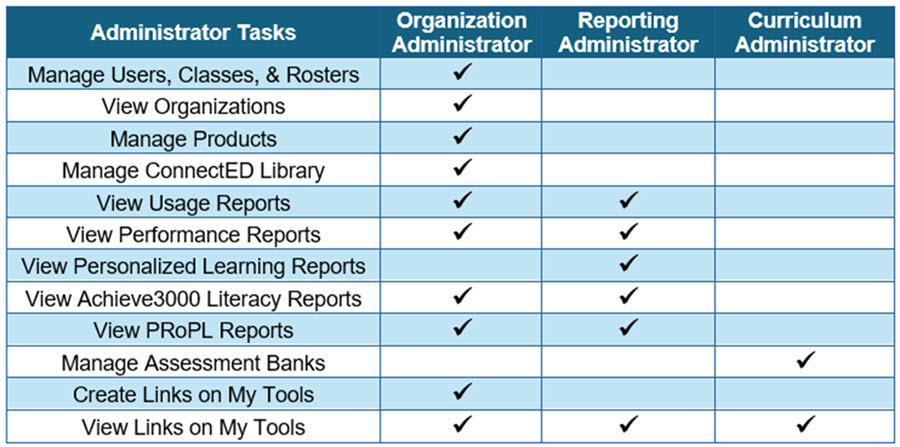
Three administrator types are available, each granting access to a distinct set of tools. A single user account can hold one or more administrator roles simultaneously. For instance, an administrator who needs to view usage data and manage assessments can be assigned both the Reporting and Curriculum roles. Administrator accounts can be associated with an entire district or with individual schools.
When adding new administrators to your organization, make sure to assign the appropriate role type(s) to their accounts to ensure they have access to the correct administrator tools. For existing administrator accounts, additional role types can be enabled at any time.
- Organization Administrators – Organization Administrators oversee access management for teachers, students, and other administrators across their affiliated organizations. Their responsibilities also include managing class rosters, products, and associated licenses.
- Reporting Administrators – Reporting Administrators can view and export usage and performance data for all of their affiliated organizations. Refer to the Reporting Administrator User Guide for more information.
- Curriculum Administrators – Curriculum Administrators can create and share assessments with teachers in the schools they manage.
- Refer to the Curriculum Administrator District Bank Management Resources and Curriculum Administrator Custom Assessment Resources articles for more information.
- Refer to the Create and Edit eAssessment Tests as an Administrator and StudySync Administrator Assessment Management articles for additional information about eAssessment and StudySync assessments.
The following chart outlines key administrator tasks and identifies which administrator type is responsible for each one. All of these tools are easily accessible from a single, centralized location within the administrator tools.
Initial Organization Administrator
McGraw Hill identifies an initial Organization Administrator when your district purchases its first PreK-12 digital program. This user will receive an email with their account login and information to help them get started. Their account sits at the district level, which enables them to create additional administrator accounts affiliated with the district or one or more schools.
Refer to the Create McGraw Hill Administrator Accounts article for additional information.
Obtain an Administrator Account
If you need an administrator account at the district level, or access to multiple schools, you will need to reach out to your district’s Organization Administrator to have an account created for you or for them to add the appropriate administrator role to your existing account. If you only need administrator access to a specific school, an Organization Administrator assigned to that school can create an account for you or add the appropriate administrator role to your existing account.
If you are unable to locate an Organization Administrator in your district, contact our PreK-12 Technical Support team for further assistance.
Log in to Administrator Account
If you're not using Single Sign-On (SSO), visit my.mheducation.com to sign in once you've received your login credentials. Enter your username or email address and your password in the appropriate fields, keeping in mind that your password is case-sensitive. If you’re unsure of your login information, refer to the Recover Your Teacher or Administrator Login Information article.
Once you have successfully logged into your account, if you have dual roles as a teacher and an administrator, you will first land on your teacher profile. Follow the steps in the Access Assigned Roles, View Organizations, and Change Profile Settings article to toggle between your user roles.
Organization Administrator Tasks
The following includes a brief explanation of each Organization Administrator task with links to support articles that provide additional information:
View Organizations
View a list of all districts and schools affiliated with your purchasing account(s). If the account needs to be adjusted in any way, such as adding or removing schools, please contact the PreK-12 Technical Support team as soon as possible.
See the View Organizations article to learn more about this page in your administrator tools.
Manage Users
When Organization Administrators access the administrator tools, the page defaults to the Manage Users page. From here, you can view and export lists of students and staff affiliated with your organization. You can also create new and modify existing student and staff accounts. Refer to the Manage User Accounts article to learn more.
Teachers and students also have the option of creating their own accounts. Teachers will need the district Registration Code to create their accounts, while students will need their teacher's class code. This code can be found on the teacher's account or by editing the class roster in the adminstrator tools.
Teachers who use an SSO portal or launch point should not self-register unless instructed to do so by an administrator.
Manage Class Rosters
Organization Administrators can view lists of classes affiliated with their assigned schools and their respective rosters. From the Manage Class Rosters page, administrators can add or remove students and co-teachers from classes, as well as archive those classes. See the Edit Class Rosters as an Administrator article to learn more.
For Single Sign-On districts: Some students may need to enter a class code the first time they sign into their McGraw Hill account. This code can be found on the teacher's account or by editing the class roster in the administrator tools.
Manage Users, Classes, and Rosters with the Import Tool
Organization Administrators can import new and update existing students, teachers, classes, and rosters directly from the administrator tools using the Users/Rosters feature. For more information on the import process, refer to the articles listed on the Administrator Import Users/Rosters Resources article.
Districts that use a Single Sign-On portal for user creation should not use this tool to create new users; however, they can use it to update student and teacher information, as well as create and roster classes.
Manage Products and Licenses
The Manage Products page provides a comprehensive view of all products available to your organization, including their associated master codes. From this page, you can also access resource codes for select programs — such as ALEKS, ALEKS Adventure, and Redbird — wherever applicable. Additionally, the page displays license details for each product, including the number of licenses available and in use, as well as their start and end dates.
Refer to the Manage Purchased McGraw Hill Products article for more information.
Manage the ConnectED Product Library
With the new class creation process available for all programs this year, teachers will no longer have to enter Master Codes to gain access to their Teacher Editions. However, they will still need to redeem a Master Code or select the program from the ConnectED Product Library to gain access to the Student Edition. They will only need to do this for select programs.
Granting access to the ConnectED Library is the simplest way to distribute content for those who need to manually add Student Editions to their accounts. If you choose to allow teachers to self-select content from the ConnectED Library, you'll first need to configure access through the Manage Library page in your administrator tools. For more information, see the Manage the ConnectED Product Library article.
If you receive a message on the Manage Library page that it is not activated, you will need to contact the PreK-12 Technical Support team to have the option turned on.
Administrator Reports
The Administrator Dashboard report page is available to Organization and Reporting Administrators and includes access to Usage, Standards Performance, and Activity Performance reports. All programs that use McGraw Hill Assess - which includes most Open Learning and select ConnectED programs - will be able to produce reports in the Administrator Dashboard. The Achieve3000 Literacy Growth and Usage Reports, and soon PRoPL reports, are also available within the Administrator Dashboard. Refer to the Access and Navigate the Administrator Dashboard article to help guide you through the available reports.
Programs such as ALEKS, Actively Learn, StudySync, Redbird, or those that use eAssessment will not be available in the reports as they do not use McGraw Hill Assess.
Program-specific administrator reports for these programs can be found by selecting the appropriate link below:
Manage Assessment Banks
Curriculum Administrators can create, manage, and share assessment banks with teachers across their district for supported learning programs to ensure proper administrator reporting. They have access to the same assessment banks as teachers for each program that uses McGraw Hill Assess, making it easy to customize assessments as needed.
See the Curriculum Administrator District Bank Management Resources and Curriculum Administrator Custom Assessment Resources for more information.
My Tools
The My Tools feature allows administrators to create custom links which serve as a launch point to other McGraw Hill programs or third-party content providers. For districts that use ALEKS, Actively Learn, Achieve3000 Literacy, Redbird, and StudySync® ©2021, links to the administrator tools for these programs are automatically configured for you.
Only Organization Administrators can create My Tools links at the organization level; however, once created, these links are accessible to administrators at all levels — Organization, Reporting, and Curriculum — through the My Tools page in their accounts. Visibility of links within My Tools is determined by the Organization Administrator's school affiliations. If an Organization Administrator is affiliated with one or more specific schools, any My Tools links they create will only be visible to administrators at those schools.
Teachers can also create My Tools links at the class level.
For guidance on managing these links, refer to the Using My Tools in the Administrator Tools article for administrator-level management, or the Using My Tools on the McGraw Hill Platform article for teacher-level management.
Product-Specific Access
For Wonders products, Curriculum Administrators can create and share District Planners with teachers to ensure uniform lesson planning across classes. For more information, see the Wonders/Maravillas District Planner Manager article.
For districts or schools that use ALEKS and ALEKS Adventure, Organization Administrators can create Master Templates to guarantee that teachers are using the same course structure for their classes. This saves time when adding and editing assignments, setting up resources, and more. For more information on the process, refer to the ALEKS Master Template Resources article.
Administrator abilities to select programs — such as ALEKS, Actively Learn, Achieve3000 Literacy, Redbird, and StudySync® ©2021 — can be accessed through the My Tools page or at the bottom of the administrator tools navigation menu.
Next Steps
- Review the administrator guide that corresponds to any additional assigned administrator role for more information and links to self-help articles.
- Before you begin your school year, we recommend reviewing the Manage Products page to verify you have enough licenses to meet your expected enrollment for the new school year. If you need to purchase additional licenses, contact your sales representative.
- Use the Administrator Import Users/Rosters process to add new students, teachers, classes, and rosters. This feature should not be used by districts that use a Single Sign-On portal or launch point to create new users. They can use it to manage class creation and rostering.
Teacher Resources
Teachers can perform certain set-up tasks, such as creating classes and student accounts, and rostering students to new and existing classes. You may decide that certain set-up tasks, such as creating and rostering classes, will be handled by teachers instead of administrators. If you also have teacher responsibilities, or to view what teachers need to do to get their classes and students ready for the new year, take a look at the following resources:
Additional Help
Find additional help documents on the new PreK-12 Support Center site or contact the PreK-12 Technical Support team via phone, email, or live chat.
