



 80 / 121

Roberta Olenick/All Canada Photos/Getty Images
Prior to the winter of 1947–48 there were apparently no wolves on Isle Royale. During
that winter, a single pair of wolves crossed the ice on Lake Superior, reaching the
island. During the next ten years the population of wolves reached about twenty indi-
viduals. Notice that the graph in
Figure 5
on the previous page
shows that the rise and
fall of the numbers of each group was dependent on the other group. For example,
follow the wolves’ line on the graph. As the number of wolves decreased, the number of
moose increased.
Disease
Another density-dependent factor is disease. Outbreaks of disease tend to
occur when population size has increased and population density is high. When
population density is high, disease is transmitted easily from one individual to another
because contact between individuals is more frequent. Therefore, the disease spreads
easily and quickly through a population. This is just as true for human populations as it
is for populations of protists, plants, and other species of animals.
Competition
Competition between
organisms also increases when density
increases. When the population increases to a
size where resources such as food or space
become limited, individuals in the population
must compete for the available resources.
Competition can occur within a species or
between two different species that use the
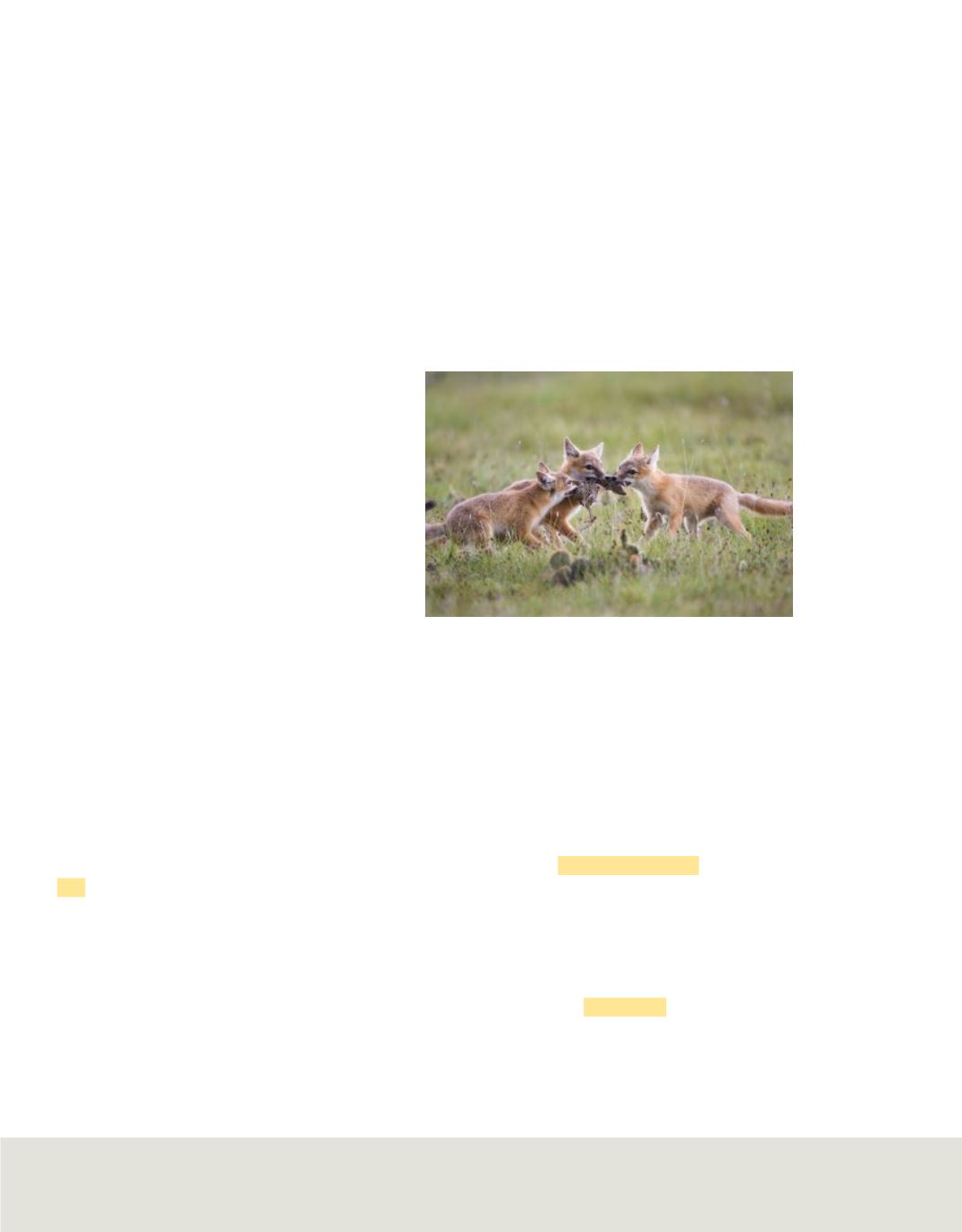
same resources. For example, the foxes fighting
over the squirrel in
Figure 6
also compete with
other species, such as coyotes, for the same
food source.
Competition for insufficient resources might
result in a decrease in population density in an
area due to starvation or to individuals leaving the area in search of additional
resources. As the population size decreases, competition becomes less severe.
Parasites
Like disease, parasitic organisms can place limits on a population. The
presence of parasites is a density-dependent factor that can negatively affect population
growth at higher densities.
Population growth rate
An important characteristic of any population is its growth rate. The
population growth
rate
(PGR) explains how fast a given population grows. One of the characteristics of the
population ecologists must know, or at least estimate, is natality. The natality of a
population is the birthrate, or the number of individuals born in a given time period.
Ecologists also must know the mortality—the number of deaths that occur in the popu-
lation during a given time period.
The number of individuals emigrating or immigrating also is important.
Emigration
(em
uh GRAY shun) is the term ecologists use to describe the number of individuals moving
away from a population.
Figure 6
A decrease in the food supply can trigger
competition between members of the same species.
82
Module 4 • Population Ecology