


 78 / 121

(l) SanerG/Getty Images; (r) ©Erin Paul Donovan/Alamy
You may have learned that organisms adapt to the biotic and abiotic factors in their envi-
ronment. A species might not be able to expand its population range because it cannot
survive the abiotic conditions found in the expanded region. A change in temperature
range, humidity level, annual rainfall, or sunlight might make a new geographic area
uninhabitable for the species. In addition, biotic factors, such as predators, competitors,
and parasites, present threats that might make the new location difficult for survival.
Get It?
Describe
two reasons why a species might not be able to expand its range.
Population-Limiting Factors
Limiting factors are biotic or abiotic factors that keep a population from continuing to
increase indefinitely. Decreasing a limiting factor, such as the available food supply,
often changes the number of individuals that are able to survive in a given area. In
other words, if the food supply increases a larger population might result, and if the
food supply decreases a smaller population would likely result.
Density-independent factors
Any factor in the environment that does not depend on the number of members in a
population per unit area is a
density-independent factor.
These factors usually are
abiotic and include natural phenomena such as weather events. Weather events that
limit populations include drought or flooding, extreme heat or cold, tornadoes,
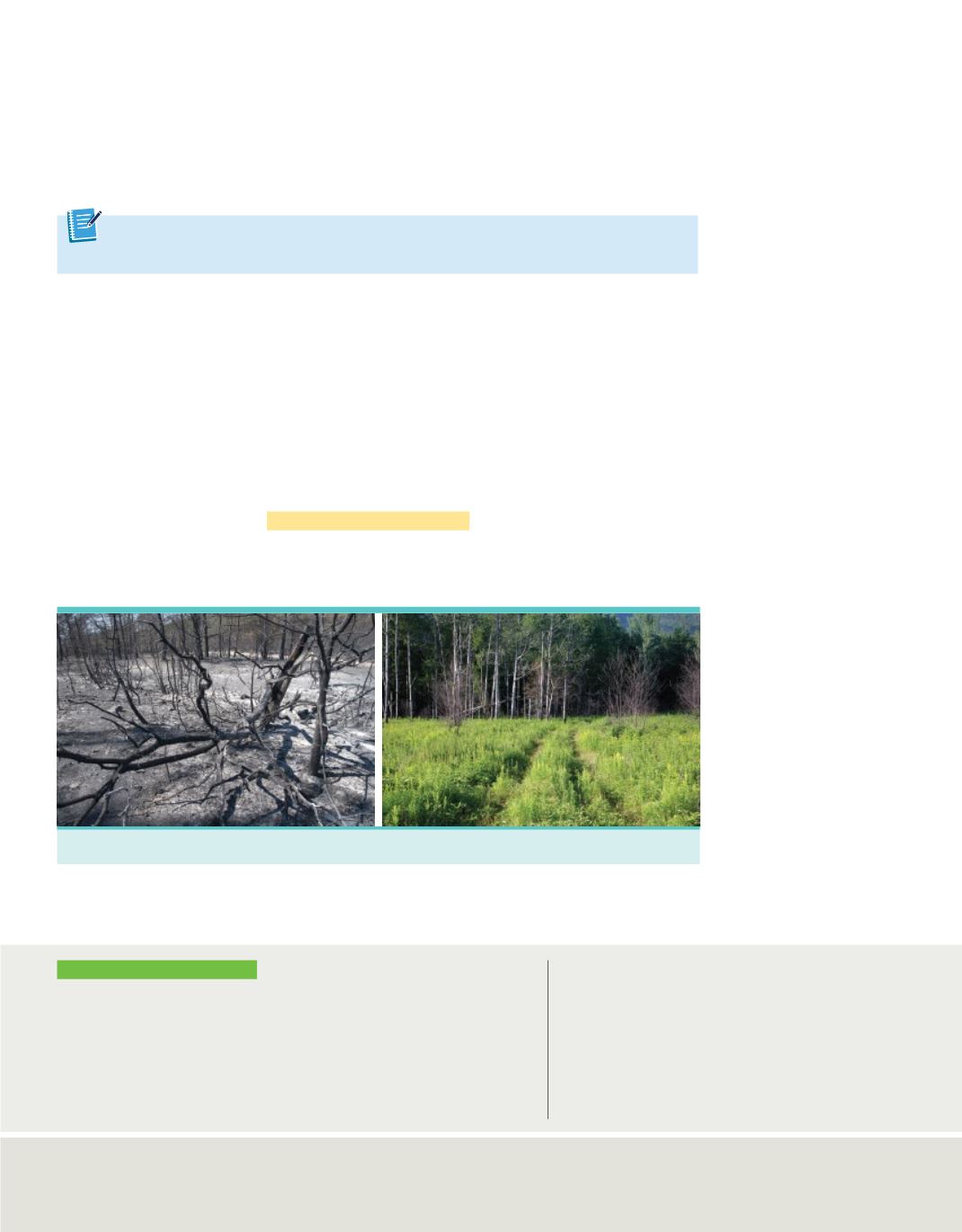
hurricanes, or fires (as shown in
Figure 4
).
Crown fire damage
Managed ground fire damage
Figure 4
A crown fire is a density-independent factor that can limit population growth. However, small
ground fires can promote growth in a forest community.
Explain
why these two situations involving fire have different results on the tree populations.
STEM CAREER Connection
Population Biologist
Why is it important to know the characteristics, such as size, growth, and distribu-
tion, of populations? How would you study a population to determine these
characteristics? Would you like a job that requires you to be in the field studying
organisms in their natural habitat? If these questions interest you, you might be a
future population biologist. Population biologists use their findings to predict the
future of populations and determine what can be done to lessen negative impacts.
ACADEMIC VOCABULARY
dominant
more powerful, successful, or in control
than something else
The hand with which you write and do
most other tasks is called your
dominant hand.
80
Module 4 • Population Ecology