


 82 / 121

ruvanboshoff/E+/Getty Images
Carrying capacity
Ecosystems have limits to the numbers of organisms and
populations they can support. The maximum number of individuals in a species that
an environment can support for the long term is the
carrying capacity.
You will notice
in
Figure 8
on the last page that logistic growth levels off at the line on the graph
identified as the carrying capacity.
Carrying capacity is limited by such factors as the availability of living and nonliving
resources and from such challenges as predation, competition, and disease. Organisms
would have the capacity to produce populations of great size were it not for the fact that
environments and resources are finite. This fundamental tension affects the abundance
(number of individuals) of species in any given ecosystem. When populations develop
in an environment with plentiful resources, there are more births than deaths. The
population soon reaches or passes the carrying capacity. As a population nears the
carrying capacity, resources become limited.
If a population exceeds the carrying capacity, deaths outnumber births because
adequate resources are not available to support all of the individuals. The population
then falls below the carrying capacity as individuals die. The concept of carrying
capacity is used to explain why many populations tend to stabilize.
Reproductive patterns
The graph in
Figure 8
shows the number of individuals increasing until the carrying
capacity is reached. The graph is a useful population model, and can be used to predict
how a population’s number might change over time.
However, there are several additional factors that must be considered for real popula-
tions. Species of organisms vary in the number of births per reproduction cycle, in the
age that reproduction begins, and in the life span of the organism. Both plants and
animals are placed into groups based on their reproductive factors. However, not all
organisms fit under a specific reproductive strategy.
Members of one of the groups are called the
r
-strategists. The rate strategy, or
r
-strategy,
is an adaptation for living in an environment where fluctuation in biotic or abiotic
factors occur. Fluctuating factors might be availability of food,
changing temperatures, or migrating animals. An
r
-strategist is
generally a small organism such as a fruit fly, a mouse, or the
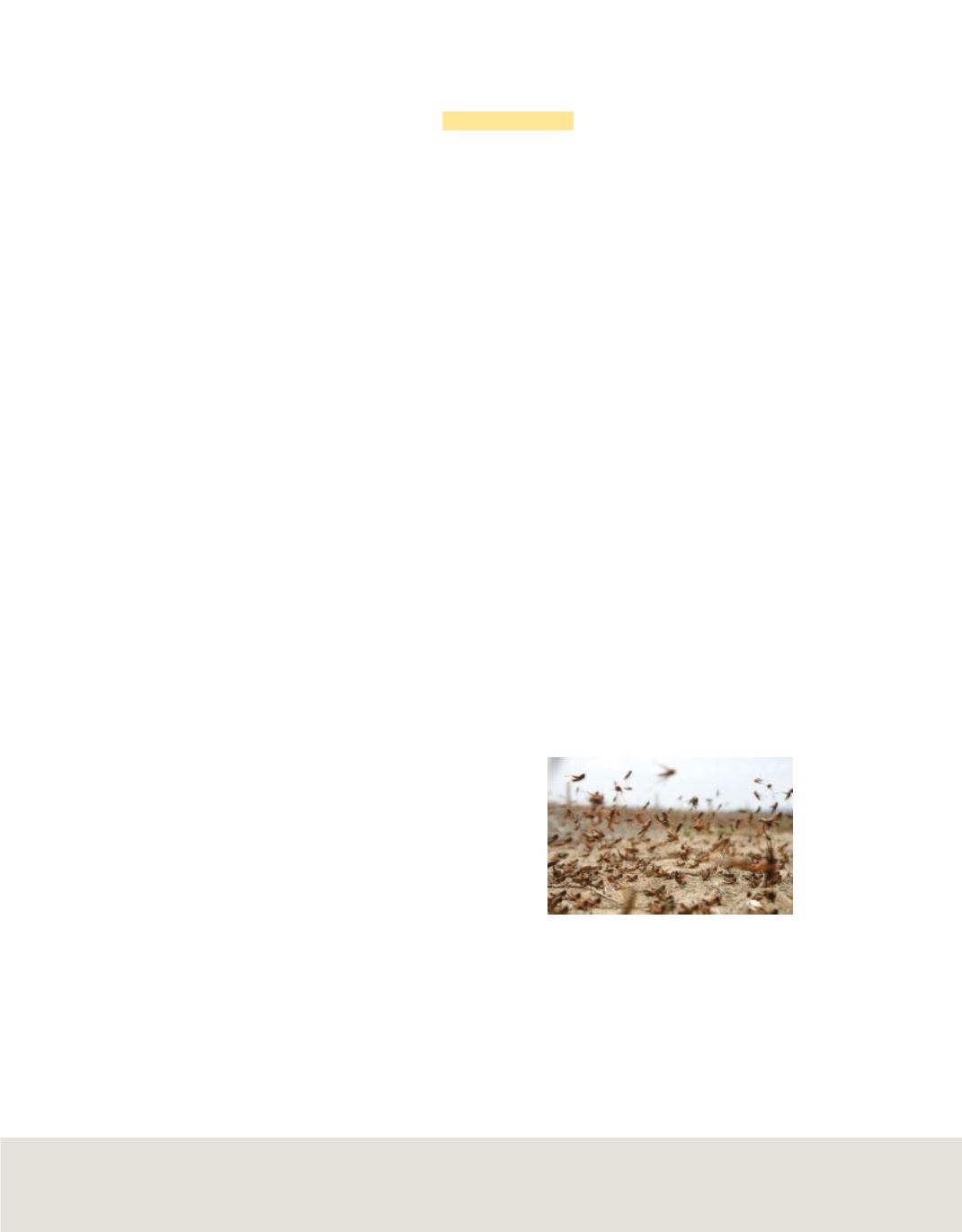
locusts shown in
Figure 9
.
r
-strategists usually have short life
spans and produce many offspring.
The reproductive strategy of an
r
-strategist is to produce as many
offspring as possible in a short time period in order to take
advantage of some environmental factor. Organisms classified as
r
-strategists typically expend little or no energy in raising their
young to adulthood. Populations of
r
-strategists are usually
controlled by density-independent factors, and they usually do
not maintain a population near the carrying capacity.
Figure 9
Locusts, which are an example
of
r
-strategists, produce many offspring
in their short lifetimes.
Infer
what specific factors might
fluctuate in a locust’s environment.
84
Module 4 • Population Ecology