



 84 / 121

Industrial
Revolution begins
Plowing and
irrigation begin
Bubonic plague
(1347–1350)
12
11
10
9
8
7
6
5
4
3
2
1
0
Population (in billions)
2 million
years
6000
B.C.
5000
B.C.
4000
B.C.
3000
B.C.
2000
B.C.
1000
B.C.
A.D.
1
A.D.
1000
A.D.
2000
Modern Age
Middle Ages
Old
Stone
Age
Iron
Age
Bronze
Age
New
Stone Age
Human Population on Earth
Year
Farming
begins
Human Population Growth
The study of human population size, density, distribution, movement, and birth and
death rates is
demography
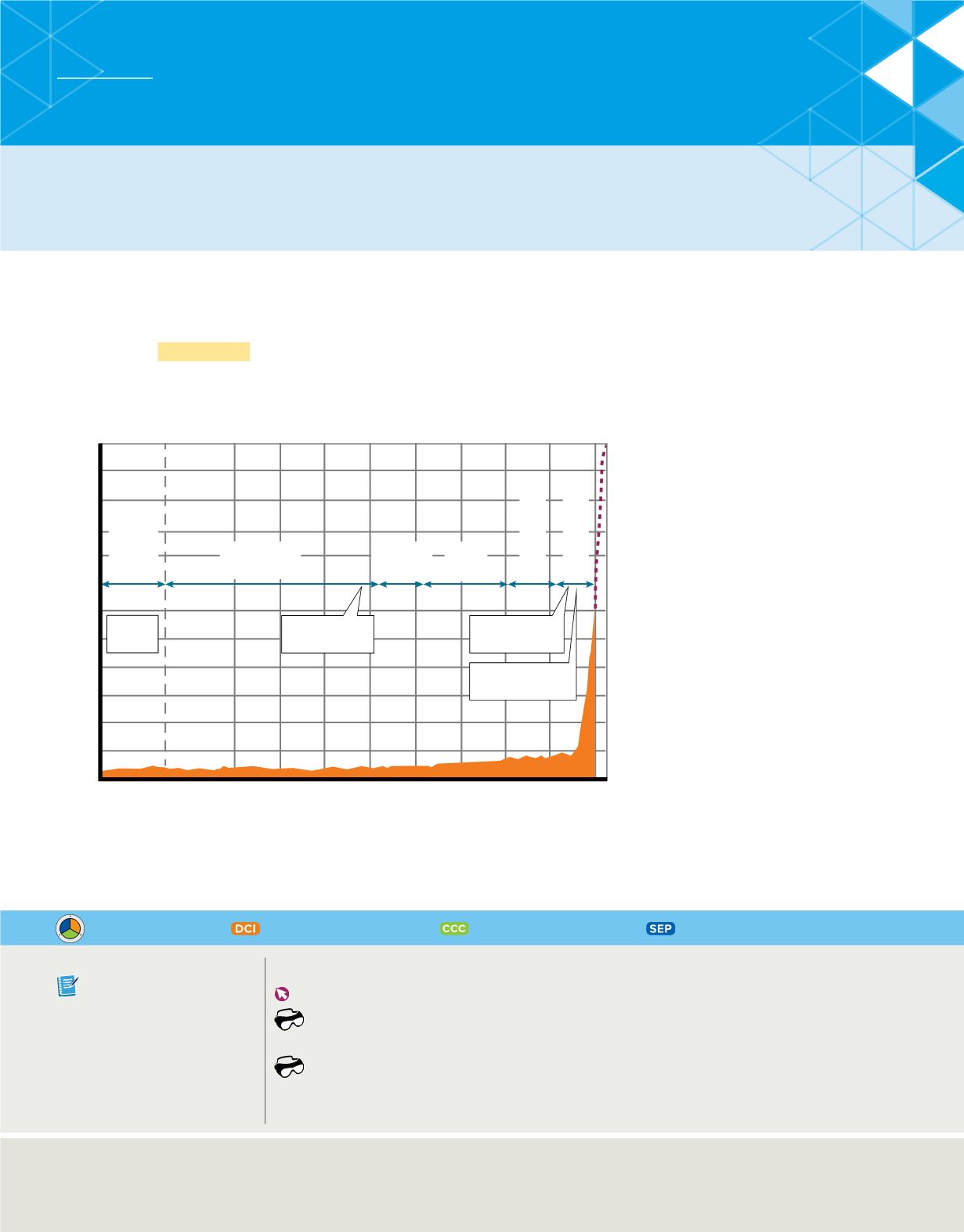
(de MAH gra fee). The graph in
Figure 11
shows demogra-
phers’ estimated human population on Earth for several thousand years.
Figure 11
The human population on Earth was relatively constant until recent times, when the population
began to grow at an exponential rate.
FOCUS QUESTION
What factors affect human population growth?
LESSON 2
HUMAN POPULATION
Disciplinary Core Ideas
Crosscutting Concepts
Science & Engineering Practices
3D THINKING
C
C
C
S
E
P
D
C
I
COLLECT EVIDENCE
Use your Science Journal to
record the evidence you collect as
you complete the readings and
activities in this lesson.
INVESTIGATE
GO ONLINE
to find these activities and more resources.
BioLab:
How can you show a population trend?
Plan and carry out an investigation
to determine the
cause and effect
of
population
trends.
Quick Investigation:
Evaluate Factors
Analyze and interpret data
to determine the factors that affect
population
growth.
86
Module 4 • Population Ecology