



 77 / 121

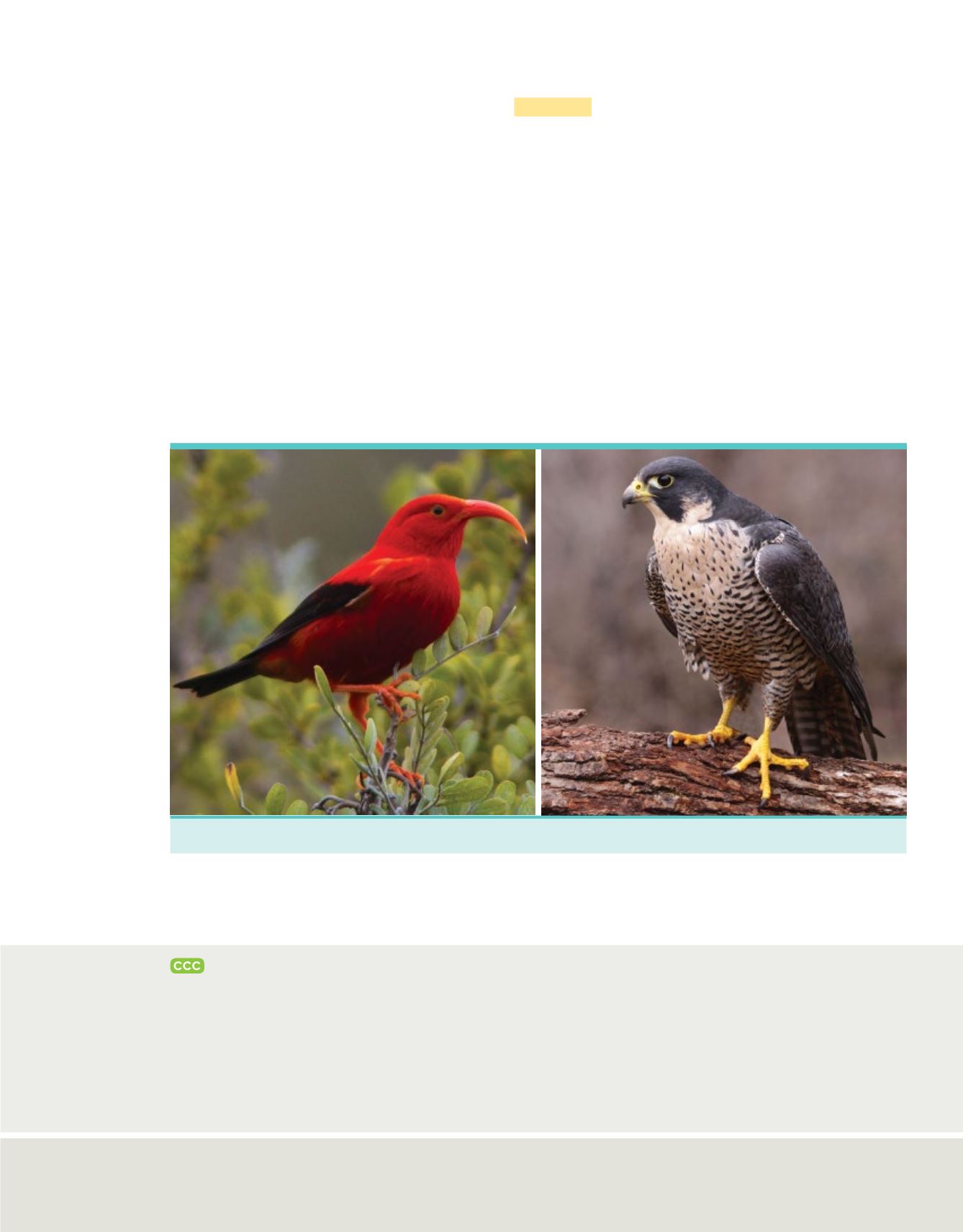
(l) JohnMernick/iStock/Getty Images; (r) Chris Hill/Shutterstock.com
Spatial distribution
Another characteristic of a population is called
dispersion
—the pattern of spacing of a
population within an area.
Figure 2
on the previous page shows the three main types of
dispersion—uniform, clumped, and random. Black bears are typically dispersed in a
uniform arrangement. American bison are dispersed in clumped groups or herds.
White-tailed deer are dispersed randomly with unpredictable spacing. The availability
of resources such as food and water is one of the main determinants of spatial distribu-
tion of a population within its ecosystem.
Population ranges
No population, not even the human population, occupies all habitats in the biosphere.
Some species, such as the Hawaiian honeycreeper shown in
Figure 3
, have a very
limited population range, or distribution. This songbird is found only on some of the
islands of Hawaii. Other species, such as the peregrine falcon shown in
Figure 3
, have a
vast distribution. Peregrine falcons are found on all continents except Antarctica. Note
the ranges of the animals in
Figure 2.
Hawaiian honeycreeper
Peregrine falcon
Figure 3
The Hawaiian honeycreeper lives only on some of the Hawaiian islands. The peregrine falcon is
found worldwide.
CROSSCUTTING CONCEPTS
Scale, Proportion, and Quantity
The coyote lives in almost every habitat in California,
with the exception of major city centers. The Department of Fish and Wildlife estimates a
population of between 250,000 and 750,000 animals. Why do you think that the estimate
is such a wide range of values? Find the area of the state and then determine the range of
the estimated population density. What evidence would be needed to determine a more
accurate estimate of the coyote population density? Debate with your classmates whether
coyotes are a pest or simply just another wild animal looking for suitable habitat.
Lesson 1 • Population Dynamics
79