



 75 / 121

Maggy Meyer/Shutterstock.com
Population Characteristics
All species occur in groups called populations. There are certain characteristics that
all populations have, such as population density, spatial distribution, and growth
rate. These characteristics are used to classify all populations of organisms, including
bacteria, animals, and plants.
Population density
One characteristic of a population is its
population density,
which is the number of
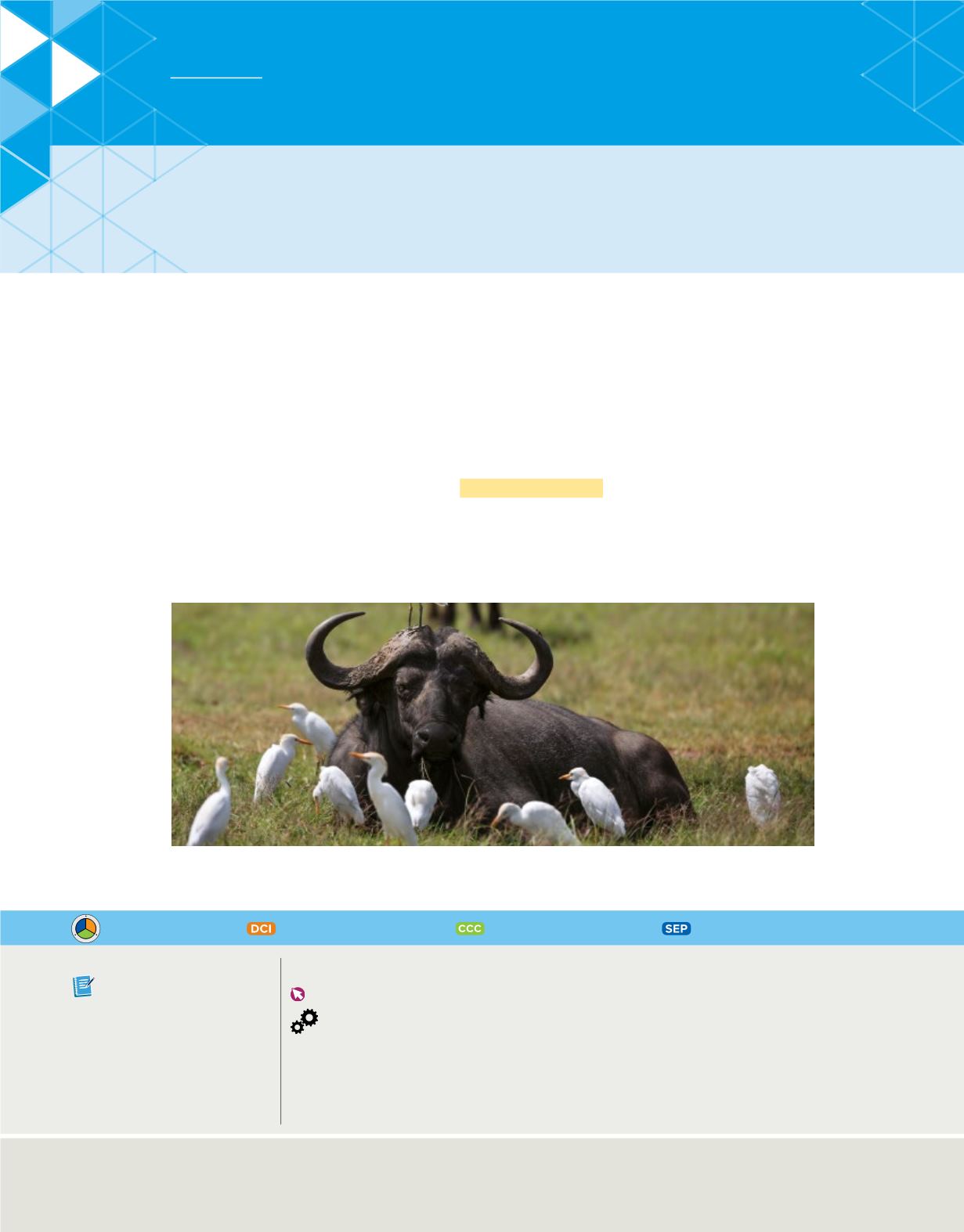
organisms per unit area. For example, the population density of cattle egrets, shown
with the Cape buffalo in
Figure 1
, is greater near the buffalo than farther away. Near
the Cape buffalo, there might be three birds per square meter. Fifty meters from the
Cape buffalo, the density of birds might be zero.
Figure 1
The population density of the cattle egrets is greater near the Cape buffalo.
Suggest
the type of dispersion you would expect these birds to have.
LESSON 1
POPULATION DYNAMICS
FOCUS QUESTION
What are characteristics of populations and how are they
determined?
Disciplinary Core Ideas
Crosscutting Concepts
Science & Engineering Practices
3D THINKING
C
C
C
S
E
P
D
C
I
COLLECT EVIDENCE
Use your Science Journal to
record the evidence you collect as
you complete the readings and
activities in this lesson.
INVESTIGATE
GO ONLINE
to find these activities and more resources.
Applying Practices:
Local Ecosystem Dynamics
HS-LS2-1.
Use mathematical and/or computational representations to support explanations
of
factors that affect carrying capacity of ecosystems
at different scales.
Lesson 1 • Population Dynamics
77