



 83 / 121

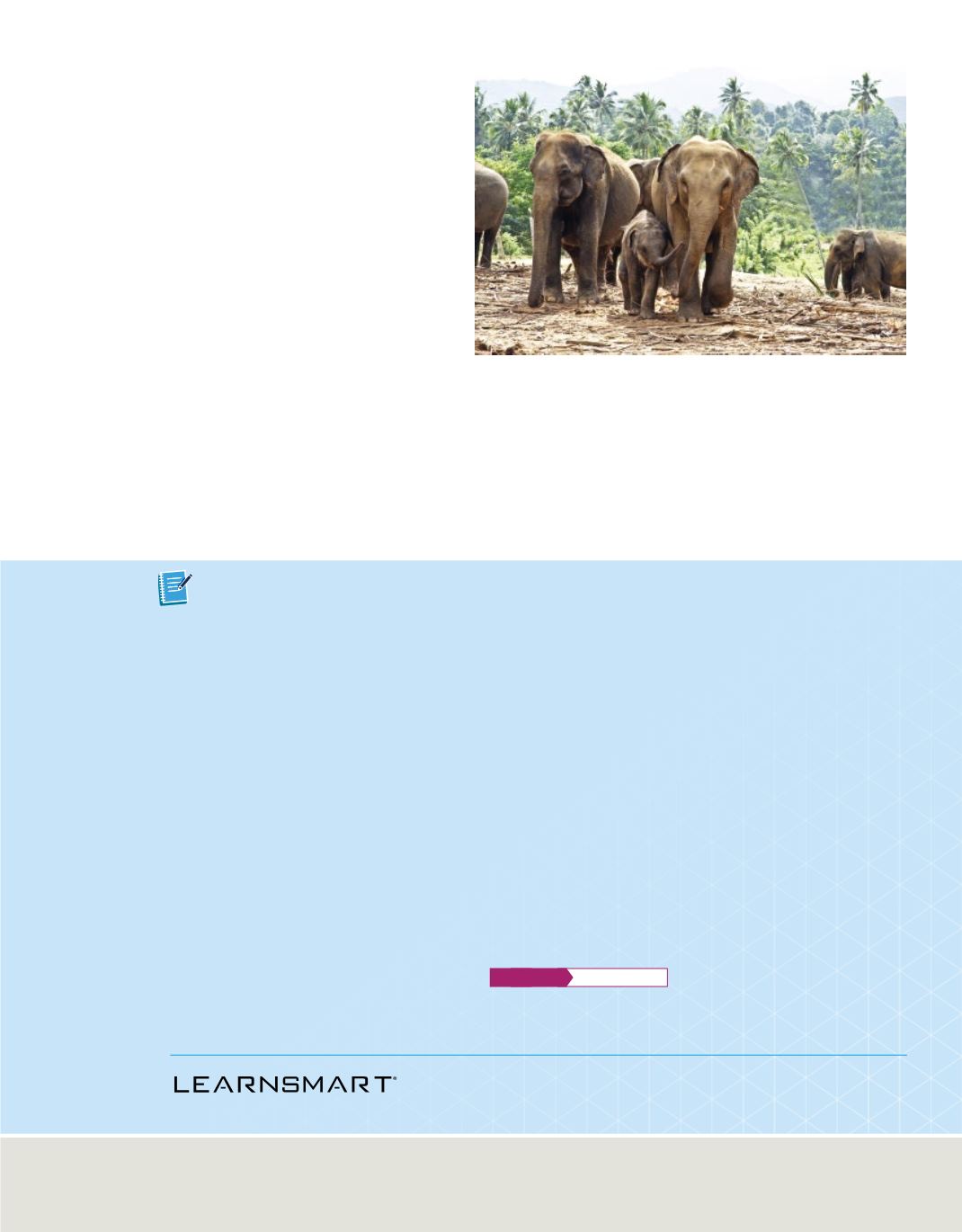
Meinzahn/iStock/Getty Images
Go online to follow your personalized learning path to review, practice,
and reinforce your understanding.
Summary
• There are population
characteristics that are
common to all populations of
organisms, including plants,
animals, and bacteria.
• Populations tend to be
distributed randomly, uniformly,
or in clumps.
• Population-limiting factors are
either density-independent or
density-dependent.
• Populations tend to stabilize
near the carrying capacity of
their environment.
Demonstrate Understanding
1.
Compare and contrast
spatial distribution, population
density, and population growth rate.
2.
Summarize
the concepts of carrying capacity and
limiting factors, and their effects on reproductive
patterns.
3.
Sketch
diagrams showing population dispersion
patterns.
4.
Analyze
the impact a nonnative species might have on
a native species in terms of population dynamics.
Explain Your Thinking
5.
Design
an experiment that you could perform to
determine which population growth model applies to
fruit fly populations.
6.
Connection
WRITING
Write a newspaper article
describing how a weather event, such as drought, has
affected a population of animals in your community.
Check Your Progress
Figure 10
Elephants are
k
-strategists that produce few offspring, but
they invest a lot of care in the raising of their offspring.
Just as some environments fluctuate,
others are fairly predictable. The
elephants in
Figure 10
experience a
carrying capacity that changes little
from year to year. The carrying-capacity strategy, or
k
-strategy, is an
adaptation for living in environments
that are fairly stable.
A
k
-strategist generally is a larger
organism that has a long life span,
produces few offspring, and whose
population reaches equilibrium at the
carrying capacity.
The reproductive strategy of a
k
-strategist is to produce only a few
offspring that have a better chance of living to reproductive age because of the energy,
resources, and time invested in the care for the young. The number of individuals in a
population of
k
-strategists usually are controlled by density-dependent factors and not
by density-independent factors. For example, a ten-degree change in temperature might
be enough to drastically reduce the number of locusts in a population, but it would not
likely influence the number of elephants in a population.
Lesson 1 • Population Dynamics
85