


 35 / 121

Kangaroo rat
(seed eater)
Pronghorn
Gambel’s quail
Jackrabbit
Long-tailed weasel
Ridgenose
rattlesnake
Tortoise
Chihuahuan
raven
Prickly pear cactus
Roadrunner
Mexican whiptail
lizard
Coyote
(top carnivore)
Food webs
Feeding relationships usually are more complex than a single food chain because most
organisms feed on more than one species. Birds, for instance, eat a variety of seeds, fruits,
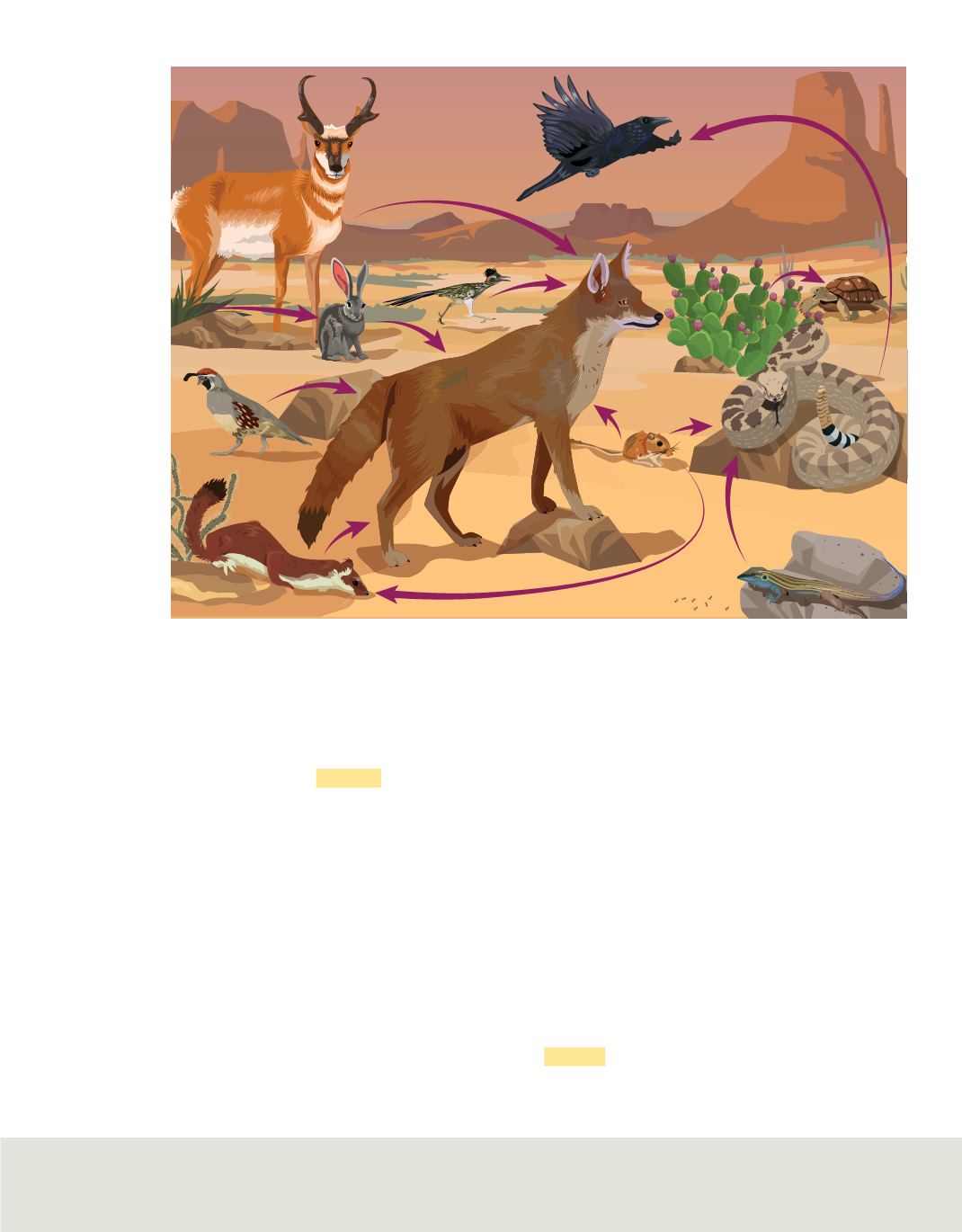
and insects. The model most often used to represent the feeding relationships in an ecosys-
tem is a food web. A
food web
is a model representing the many interconnected food chains
and pathways in which energy flows through a group of organisms.
Figure 15
shows a food
web illustrating the feeding relationships in a desert community.
Ecological pyramids
Another model that ecologists use to show how energy flows through ecosystems is the
ecological pyramid. An ecological pyramid is a diagram that can show the relative
amounts of energy, biomass, or numbers of organisms at each trophic level in an
ecosystem.
Notice in
Figure 16,
on the next page,
that in a pyramid of energy, only 10 percent of all
energy is transferred to the level above it. This occurs because most of the energy
contained in the organisms at each level is consumed by cellular processes or released
to the environment as heat. Usually, the amount of
biomass
—the total mass of living
matter at each trophic level—decreases at each trophic level.
Figure 15
A food web is a model of the many ways in which energy flows through organisms.
Lesson 2 • Flow of Energy in an Ecosystem
37